Introduction
Corporate leaders face mounting pressure from investors, regulators, and boards to demonstrate measurable ESG performance. According to Deloitte's 2024 survey, 83% of M&A buyers would pay a premium for companies with strong ESG credentials, while 67% would seek price reductions for sustainability weaknesses. This isn't soft advocacy—it's hard capital allocation. For Indian enterprises, ESG consulting operates inside a distinctive regulatory landscape. BRSR (Business Responsibility and Sustainability Report) is mandatory for the top 1,000 listed companies by market capitalization under SEBI (LODR) Regulation 34(2)(f). BRSR Core is mandatory for the top 250 by market cap, requiring third-party assurance. Companies Act 2013 Section 135 requires 2% of average net profits over three preceding years to be spent on CSR by qualifying companies. RBI Climate Framework (2025) applies to banks and NBFCs. SEBI ESG Ratings Framework governs the six accredited ESG rating providers. Getting Indian ESG regulatory sequencing right is central to every ESG mandate here.
The ESG consulting landscape has evolved considerably by 2026. Firms now offer services spanning carbon accounting, regulatory disclosure, and ESG-integrated acquisition strategy. Multinational enterprises operating across the US, Europe, India, and APAC face overlapping disclosure mandates — CSRD, BRSR, and ISSB frameworks among them.
Firm selection is no longer a procurement exercise. It's a consequential strategic decision that determines whether ESG becomes a value driver or a costly compliance burden.
This guide covers:
- How to evaluate ESG consulting firms against your disclosure obligations and strategic goals
- The leading firm types — from Big Four generalists to boutique specialists
- Key selection criteria for corporate leaders operating across multiple regulatory regimes
Key Takeaways
- ESG consulting firms design, implement, and report on sustainability strategies aligned with investor and regulatory requirements
- Top firms for 2026: McKinsey, EY, BCG, Deloitte, ERM — each with distinct strengths across strategy, assurance, transformation, and technical risk
- 36 jurisdictions covering 60% of global GDP have adopted or are aligning with ISSB Standards — making ESG compliance non-optional for most enterprises
- Evaluate firms on regulatory coverage (CSRD, SEC, GRI, TCFD), sector depth, and the firm's own ESG track record
- Brand reputation over mandate fit is the most costly selection mistake enterprises make
What Corporate Leaders Should Know About ESG Consulting in 2026
Before selecting a firm, corporate leaders need to understand what ESG consulting actually covers at the enterprise level — and where the gaps between firms are sharpest. Four core service lines define the field:
- ESG strategy design — Embedding sustainability into corporate strategy and capital allocation
- Sustainability reporting and disclosure — Preparing investor-grade reports under frameworks like GRI, TCFD, CSRD, and ISSB
- Regulatory compliance — Navigating overlapping mandates such as CSRD in the EU, BRSR in India, and emerging SEC climate rules in the US
- Operational transformation — Redesigning business models, supply chains, and emissions tracking systems
Leading firms typically offer several or all of these capabilities. The distinction matters: a firm excellent at CSRD compliance may lack sector-specific expertise in heavy industry environmental risk.
Multi-Jurisdictional Complexity Is the New Norm
Multinational enterprises face fragmented regulatory landscapes. A corporation operating across the US, Europe, India, and APAC must navigate:
- EU CSRD — Applies to companies with 1,000+ employees and €450M+ turnover (following December 2025 "Omnibus" simplification)
- India BRSR Core — Mandatory assurance of key performance indicators for top 500 listed entities from FY 2025-26
- ISSB Standards (IFRS S1/S2) — Adopted by 36 jurisdictions representing 60% of global GDP
- US State-Level Rules — California climate disclosure laws, despite federal SEC rule withdrawal
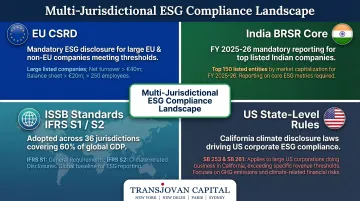
PwC's 2025 survey confirms that navigating overlapping obligations is now a core challenge for large enterprises, making global consulting capability a key differentiator.
Market Size Signals Strategic Importance
That regulatory complexity is a direct growth engine for the consulting market. Firms with the technical depth to handle multi-framework compliance are capturing the bulk of new mandates:
| Research Firm | 2024 Market Size | 2030 Forecast | CAGR |
|---|---|---|---|
| Verdantix | $12.3B | ~$30B | 16.0% |
| MarketsandMarkets | $15.6B | $59.5B | 25.0% |
The growth reflects a fundamental shift in what clients actually need: less high-level strategy, more verified data, audit-ready disclosures, and compliance systems that hold up under regulatory scrutiny. For corporate leaders selecting a firm, that shift means a firm's brand carries less weight than its technical track record in your specific jurisdictions.
Top ESG Consulting Firms for Corporate Leaders — 2026 Rankings
These firms were evaluated on ESG service breadth, global delivery capability, framework coverage, industry reputation, and demonstrated client outcomes—not just brand size.
McKinsey & Company
McKinsey's Sustainability Practice operates as a strategy-first ESG advisory unit helping global corporations embed sustainability into corporate strategy, operating models, and capital allocation decisions. Launched in 2021, the practice partners with bodies like the World Economic Forum and operates proprietary platforms including Catalyst Zero, which uses machine learning to automate marginal abatement cost curve (MACC) generation.
Why it stands out: Translates ESG commitments into quantifiable financial and operational value for Fortune 500 clients, with particular depth in energy transition, supply chain decarbonization, and Scope 3 emissions strategy.
| Category | Details |
|---|---|
| Core ESG Service Areas | ESG strategy integration, net-zero roadmaps, Scope 1–3 measurement, climate tech implementation, supply chain decarbonization |
| Key Reporting Frameworks Supported | GRI, CDP, SASB, TCFD, ISSB |
| Ideal For | Fortune 500 enterprises seeking to embed ESG into core corporate and growth strategy |
EY (Ernst & Young)
EY's Climate Change and Sustainability Services (CCaSS) integrates financial rigor with environmental and social disclosure requirements. The firm takes a technology-centric approach using AI platforms like EY.ai and EY Nexus to drive transparency and reporting efficiency. EY's CSRD Barometer 2025 revealed that 89% of first-time CSRD reports utilised limited assurance, highlighting gaps the firm helps address.
Why it stands out: Dual strength in ESG assurance and regulatory advisory makes it the preferred choice for companies navigating CSRD and SEC climate rules simultaneously, for companies managing multi-jurisdictional reporting obligations.
| Category | Details |
|---|---|
| Core ESG Service Areas | ESG assurance, CSRD compliance, climate risk disclosure, digital ESG transformation, ESG-linked financial reporting |
| Key Reporting Frameworks Supported | GRI, CDP, SASB, TCFD, CSRD, SEC |
| Ideal For | Enterprises requiring ESG assurance, investor-grade disclosures, or multi-jurisdictional regulatory compliance |
BCG (Boston Consulting Group)
BCG's Climate & Sustainability practice, backed by over $2 billion in climate action commitments, focuses on transformation. The firm delivered 2,300+ climate and sustainability projects in 2024. Its BrightHouse division helps organisations define ESG purpose at the strategic level, while AI tools like CO2 AI provide operational visibility into emissions and impact.
Why it stands out: Pairs strategic ESG purpose definition with executional support through data analytics and AI — giving corporations the tools to build ESG credibility with investors and customers alike.
| Category | Details |
|---|---|
| Core ESG Service Areas | ESG purpose and culture transformation, supply chain decarbonization, AI-enabled emissions tracking, circular economy strategy |
| Key Reporting Frameworks Supported | GRI, CDP, SASB, TCFD, CSRD |
| Ideal For | Large corporations looking to build investor-grade ESG programmes grounded in measurable operational outcomes |
Deloitte Sustainability
Deloitte Sustainability operates as the operational ESG arm of a global Big Four firm, offering GHG accounting, internal ESG audits, regulatory readiness, and stakeholder reporting with emphasis on data integrity and process rigor. Deloitte's 2024 Sustainability Action Report found that 57% of executives cite data quality as a top ESG reporting challenge.
Why it stands out: Deep focus on ISSB and TCFD-aligned reporting, combined with enterprise-grade internal audit capabilities, makes it effective for corporations preparing for third-party assurance for the first time.
| Category | Details |
|---|---|
| Core ESG Service Areas | GHG accounting, ESG internal audit, regulatory readiness, third-party assurance, ISSB/TCFD reporting |
| Key Reporting Frameworks Supported | GRI, ISSB, TCFD, SASB, CSRD |
| Ideal For | Enterprises prioritising ESG reporting credibility, audit readiness, and compliance with emerging global disclosure standards |

ERM (Environmental Resources Management)
ERM is a specialist sustainability and environmental risk consultancy with over 50 years of experience, focused exclusively on sustainability and EHS. That singular focus produces deeper technical expertise in sector-specific environmental challenges than broader management consultancies typically offer. The ERM Sustainability Institute publishes research including the 2026 Annual Trends Report and Global Regulations Radar.
Why it stands out: Sector depth in heavy industry, infrastructure, chemicals, and energy makes it the preferred choice for industrial enterprises managing complex environmental risk alongside ESG reporting obligations.
| Category | Details |
|---|---|
| Core ESG Service Areas | Environmental risk management, ESG due diligence, energy transition planning, biodiversity strategy, EHS compliance |
| Key Reporting Frameworks Supported | GRI, CDP, SASB, ISO 14001 |
| Ideal For | Industrial, energy, infrastructure, and capital-intensive enterprises with complex environmental risk profiles |
How to Choose the Right ESG Consulting Firm for Your Enterprise
The most common mistake corporate leaders make: selecting an ESG firm based on global brand recognition rather than mandate fit. A firm excellent at sustainability reporting may be poorly equipped to support ESG-integrated M&A due diligence or sector-specific environmental compliance.
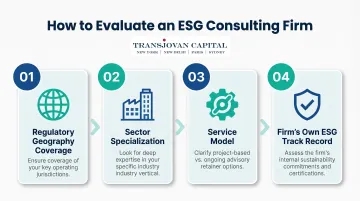
Four Decision Criteria for Firm Evaluation
1. Regulatory Geography Coverage
Which jurisdictions does the firm have active compliance expertise in? If you operate across the EU, India, and the US, you need a firm with demonstrated CSRD, BRSR, and ISSB experience—not just theoretical knowledge.
2. Sector Specialization
Does the firm have demonstrated experience in your industry? Heavy industry clients need environmental remediation and EHS audit depth (ERM's strength). Technology clients need emissions tracking and digital transformation (where EY and BCG excel).
3. Service Model
Are you seeking project-based advisory or embedded ongoing support? For one-time CSRD compliance, a fixed-scope project works. For continuous ESG integration across M&A pipelines, an embedded retainer model typically yields more consistent disclosures, faster regulatory response, and tighter alignment with deal timelines.
4. The Firm's Own ESG Track Record
Does the firm publish its own sustainability reports? Have they achieved third-party assurance? A consultancy unable to demonstrate ESG maturity in its own operations lacks institutional credibility.
Enterprise Scale Matters
Large multinational corporations require firms with cross-border delivery teams, multilingual capability, and experience managing ESG across multiple business units and supply chain tiers simultaneously. Verdantix's 2026 Green Quadrant identified only five firms—Deloitte, ERM, EY, KPMG, and PwC—with comprehensive end-to-end capabilities.
When evaluating at this scale, confirm the firm can deliver across:
- Cross-border regulatory filings (CSRD, BRSR, SEC climate rules simultaneously)
- Multi-tier supply chain ESG assessments
- Consolidated ESG reporting across subsidiaries and joint ventures
ESG Consulting Is No Longer Standalone
ESG advisory now intersects directly with corporate strategy, investor relations, and M&A decision-making. Firms that treat ESG as a reporting exercise — separate from deal screening or capital allocation — will struggle to extract real value from the engagement. Ask any shortlisted firm how their ESG work has influenced a client's acquisition thesis or post-merger integration plan. The answer will tell you more than their credentials page.
ESG, M&A, and Corporate Development: Why They Can No Longer Be Separated
ESG due diligence has become standard in cross-border M&A by 2026. Buyers face liability exposure, valuation risk, and reputational downside if environmental, social, or governance risks in target companies aren't properly assessed. Deloitte's 2024 survey revealed that 83% of M&A buyers would pay a premium for strong ESG credentials, while 67% would seek price reductions for sustainability weaknesses.
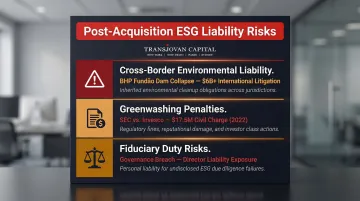
Post-Acquisition Liabilities Are Destroying Value
Inadequate environmental diligence leads to massive post-close losses:
- BHP Liability Case — The November 2025 UK High Court judgment held BHP parent companies liable for the 2015 Fundão dam collapse, highlighting cross-border environmental liability risks
- Greenwashing Penalties — The SEC charged Invesco $17.5M for misleading ESG statements; DWS paid €25M to settle similar allegations
- Fiduciary Duty Risks — When environmental risks are foreseeable but ignored during diligence, plaintiffs may allege breaches of fiduciary duty if those risks surface post-acquisition
ESG-Integrated Corporate Development
Companies now use ESG criteria proactively to identify acquisition opportunities in cleantech, energy transition, and sustainability-linked sectors that align with net-zero commitments. KPMG's 2024 study found that four out of five dealmakers globally indicate ESG considerations are on their M&A agenda, with 55% willing to pay 1-10% premiums for targets with high ESG maturity. For multinationals executing cross-border growth strategies across the US, Europe, India, and APAC, this shift means ESG screening increasingly determines which targets enter the pipeline — not just how they're priced once they do.
Where CDaaS Meets ESG
Corporate leaders managing active M&A pipelines need their ESG advisory and Corporate Development functions to work in concert. Transjovan Capital addresses this through its Corporate Development as a Service (CDaaS) model, which embeds ESG due diligence directly into deal origination — screening targets on environmental and governance criteria before financial modeling begins, not after a term sheet is signed.
The firm's partner-led execution teams — operating across New York, New Delhi, Paris, and Sydney — coordinate ESG risk assessment with corporate strategy from the outset. This is especially relevant in sectors like cleantech and advanced manufacturing, where a target's ESG standing directly shapes deal rationale, financing terms, and post-close integration requirements.
Conclusion
The right ESG consulting firm aligns with your specific regulatory context, industry risk profile, and strategic goals. The firms listed here each excel within their respective areas of strength—whether that's McKinsey's strategy integration, EY's assurance rigor, BCG's transformation focus, Deloitte's audit readiness, or ERM's technical depth.
ESG performance directly drives enterprise value, investor confidence, and deal outcomes. Boards that treat ESG as a strategic investment — not a compliance cost — are better positioned to capture value and withstand scrutiny.
If you're navigating ESG-integrated corporate growth or cross-border M&A, explore how an experienced Corporate Development advisor can bring ESG and deal strategy together. Transjovan Capital's partner-led CDaaS model offers embedded ESG due diligence across US, Europe, India, and APAC mandates, ensuring sustainability considerations are built into your acquisition strategy from the outset.
Contact 1800 102 5700 or info@transjovancap.com.
Indian ESG Advisory Landscape (2026)
ESG consulting for Indian enterprises spans four regulatory dimensions unique to the Indian market:
BRSR and BRSR Core (SEBI LODR framework): mandatory Business Responsibility and Sustainability Report for the top 1,000 listed Indian companies by market capitalization under SEBI (LODR) Regulation 34(2)(f). Nine sustainability principles cover environmental, social, and governance disclosures. BRSR Core (mandatory for top 250) requires third-party reasonable assurance across a defined set of 49 attributes. Non-compliance carries SEBI enforcement and market-cap discount.
Companies Act Section 135 CSR: qualifying companies (net worth above ₹500 crore, turnover above ₹1,000 crore, or profit above ₹5 crore in immediately preceding financial year) must spend 2% of average net profits over three preceding years on CSR activities listed in Schedule VII. Unspent CSR must be transferred to specified funds within six months of financial year end. Non-compliance carries penalty up to ₹1 crore for the company and ₹2 lakh for each defaulting officer.
RBI Climate Framework and Climate Stress Testing: 2025 RBI notification requires banks and NBFCs above specified thresholds to conduct climate stress testing, disclose climate-related financial risks, and integrate climate into risk management. Applies to lending to sectors with climate transition exposure (energy transition, industrials, automotive, chemicals, real estate).
Sectoral ESG standards: sector-specific regulations shape ESG practice. Environmental clearance under EIA Notification 2006 for large industrial projects. Water and air pollution consent under CPCB (Central Pollution Control Board) and SPCB (State PCB) frameworks. Extended Producer Responsibility (EPR) rules for plastic packaging, e-waste, tyres, and batteries. Battery Waste Management Rules 2022 for EV and energy transition. Forest Conservation Act 1980 amendments for infrastructure projects.
ESG-integrated M&A and Corporate Development in India: ESG DD is now standard in mid-large Indian M&A, with focus on: (1) legacy environmental liabilities under Public Liability Insurance Act, (2) EPR obligations for packaging, e-waste, and battery targets, (3) BRSR readiness for post-acquisition public listing plans, (4) climate transition risk under RBI framework for financed emissions, and (5) social license to operate under project-affected community frameworks. Indian ESG-integrated corporate development is where CDaaS models add material value beyond one-off transaction advisory.
Global ESG consultancies with strong Indian practices include McKinsey Sustainability, EY Sustainability, BCG Climate & Sustainability, Deloitte Sustainability, ERM, and PwC India Sustainability. India-focused ESG advisors span KPMG India Sustainability, Sattva Consulting (impact), CRISIL Sustainability, and specialist ESG data providers. Focus sectors within Transjovan's coverage where ESG-integrated M&A is most active include energy transition, electric vehicles, agrochemicals, chemicals, industrials, manufacturing, and building materials.
Transjovan Capital's Work in Sustainability and Energy Transition
Transjovan Capital's perspective on sustainability and energy-transition advisory comes out of live mandates rather than desk research. The firm attended the Indo-French Chamber of Commerce and Industry's 48th Annual General Meeting in Mumbai on 26 September 2025 — themed "Innovating for Tomorrow" and drawing 400+ C-suite leaders from BNP Paribas, Capgemini, Saint-Gobain, Schneider Electric and TotalEnergies (release). Indo-French transaction value has passed USD 10 billion over the last three years, and Managing Partner Gaurav Asthana framed the fit as one where "France's strategic focus on clean tech, renewables, and industrial innovation aligns with India's manufacturing and green-energy push."
As a member firm of the Indo-German Chamber of Commerce, Transjovan Capital attended its 69th Annual General Meeting in Mumbai on 24 September 2025, an event drawing over 300 senior leaders, policymakers and diplomats, where the headline panel — "Germany & India: Evolving Together" — examined how German companies are contributing to India's industrial evolution (release). Commenting on the corridor, Asthana said: "German OEMs are pursuing GTM-driven acquisitions or partnerships in India. Germany's energy transition coupled with India's manufacturing drive create room for bi-directional bolt-ons." On the Australian side, Asthana has pointed to Indian acquirers "targeting critical minerals in Australia to back EV and grid storage plans" (release). Its cumulative record runs to $15 billion+ in transactions across 250+ clients, and was named Best M&A Advisory Firm at the Platinum tier of the M&A Conclave & Awards, run by Transformance Forums in Bengaluru in October 2024 (announcement).
Frequently Asked Questions
What are the top sustainability consulting firms?
The most widely recognized global ESG and sustainability consulting firms include McKinsey (strategy-first ESG integration), EY (assurance and multi-jurisdictional compliance), BCG (transformation and purpose), Deloitte (audit readiness and ISSB reporting), ERM (environmental risk and heavy industry), and WSP (infrastructure and technical services).
What services do ESG consulting firms typically offer to large enterprises?
Core service offerings typically include:
- ESG strategy design and materiality assessments
- GHG emissions measurement and reduction planning
- Regulatory disclosure and reporting (CSRD, ISSB, BRSR)
- ESG due diligence for M&A transactions
- Third-party assurance services
Many firms also provide digital platforms to automate Scope 3 tracking and reporting.
How do ESG consulting firms differ from general management consultants?
While general management consultants may offer ESG as one service line, specialist ESG firms provide deeper regulatory, technical, and sector-specific expertise. The distinction matters most for complex environmental risk, heavy industry EHS compliance, or multi-framework disclosure needs where technical depth is critical.
What ESG reporting frameworks should corporate leaders prioritize in 2026?
The most relevant frameworks for enterprise leaders in 2026:
- GRI — most widely adopted globally
- TCFD — climate-related financial disclosures
- ISSB (IFRS S1/S2) — adopted by 36 jurisdictions covering 60% of global GDP
- CSRD — mandatory for EU-linked operations
- CDP — investor-focused environmental disclosure
The right framework depends on your investor expectations and jurisdictional reporting obligations.
How does ESG consulting support mergers and acquisitions?
ESG due diligence is now embedded in M&A processes to identify environmental liabilities, governance risks, and social exposure in target companies. ESG criteria are increasingly used to screen and value acquisition targets in sustainability-linked sectors, with 83% of buyers willing to pay premiums for strong ESG credentials.
How much do ESG consulting engagements typically cost for large enterprises?
Costs vary widely based on scope, firm, and geography. Enterprise-scale engagements range from $100,000 for discrete regulatory compliance projects to multi-million dollar retainers for embedded advisory models. Costs escalate when projects require external verification, technical platform integrations, or complex multi-jurisdictional regulatory mapping — making embedded retainers more cost-effective than repeated one-off engagements.
What is BRSR and which Indian companies must comply?
BRSR (Business Responsibility and Sustainability Report) is India's mandatory ESG disclosure framework under SEBI (LODR) Regulation 34(2)(f). It applies to the top 1,000 listed Indian companies by market capitalization. BRSR Core, a stricter subset requiring third-party reasonable assurance, applies to the top 250 by market capitalization. The framework covers nine sustainability principles including environmental impact, employee welfare, community engagement, product responsibility, and consumer protection, with 49 mandatory attributes under BRSR Core requiring assurance from an accredited assurer. Non-compliance carries SEBI enforcement action and materially affects market-cap valuation, foreign institutional investor mandates (many of which require BRSR-equivalent disclosure), and lender ESG ratings.
How does Section 135 CSR affect Indian enterprises and ESG spending?
Section 135 of the Companies Act 2013 requires qualifying Indian companies to spend 2% of average net profits over three preceding financial years on CSR activities. Qualification thresholds are: net worth above ₹500 crore, or turnover above ₹1,000 crore, or profit above ₹5 crore in the immediately preceding financial year. CSR activities must fall within Schedule VII (education, health, sanitation, environmental sustainability, rural development, and specified areas). Unspent CSR amounts must be transferred to specified funds (like PM Cares) within six months of financial year end, unless committed to an ongoing multi-year project. Non-compliance carries penalty up to ₹1 crore for the company and ₹2 lakh for each defaulting officer. Indian CSR spending has become a strategic capital deployment tool for large corporates like Reliance, Tata Group, Infosys, and Adani Group.
Which ESG consulting firm is best for an Indian mid-market enterprise?
For Indian mid-market ESG mandates, best-fit advisors vary by scope. BRSR readiness and BRSR Core assurance readiness: Big Four Indian sustainability practices (KPMG India, EY Sustainability, PwC India Sustainability, Deloitte India). ESG-integrated M&A and corporate development: Transjovan Capital via CDaaS model, embedding ESG DD across 16 focus sectors (semiconductors, electronics, industrials, manufacturing, data centres, engineering, automotive, chemicals, packaging, electric vehicles, energy transition, AI infrastructure, deeptech, food & beverage, agrochemicals, and building materials) and Indo-US, Indo-Japan, Indo-French, Indo-German, Indo-Italian, Indo-Australian, and Indo-European corridors. CSR strategy and impact measurement: Sattva Consulting is a leading India-focused impact advisor. Sector-specific technical ESG: ERM for industrial and environmental, CRISIL Sustainability for financial services climate stress testing, and specialist providers for EPR compliance. Partner-led execution, Indian ESG regulatory fluency (BRSR, Section 135, RBI Climate Framework, EPR rules), and sector track record matter more than global-firm brand at mid-market scale.