Introduction: Why Most Mergers Fail Before They Begin
The champagne toast at the deal signing represents a dangerous illusion. For most acquirers, celebrating the close means celebrating the wrong milestone. The legal transfer of ownership isn't the finish line — it's the starting gun for the highest-stakes phase of any M&A transaction: post-merger integration.
The statistics are sobering. KPMG research shows that 57.2% of public acquirers ultimately destroy shareholder value, with total shareholder return dropping an average of 7.4% in the two years following a deal. Even more striking, study after study puts the M&A failure rate between 70% and 90% — often because integration execution falls short of the deal thesis.
The root cause is consistent: acquirers overestimate benefits, overpay for synergies they never capture, and underestimate the complexity of combining two organizations. In India-linked cross-border deals, that complexity increases across regulation, leadership retention, reporting standards, tax, culture, systems, and local operating practices.
What separates acquirers who create value from those who destroy it comes down to execution discipline. This guide covers:
- The four integration archetypes and when to use each
- A step-by-step process from pre-close planning through Day 1 and the first 100 days
- 2026 best practices for cross-border deals across Indo-US, Indo-Japan, Indo-French, Indo-German, Indo-Italian, India-Australian, and Indo-European corridors
- The most common PMI pitfalls — and how to avoid them
- How to measure integration success
Key Takeaways
- PMI is the structured process of combining organizations to capture the synergies that justified the deal in the first place
- Integration planning should start during due diligence — waiting until Day 1 costs momentum and early synergy capture
- Four integration models — Preservation, Symbiosis, Absorption, and Holding — each demand a distinct playbook
- Day 1 through Day 100 is the highest-leverage window for momentum, morale, and synergy capture
- In India-linked transactions, culture clash, talent attrition, regulatory sequencing, and the synergy execution gap are the top PMI killers
What Is Post-Merger Integration—and Why It Makes or Breaks a Deal
Post-merger integration, or PMI, is the structured, milestone-driven process of combining two or more companies — their people, processes, systems, cultures, and governance models — to materialize the synergies and strategic value that motivated the transaction. It is the operational mechanism that translates deal thesis into business reality. PMI is distinct from deal close. The close represents legal and financial ownership transfer. Integration completion means the combined entity operates with clear governance, aligned reporting, stable leadership, protected customer relationships, and measurable synergy capture.
For Indian companies acquiring abroad, or global companies acquiring or merging into India, PMI also determines whether the buyer can convert cross-border ambition into operating performance. The challenge is not only combining two companies; it is aligning two jurisdictions, two leadership cultures, and often two very different approaches to decision-making.
Why PMI Is the Highest-Risk Phase of M&A
The majority of value erosion in failed deals occurs post-close, not during diligence or structuring. KPMG’s research found that 57.2% of acquirers destroyed shareholder value, primarily because they overestimated synergy benefits and underestimated the complexity of operationalizing them.
The most common failure points are not financial — they are execution failures:
- Delayed integration planning, especially when teams wait until Day 1
- Cultural misalignment that drives talent attrition in the acquired company
- Fragmented systems integration that creates reporting blind spots
- Synergy tracking that stops at targets rather than measuring actual capture
- Weak local execution in cross-border deals involving India
Companies that execute rigorous, well-governed integration consistently outperform peers on revenue growth and EBITDA expansion in the 24 months post-close. The financial model is only as good as the integration that follows it.
The 4 Types of Post-Merger Integration
The right integration approach depends on the strategic rationale for the deal, the target’s role in the acquirer’s portfolio, and the degree of operational interdependency required. Choosing the wrong archetype destroys the value you paid to acquire.
The four archetypes below map to distinct deal contexts. Match your integration model to your strategic intent — not your integration team’s default preference.
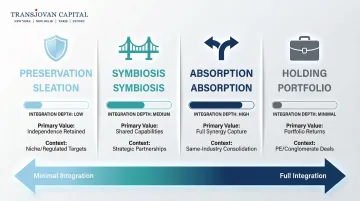
| Archetype | Integration Depth | Primary Value Driver | Typical Deal Context |
|---|---|---|---|
| Preservation | Minimal | Standalone brand/innovation | Startup, niche consumer brand |
| Symbiosis | Selective | Capability + cost synergies | Tech acquisition, branded consumer |
| Absorption | Full | Scale efficiency, cost base | Adjacent/identical market consolidation |
| Holding | None | Capital access, governance | Conglomerate, financial sponsor |
Preservation
The acquired company retains its pre-merger structure, brand, and culture, operating with significant autonomy. Minimal operational integration occurs beyond financial reporting and governance alignment.
Best for: Deals where the target’s standalone value, brand equity, local relationships, or innovation culture is the primary asset. This may apply when an overseas acquirer enters India through a strong regional platform, or when an Indian buyer acquires a specialized overseas business where integration would erode differentiation.
Symbiosis
A selective integration where the acquirer absorbs high-value capabilities or functions — such as R&D, product lines, customer relationships, or procurement — while deliberately preserving cultural and operational autonomy in others.
Best for: Technology, engineering, electronics, semiconductors, deeptech, EV, AI infrastructure, or consumer deals where the target’s capabilities must be protected while finance, reporting, governance, or back-office functions are aligned. In practice, defining which boundaries are permeable — and which are not — is where Symbiosis deals most often stall.
Absorption
Full integration of the target into the acquirer’s operations, systems, governance model, and culture. The target ceases to operate as a separate unit.
Best for: Deals targeting scale efficiency and cost synergies. Absorption is the most execution-intensive archetype — requiring systems migration, workforce restructuring, reporting alignment, and cultural unification simultaneously. It is suited to adjacent or identical market plays where the strategic goal is consolidation, not differentiation.
Holding
The acquirer maintains ownership without integrating operations or processes. The target retains significant autonomy while aligning on governance, financial reporting, and strategic priorities.
Best for: Conglomerates, financial sponsors, or portfolio companies where value creation comes primarily from capital access, risk-sharing, and governance oversight rather than operational consolidation. In India-linked transactions, Holding can work when the buyer wants exposure to a sector or geography without disrupting the local operating engine.
Key Steps in the Post-Merger Integration Process
PMI is a phased, milestone-driven discipline that begins before the deal closes and extends through long-term value realization. Execution quality in each phase determines whether the deal delivers on its thesis — or destroys the value it was meant to create.
Pre-Close Planning and the Integration Blueprint
Integration planning should begin as soon as due diligence completes, not at Day 1. Waiting until close creates a dangerous gap where deal knowledge dissipates and integration momentum stalls. Pre-close activities include:
- Identifying key stakeholders for the Integration Management Office (IMO)
- Conducting a formal cultural assessment of the target organization
- Validating which synergy assumptions from deal modeling are realistic and operationalizable
- Developing an integration blueprint that maps the deal thesis to specific functional workstreams, milestones, resource requirements, and accountability owners
For India-linked transactions, the blueprint should also define the cross-border operating model: who owns India-side decisions, who owns overseas integration, which approvals are required, and how reporting, governance, and leadership continuity will work across jurisdictions.
The clean room concept: For deals with antitrust or regulatory sensitivity, a “clean team” operates in a restricted information environment — physically and electronically separate from competitive planning functions. Clean teams filter competitively sensitive information such as pricing plans, strategic initiatives, and customer bids, allowing integration planning during regulatory review without breaching competition law.
Day 1 Readiness
Day 1 is the legal and financial transfer of ownership. Operations must continue without interruption, and employees must understand what the transaction means for them.
Day 1 priorities:
- Legal and statutory completions, including ownership transfer and regulatory filings
- Financial controls activation, including treasury and accounting systems access
- Employee communication addressing “what does this mean for me?”
- IT access and systems continuity, including email, VPN, ERP, and cybersecurity protocols
- Branding and signage alignment where required by integration type
In India-linked deals, Day 1 readiness also includes local statutory compliance, payroll continuity, bank mandate changes, tax registrations, contract notices, and leadership communication across Indian and overseas teams.
Operational disruption on Day 1 — even a delayed payroll run or a locked email account — signals dysfunction at exactly the moment employees and customers are forming their first impressions of the combined entity. Competitors actively monitor these transitions for signs of distraction.
The First 100 Days: Synergy Capture and Momentum
The first 100 days represent the highest-leverage integration window. Leadership attention is focused, organizational tolerance for change is highest, and the board is actively watching for proof that the deal thesis holds.
100-day priorities:
- Prioritize the top 3–5 synergy initiatives with the highest certainty and shortest time-to-value
- Establish clear KPIs tied directly to the deal thesis: cost reduction, revenue synergy, customer retention, and talent retention
- Hold structured weekly workstream updates and monthly IMO reporting to the executive steering committee
- Separate integration tasks from operational improvement projects to prevent scope creep and burnout
Quick wins in the first 100 days — such as procurement consolidation, eliminating overlapping vendor contracts, or centralizing shared services — build confidence and create runway for longer-horizon initiatives. For India-linked transactions, early wins may also include sales handovers, distributor alignment, supplier continuity, and reporting integration across Mumbai, Delhi NCR, Bengaluru, Pune, Chennai, Ahmedabad, or Hyderabad operating hubs.
Functional Integration Workstreams
Sustaining that momentum requires structured execution across every function. Each workstream needs its own sub-plan covering organizational structure, process harmonization, and systems consolidation — with sequencing dependencies mapped from the start.
Core workstreams:
- HR/People: Organizational structure, compensation harmonization, redundancy management, key talent retention, HRIS integration, performance management alignment
- Finance: Chart of accounts consolidation, treasury integration, financial reporting systems, tax structure optimization
- Sales & Marketing: CRM integration, sales territory realignment, brand strategy, go-to-market model alignment
- IT Systems: ERP migration, cybersecurity framework harmonization, data governance, cloud infrastructure consolidation
- Supply Chain: Vendor rationalization, logistics network optimization, inventory management system integration
- Legal/Compliance: Contract novation, regulatory compliance alignment, IP portfolio integration, litigation risk assessment
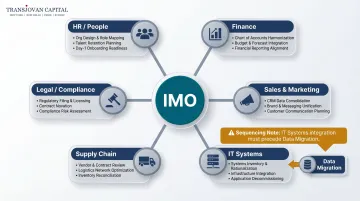
For cross-border deals involving India, these workstreams must be adapted to the relevant corridor — Indo-US, Indo-Japan, Indo-French, Indo-German, Indo-Italian, India-Australian, or broader Indo-European — because labor, tax, data, reporting, and governance requirements vary by jurisdiction.
Critical principle: Integration sequencing matters. Some functions, such as IT infrastructure, must precede others, such as data migration. The IMO must actively track cross-functional dependencies to prevent bottlenecks from cascading across workstreams.
Establishing the Integration Management Office (IMO)
The IMO is the air traffic control of the entire integration. Without it, functional workstreams operate in silos, dependencies fall through the cracks, and synergy targets drift.
IMO structure:
- Integration Director: Dedicated leader with decision authority and direct access to the CEO
- Executive Steering Committee: C-suite sponsors who resolve escalated decisions and remove barriers
- Functional Workstream Leads: Accountable owners for HR, Finance, IT, Sales, Supply Chain, and Legal
- Regional Coordinators: For cross-border deals, regional leads ensure local compliance, cultural bridging, and execution discipline
IMO responsibilities:
- Own the integration blueprint and milestone tracking
- Resolve cross-functional bottlenecks and escalate critical decisions
- Manage internal and external communications
- Track synergy realization against targets
- Report integration health to the executive steering committee and board
Most integration failures trace back not to strategy gaps, but to IMO execution gaps — insufficient bandwidth, unclear authority, or no dedicated resource to hold workstream leads accountable. For companies without an in-house corporate development function, an embedded advisory partner can serve as the operational IMO backbone.
Transjovan Capital’s corporate development support is structured for this role: providing partner-led execution across strategy, M&A, Day 1 readiness, and post-merger integration without diverting CXO bandwidth from running the business.
Post-Merger Integration Best Practices for 2026
Most integrations fail not from bad strategy but from execution gaps — the decisions made or deferred in the first 180 days. These guidelines address the ones that matter most.
Start Integration Planning During Due Diligence
The best acquirers do not separate diligence and integration into sequential phases. The team conducting diligence should carry findings directly into integration planning, avoiding information loss in hand-offs.
Items flagged during diligence should be tagged as integration priorities:
- Cultural risks and leadership style mismatches
- IT system incompatibilities or cybersecurity gaps
- Key talent whose departure would jeopardize value
- Customer concentration risks requiring immediate relationship management
- Regulatory or compliance issues requiring Day 1 attention
For India-linked deals, this also includes promoter transition risk, local management depth, city-level operating dependencies, tax exposure, and regulatory sequencing across corridors such as Indo-US, Indo-Japan, Indo-German, Indo-French, Indo-Italian, India-Australian, and Indo-European transactions. This continuity ensures the integration blueprint reflects actual deal risks, not generic templates.
Anchor Every Decision to the Deal Thesis
Integration decisions — what to merge, what to preserve, how fast to move — must trace back to the deal thesis. Acquirers who lose sight of why they did the deal tend to over-integrate, destroying target capabilities, or under-integrate, failing to capture synergies.
Define 3–5 quantifiable integration objectives that translate the deal thesis directly into measurable outcomes. For example:
- Geographic expansion thesis → “Launch combined go-to-market in target regions within 180 days”
- Cost consolidation thesis → “Achieve defined G&A savings by month 12”
- India-entry thesis → “Stabilize local leadership, customer handovers, and statutory reporting within the first 100 days”
Communicate Early, Often, and Honestly—Especially on People Issues
Every employee in both organizations wants to know “what does this mean for me?” Delaying communication creates anxiety, attrition risk, and productivity loss.
Address key employment questions 30–60 days pre-announcement where possible. Communicate with transparency even when not all answers are available. Acknowledge uncertainty directly rather than deferring hard questions. Cultural misalignment remains one of the most common reasons integrations fail. In India-linked M&A, communication must bridge differences in hierarchy, decision-making speed, employment expectations, and leadership style. Cultural integration belongs on the financial model, not just the HR workstream.
Use a Phased Synergy Capture Approach (Cost and Revenue)
Do not attempt to capture all synergies simultaneously. Prioritize quick wins in the first 100 days to build confidence and momentum.
Synergy sequencing:
- 0–100 days: Quick wins — procurement consolidation, vendor rationalization, headcount optimization in overlapping functions
- 6–12 months: Revenue synergies — cross-sell initiatives, channel integration, combined go-to-market strategies
- 12–24 months: Longer-horizon synergies — R&D integration, market expansion, capability sharing
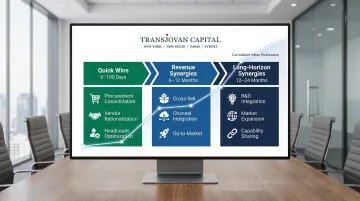
Sequencing matters because cost and revenue synergies behave differently. Cost synergies are easier to model and faster to realize; revenue synergies deliver higher impact but require longer lead times, deeper organizational alignment, and sustained management ownership.
Apply Cross-Border and Multi-Jurisdictional Best Practices
Cross-border M&A brings layered complexity across regulatory environments, labor laws, tax structures, reporting standards, and cultural norms. This is especially true when India is the common denominator — whether an Indian company is acquiring abroad or a foreign company is acquiring or merging into India.
Best practices:
- Engage in-market legal, tax, and HR counsel early to navigate labor law, employee contracts, statutory requirements, and regulatory approvals
- Design tiered governance that gives local teams autonomy within a global integration framework
- Invest in cultural bridging programs between Indian and overseas leadership teams
- Sequence integration timelines by jurisdiction to accommodate regulatory approval cycles
- Build corridor-specific playbooks for Indo-US, Indo-Japan, Indo-French, Indo-German, Indo-Italian, India-Australian, and Indo-European transactions
The Most Common PMI Challenges—and How to Overcome Them
PMI challenges are predictable and therefore preventable. The following four categories account for the majority of integration failures, especially when India is central to the transaction.
Culture Clash
Cultural misalignment is of the most common reasons integrations fail, yet culture is often the least rigorously assessed during due diligence. Culture differences show up in how decisions are made, how risk is treated, how employees communicate, and what behaviors are rewarded.
In India-linked cross-border deals, this can mean reconciling promoter-led decision-making with global governance structures, or helping overseas acquirers understand local operating norms.
How to overcome:
- Conduct a formal cultural assessment pre-close using structured interviews, leadership diagnostics, and employee surveys
- Appoint a dedicated change management lead with executive sponsorship
- Design culture integration as a programmatic workstream with milestones, not an afterthought
- Create “culture bridge” teams of respected Indian and overseas leaders to model new behaviors
Talent Attrition and Leadership Uncertainty
M&A creates uncertainty that motivates top performers — who have the most options — to leave first. Average employee turnover after a merger can hit 47% within the first year, and leadership uncertainty can quickly weaken customer confidence, delivery continuity, and synergy capture.
In India-linked transactions, retaining local leadership is often critical because customer relationships, regulatory familiarity, supplier access, and city-level operating knowledge may sit with a small number of key people.
How to overcome:
- Identify key talent in both organizations pre-close through talent mapping exercises
- Develop retention packages with financial incentives, equity, role clarity, and career progression
- Communicate leadership structure decisions within the first 30 days post-close
- Protect local management continuity in key hubs such as Mumbai, Delhi NCR, Bengaluru, Pune, Chennai, Ahmedabad, and Hyderabad

Technology Stack Incompatibility
Merging organizations frequently use different ERP systems, CRMs, financial reporting platforms, cybersecurity frameworks, and data governance standards. IT integration failures cause operational disruption, compliance risks, and productivity loss.
For cross-border deals involving India, system integration must also account for data localization, tax reporting, statutory compliance, and differences in global versus local operating systems.
How to overcome:
- Map both technology stacks during due diligence, identifying critical systems and integration dependencies
- Prioritize systems with direct revenue or compliance impact, such as customer-facing systems, financial reporting, cybersecurity, and tax reporting
- Sequence migrations in a phased roadmap before back-office consolidation
- Assign technical leads from both organizations to a joint IT integration team with clear authority
The Synergy Execution Gap
Of the four challenge categories, this one destroys the most value — quietly, and after close. Many acquirers justify deal premiums with synergy assumptions that are never operationalized. The gap between modeled synergies and realized synergies is where deal returns are lost. This is especially risky in India-linked M&A when buyers overestimate market access, sales uplift, cost savings, or the speed of integration across jurisdictions.
How to close the gap:
- Assign a named owner to each synergy initiative with quarterly accountability
- Build a live synergy tracker mapping each initiative to financial baseline, target value, owner, and realization status
- Feed synergy realization data directly into the executive steering committee’s dashboards
- Hold monthly synergy review meetings for the first 12 months, transitioning to quarterly thereafter
- Track corridor-specific outcomes across Indo-US, Indo-Japan, Indo-French, Indo-German, Indo-Italian, India-Australian, and Indo-European transactions
Measuring PMI Success: KPIs, Synergy Tracking, and Milestone Reviews
Without pre-defined KPIs tied to the deal thesis, integration teams operate without a scoreboard. Set these KPIs before Day 1, covering financial, operational, people, and cross-border execution dimensions.
KPI Framework by Dimension
Financial KPIs:
- Synergy realization rate, measured as % of plan captured
- Revenue and EBITDA margin compared to pre-merger projections
- Cash flow stability and working capital efficiency
- Corridor-level revenue contribution in India-linked transactions
Operational KPIs:
- Systems migration completion, measured as % of users on integrated platforms
- Active user rates, measured as % of licensed users logging in weekly
- Process cycle time improvements across order-to-cash and procure-to-pay
- Integration progress across key operating hubs such as Mumbai, Delhi NCR, Bengaluru, Pune, Chennai, Ahmedabad, and Hyderabad
People KPIs:
- Employee retention, segmented by role, function, geography, and entity
- Employee engagement scores from pulse surveys
- Training completion rates for new systems and processes
- Local leadership retention in the acquired or merged business
Review Cadence and Synergy Tracking
Structured PMI review cadence:
- Weekly: Functional workstream updates to the IMO
- Monthly: IMO reporting to the executive steering committee
- 100-day mark: Formal integration health assessment reviewing momentum, synergy progress, and early risk signals
- 6-month mark: Comprehensive integration review with an employee climate survey to surface emerging issues
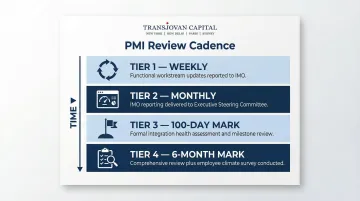
Build a live synergy tracker — updated monthly — that maps each initiative to its financial baseline, target value, accountable owner, and realization status. For India-linked cross-border deals, the tracker should also show corridor-specific progress across Indo-US, Indo-Japan, Indo-French, Indo-German, Indo-Italian, India-Australian, and Indo-European transactions.
When deal sponsors can see exactly where synergy capture, leadership retention, or market integration is lagging, course corrections happen before value erodes.
Indian Post-Merger Integration Landscape (2026)
PMI for Indian M&A operates across five distinct dimensions:
- Statutory and Legal Closure — after signing, deal closure timelines are dictated by NCLT approvals (for schemes under Companies Act Section 230–232), SEBI (SAST) open-offer completion (~140 days for listed acquisitions), CCI clearance (30–120 days), and FEMA reporting (Form FC-GPR within 30 days of allotment). The HDFC Ltd → HDFC Bank merger took ~15 months from announcement to effectiveness for full statutory closure.
- Financial and Reporting Integration — purchase price allocation under Ind AS 103, goodwill and intangible asset recognition, consolidated financial reporting from the effective date, and GST re-registration if operational states change. Cross-border Indo-US or Indo-European deals additionally require IFRS-to-Ind AS conversion.
- Operational and Systems Integration — ERP migration (typically SAP or Oracle for large Indian corporates), integrating shared services (F&A, HR, procurement), harmonizing IT security policies, and aligning KPIs. Integration timelines average 12–24 months for complex deals; the Adani acquisition of Ambuja Cements/ACC had multi-year systems integration in the cement plant network.
- Cultural Integration — critical in cross-border Indo-X deals. Indian corporate culture (relationship-driven, hierarchical, family-legacy oriented for promoter-led entities) must align with target-market styles: US (task-driven, meritocratic), Japan (consensus-based, quality-focused), Europe (formal, process-heavy). Failed integrations often trace to cultural misfit rather than commercial errors.
- HR and Talent Retention — retention of key management from the target company is the strongest predictor of synergy capture. Indian acquirers typically extend 18–36 month lock-ins with performance-linked ESOPs. Cross-border integrations require additional attention to work permit / visa transitions, especially for Indian resources deployed at foreign target locations.
The ArcelorMittal-Nippon acquisition of Essar Steel, completed under the IBC framework, illustrates the additional PMI complexity in stressed-asset acquisitions — where the acquiring consortium must simultaneously execute an approved resolution plan, address creditor claims per the plan, and stabilize operations of a distressed target.
How Transjovan Capital Approaches Post-Merger Integration
How Transjovan Capital reads post-merger integration is a matter of public record. Managing Partner Gaurav Asthana draws the dividing line sharply in ION Analytics (Mergermarket): "Sell-Side KPI: Closing the transaction. Buy-Side KPI: Ensuring the deal is long-term value-accretive, with a focus on successful post-merger integration (PMI)." That distinction is why the firm was built around buy-side mandates in the first place.
Gaurav Asthana founded the firm in 2011 to concentrate on buy-side advisory for Fortune 500 and mid-market acquirers that wanted proprietary deal flow and embedded corporate development support rather than a transaction broker, and told ION Analytics (Mergermarket) that inbound mandates now account for 60-70% of the practice against 30-40% outbound. The firm has advised on $15 billion+ in cumulative transactions across 250+ clients, and took the Platinum award for Best M&A Advisory Firm at the M&A Conclave & Awards hosted by Transformance Forums in Bengaluru in October 2024 (announcement).
Frequently Asked Questions
What is post-merger integration?
Post-merger integration is the structured process of combining two companies — their people, processes, systems, cultures, and governance models — following a merger or acquisition. The goal is to realize the synergies and strategic value that motivated the transaction. In India-linked cross-border deals, PMI also ensures that Indian and overseas teams, reporting standards, leadership structures, and operating practices are aligned after close.
What are the key goals of post-merger integration?
Three goals drive every integration:
- Capture the cost and revenue synergies that justified the deal premium
- Maintain business continuity and operational performance through the transition
- Build a unified organization with aligned culture, leadership, governance, and accountability
For India-linked transactions, this also means protecting local customer relationships, retaining key leadership, and managing regulatory, HR, tax, and reporting requirements across jurisdictions.
What is the success rate of post-merger integration?
Study after study puts the M&A failure rate between 70% and 90%, often because companies fail to convert the deal thesis into post-close execution. Integration risk is higher in cross-border deals where culture, systems, regulation, leadership retention, and synergy tracking must be managed across two operating environments.
What are the 4 types of integration?
The four models are:
- Preservation — target operates autonomously under the acquirer’s ownership
- Holding — acquirer maintains ownership with minimal operational integration
- Symbiosis — selective integration of high-value functions while preserving independence
- Absorption — full integration into the acquirer’s operations and structure
Choice depends on how much operational independence the target needs to preserve its value, and how much integration is required to realize the deal thesis.
What are the 4 types of synergies?
The four synergy types are:
- Cost synergies — reducing overlapping expenses through consolidation
- Revenue synergies — cross-selling opportunities and market expansion
- Financial synergies — improved capital access, tax efficiency, or capital structure benefits
- Operational synergies — process efficiencies, capability sharing, and stronger execution
In India-linked M&A, synergies often depend on how well the buyer connects local market access, global customers, manufacturing capacity, technology, and leadership continuity.
What is the post-merger integration checklist for HR?
Core HR integration priorities include:
- Communicate organizational structure and role clarity early
- Harmonize compensation and benefits across both entities
- Manage redundancies equitably and transparently
- Retain key talent through targeted retention programs
- Integrate HRIS systems to a single platform
- Align performance management processes across the combined organization
For cross-border deals involving India, HR integration should also account for local employment practices, leadership retention in key hubs such as Mumbai, Delhi NCR, Bengaluru, Pune, Chennai, Ahmedabad, and Hyderabad, and cultural bridging between Indian and overseas teams.
What is a typical PMI timeline for an Indian M&A deal?
PMI timelines for Indian M&A depend on deal structure and complexity. Share purchase deals (SPA) with immediate closure typically follow a 100-day integration sprint plus a 12-24 month deep integration phase. Schemes of arrangement under Companies Act Section 230 add 6-15 months for NCLT approval before effective date — the HDFC merger took ~15 months from announcement to effectiveness. SEBI SAST open offers add ~140 days for the open-offer completion window. CCI clearance adds 30-120 days depending on Phase I vs Phase II review. IBC resolution acquisitions integrate over 24-36 months given the additional creditor-claim workstreams. Cross-border Indo-X deals typically add another 6-12 months for cultural and systems integration. Advisors typically build a 4-phase plan: Pre-close (deal signing to closure), Day 1 (closure to first month), 100-Day Plan (foundational integration), and 12-24 Month Deep Integration (systems, synergy capture, culture).
How does Indian regulatory reporting change post-merger?
Post-merger, Indian regulatory reporting changes across multiple regimes. Companies Act reporting — the amalgamated/resulting company assumes all statutory filings; annual returns, board composition, and shareholder disclosures reflect the combined entity from the effective date. Ind AS financial reporting — purchase price allocation under Ind AS 103, goodwill on acquisition, intangible asset recognition, and consolidated financial statements from the effective date. GST re-registration — if the merger involves state consolidation, new GST registrations may be required; existing input tax credits transfer as per Circular No. 96/15/2019. SEBI reporting for listed entities — disclosure of the merger effect on paid-up capital, promoter-holding changes under SEBI (LODR), and revised corporate governance reports. RBI reporting for FEMA — Form FC-GPR for inbound investment; Form FC-TRS for share transfers; ODI reporting for outbound Indian acquirers. Income Tax — revised assessments under Section 170 (transfer of business), Section 47 tax-neutrality claims, and revised depreciation on transferred assets.
What are the most common PMI failure modes in Indian cross-border M&A?
The most common PMI failure modes in Indian cross-border (Indo-US, Indo-Japan, Indo-French, Indo-German, Indo-Italian, Indo-Australian, and Indo-European) M&A are: (1) Cultural misalignment — assuming Indian working style (relationship-driven, hierarchical) will translate into target-market environments (US task-driven, Japan consensus-based, Europe process-heavy). Solution: dedicated cross-cultural integration workstream from Day 1. (2) Overstated synergies at deal announcement — Indian promoters and Boards often anchor on aspirational synergy targets that don't survive first-year execution reality. Solution: build synergy models that are challenged by target-market executives before announcement. (3) Loss of target-side talent — key executives at Indo-US or Indo-European targets leave within 12-18 months without adequate retention design. Solution: structured retention packages with 24-36 month vesting and preservation of target-culture autonomy. (4) Regulatory-timing mismatch — assuming NCLT/CCI/SEBI clearances will match commercial timelines. Solution: parallel-processing regulatory approvals with integration planning. (5) IT/systems consolidation delays — attempting ERP unification before operational stabilization. Solution: phased approach — first stabilize, then unify.