Introduction
70% to 90% of M&A deals fail to create shareholder value, and 83% of practitioners point to poor integration execution as the primary cause. Most failures trace back to one root problem: acquisitions pursued reactively, chasing targets when bankers circulate pitch books or competitors move first, rather than from a structured plan. For Indian acquirers, acquisition strategy operates inside a specific regulatory and structural framework. SEBI (SAST) governs listed-company acquisitions (25% trigger). Companies Act 2013 Sections 230 to 232 govern schemes of arrangement. IBC 2016 enables stressed-asset acquisitions. FEMA dictates FDI route selection for cross-border targets. CCI merger notification thresholds add regulatory timing. A robust strategy front-ends these constraints rather than discovering them mid-deal.
Without a formal strategy, acquisitions become exercises in misalignment — mismatched cultures, missed synergies, and integration failures that destroy rather than create value.
This article is for corporate leaders, Chief Strategy Officers, CFOs, and Corporate Development heads at large enterprises and high-growth companies who need to build or sharpen their inorganic growth capability. It explains what an acquisition strategy plan is, why it demands rigour, and lays out four actionable steps to build one that drives measurable strategic value.
Key Takeaways
- An acquisition strategy plan defines why, what, and how a company will acquire — before any specific target ever surfaces
- Skip the strategy, and acquisitions turn opportunistic — raising the odds of cultural misfit and value destruction
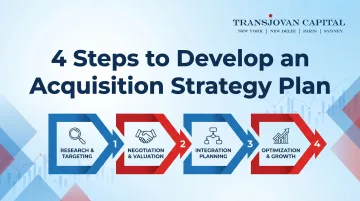
- The four steps: (1) define strategic objectives and rationale, (2) map the target landscape, (3) build an evaluation framework, (4) plan for integration
- Treat the strategy as a living document — revisit it quarterly as markets shift and internal capabilities change
- Acquirers who embed strategy into ongoing corporate development — not one-off deal cycles — close better deals and integrate them more successfully
What Is an Acquisition Strategy Plan?
An acquisition strategy plan is a structured framework that articulates a company's rationale for pursuing acquisitions, the types of targets it will seek, evaluation criteria, and how acquired entities will be integrated to create long-term value.
It is not a deal-specific acquisition plan (which governs a single transaction) or a due diligence checklist. It sits upstream of both — establishing the strategic filter through which all potential deals are assessed.
The strategy converts growth ambitions into a repeatable, disciplined process for identifying, screening, and executing deals. Rather than acting on ad-hoc opportunities, it provides the intellectual framework before any target is identified, before any investment bank sends a pitch deck, and before any deal team is assigned.
In practice, leading firms structure the plan around six core elements:
- Strategic context and growth gap analysis
- Build vs. buy vs. partner assessment
- Investment themes and deal archetypes
- Target screening criteria
- Financial capacity and guardrails
- Execution roadmap
The plan typically supports one of four strategic objectives:
- Portfolio-building — assembling complementary assets
- Cost efficiency — achieving scale through consolidation
- Revenue growth — enabling cross-sell or market expansion
- Strategic hedging — gaining diversification or technology access
Why Enterprises Need a Formal Acquisition Strategy Plan
The Cost of Reactive Deal-Making
Research consistently shows that 60% of M&A deals fail to create value, with approximately 46% of all S&P 500 M&A transactions ultimately undone, taking an average of 10 years to unwind. The top causes? Overpaying for targets (42%), inadequate due diligence (31%), and poor post-merger integration (27%).
Without defined objectives, companies risk pursuing targets that look attractive in isolation but misalign with long-term direction. Opportunistic bidders crowd out high-synergy bidders in 7% of transactions, resulting in synergy losses equal to 9% of target value in those inefficient deals.
What Formal Strategy Enables
A formal acquisition strategy gives corporate development teams the structure to act decisively rather than reactively. Key capabilities it unlocks:
- Consistent target screening against pre-defined strategic criteria
- Early-stage synergy mapping before valuations are locked in
- Faster internal decision-making through pre-agreed frameworks
- Proactive deal pipeline development rather than opportunistic chasing
The performance gap is significant. Programmatic acquirers—those making at least two small or medium-sized deals annually along the same theme—delivered 2.3% excess total shareholder return annually compared with peers. From 2000 to 2024, frequent acquirers earned 130% higher shareholder returns versus those that stayed out of the market.
The Bandwidth Challenge and Embedded Solutions
Sustaining the programmatic cadence that drives those returns requires dedicated corporate development capacity — precisely what most enterprises lack. Organizations increasingly deploy embedded models such as Corporate Development as a Service (CDaaS) to maintain a continuous, partner-led acquisition engine without expanding headcount.
Firms like Transjovan Capital offer multi-year CDaaS retainers that integrate strategy, buy-side M&A, Day-1 readiness, post-merger integration, and synergy governance into one coordinated engagement. CXO bandwidth burden decreases, while value is measured through synergy capture rather than deal count.
The 4 Steps to Develop an Acquisition Strategy Plan
Step 1: Define Strategic Objectives and Acquisition Rationale
The first step is to articulate precisely why the company is pursuing acquisitions—whether to accelerate market entry, acquire technology or talent, achieve scale, eliminate competition, or diversify. The rationale must be grounded in corporate strategy, not financial engineering.
Key Questions Leadership Must Answer:
- What capability or market position does the company need that cannot be built organically within the required timeframe?
- What is the targeted outcome in 3–5 years, and how does acquisition serve that outcome more effectively than greenfield growth or joint venture?
- What constraints or thresholds define acquisition readiness (financial stability, leverage capacity, management bandwidth)?
Define Acquisition Type Upfront:
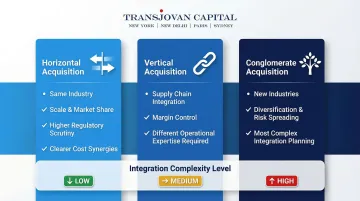
Three primary archetypes shape every subsequent decision:
- Horizontal acquisition: Same industry competitors for scale and market share
- Vertical acquisition: Supply chain integration (suppliers or distributors) for control
- Conglomerate acquisition: New industries for diversification and risk spreading
This choice shapes target criteria, valuation methodology, and integration complexity. Horizontal deals typically offer clearer cost synergies but face higher regulatory scrutiny; vertical deals deliver margin control at the cost of different operational expertise. Conglomerate plays spread risk furthest—and demand the most sophisticated integration planning.
Step 2: Conduct Target Landscape and Market Analysis
Once the rationale is defined, the company must map the landscape: identify the universe of potential targets, assess market fragmentation, and understand where value is concentrated.
Evaluate Market Dynamics:
- Industry structure: Fragmented markets (many sub-scale players) versus consolidated markets (few large incumbents)
- Competitive positioning: Revenue and EBITDA benchmarks that define viable targets
- Geographic considerations: Cross-border regulatory requirements, currency exposure, and regional competitive dynamics
Market Fragmentation as Acquisition Signal:
In fragmented markets, a programmatic acquisition strategy (multiple bolt-on acquisitions) creates more value than single large transformational deals. Industry fragmentation is measured through the four-firm concentration ratio (CR4) or Herfindahl–Hirschman Index (HHI). Fragmented retail food and beverage markets (CR4 of 40–55%) offer considerably more acquisition runway than highly concentrated telecommunications markets (CR4 of 80–95%).
In practice, this analysis shapes acquisition sequencing before any target is approached. In fragmented B2B services markets, for example, Transjovan Capital's sector mapping work has consistently shown that scaling delivery models through programmatic bolt-ons outperforms single large platform acquisitions—a pattern that holds across IT Services, Logistics, and HR Staffing mandates.
Target Screening Thoroughness:
Research shows that the average acquirer reviews roughly 20 candidates before closing a deal, eliminating high percentages at each stage. Rigorous upfront screening prevents deal fever and criteria drift later in the process.
Step 3: Build the Target Evaluation and Financial Framework
This step moves from landscape to shortlist: define specific, weighted criteria for evaluating targets and establish the financial framework that determines deal viability.
Target Screening Criteria:
- Strategic fit: Product/service overlap, geographic expansion opportunity, customer base alignment
- Financial health: Revenue trajectory, EBITDA margin, cash flow stability, debt levels
- Management quality: Leadership continuity, cultural compatibility, operational discipline
- Cultural compatibility: Values alignment, decision-making style, talent retention risk
Financial Framework Components:
Establish the valuation methodology: EV/EBITDA multiples, discounted cash flow (DCF), or comparable transactions. Set acceptable price ranges relative to expected synergies. Define minimum return thresholds—ROIC or IRR hurdles—that deals must clear before progressing to term sheet.
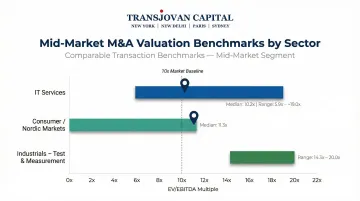
Valuation Multiples by Sector (Mid-Market Benchmarks):
- IT Services: Median EV/EBITDA of 10.2x between 2015 and 2025, with small companies (under $5M) at 5.9x and deals between $50M–$100M nearly twice as high
- Consumer: Median EV/EBITDA of 11.3x in Nordic markets
- Industrials (Test & Measurement): EV/EBITDA ranging from 14.3x for Industrial & Energy services to 20.0x for Instrumentation
Hurdle Rates:
CFOs report using elevated hurdle rates that average 6.6 percentage points above cost of capital, with average hurdle rates of 13.88% versus WACC of 8.77%. Nearly 78% of companies use this buffer to account for additional risks or optimistic cash flow forecasts.
Synergy Quantification at Strategy Stage:
Do not defer synergy quantification to post-acquisition. The strategy plan must pre-identify synergies upfront so deal teams negotiate with realistic value anchors:
- Revenue synergies: Cross-sell opportunities, geographic expansion, pricing power
- Cost synergies: Procurement consolidation, headcount rationalisation, infrastructure savings
The data on failure is stark: over 60% of transactions miss their synergy targets, and 70% of companies announce higher synergy estimates than justified by scale alone.
Step 4: Design the Integration and Value Capture Plan
Integration planning must begin at the strategy stage, not after the deal closes. Companies that explicitly validate and track synergies from the start achieve 92% success rates, compared to 14–40% baseline success rates.
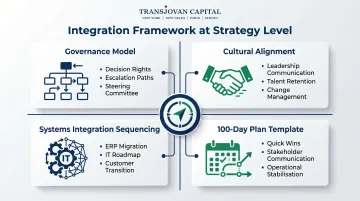
Integration Framework at Strategy Level:
- Governance model: Decision rights, escalation paths, steering committee structure
- Cultural alignment approach: Leadership communication, talent retention priorities, change management protocols
- Systems and process integration sequencing: IT systems roadmap, ERP migration timelines, customer transition plans
- 100-day plan template: Adaptable blueprint for each specific deal covering quick wins, stakeholder communication, and operational stabilisation
Value Lost to Poor Integration:
The cost of poor integration planning is well-documented:
- 41% of deals suffer from incompatible IT systems, destroying 30–50% of deal value through slow or ineffective IT integration
- 78% of successful M&A organisations spend 6% or more of deal value on integration
- 60% begin planning long-term operating models before due diligence even concludes
Define Value Capture Milestones:
Establish specific, time-bound synergy delivery targets: cost savings by month 12, revenue uplift by year 2. Companies whose total return to shareholders outperformed the market captured run rates equal to 50% of their public synergy target in the first year alone. These milestones hold the acquisition accountable to the strategic case that justified the deal.
For organisations running continuous acquisition programmes, this milestone structure requires dedicated governance infrastructure. Transjovan Capital's CDaaS model addresses this directly: synergy tracking is embedded into quarterly board-ready reporting and real-time dashboards, so leadership can see where each deal stands against its original value case—at any point in the integration cycle.
Key Factors That Determine Acquisition Strategy Success
Internal Readiness
The business must have stable financials and management capable of running day-to-day operations independently while leadership focuses on acquisition activity.
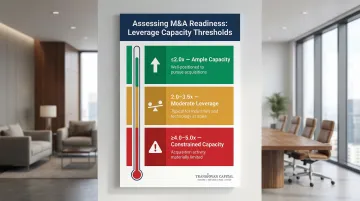
Net Debt-to-EBITDA is the key readiness metric to assess M&A capacity:
- ≤2.0x — Ample capacity; well-positioned to pursue acquisitions
- 2.0–3.5x — Moderate leverage; typical for industrials and technology companies at scale
- ≥4.0–5.0x — Constrained capacity; acquisition activity is materially limited
External Market Factors
Three external forces shape how, when, and at what cost acquisitions can be executed. Each warrants monitoring before committing to a deal timeline.
Market Timing: Global M&A volumes fell 15% to $3.2 trillion in 2023 on the back of higher interest rates and economic uncertainty, before rebounding 40% to $4.9 trillion in 2025 as conditions improved.
Rising rates compress valuations directly. Median global EV/EBITDA multiples dropped to 10.1x in 2023—a 15-year low—before recovering to 10.8x–14.3x across 2024 and 2025.
Competitive Dynamics: Failed auctions (where targets attract only one bidder) result in final premiums 15.1% lower than non-target-initiated negotiations. Competitive auction environments increase multiples and reduce negotiation leverage.
Regulatory and Geopolitical Risk: Heightened scrutiny has extended the average time to reach a regulatory outcome for scrutinised deals to 12 months, with complex deals taking up to 24 months. Cross-border acquisitions decreased as a priority, with 90% of financial-service deals in 2024 made within national borders—up from 60% in 2021—reflecting rising geopolitical hurdles.
Strategy Consistency Discipline
An acquisition strategy only works if it holds under pressure. The real test comes when an attractive deal falls outside defined criteria—and leadership chooses to chase it anyway.
Departures from strategy should trigger a formal re-evaluation with documented sign-off. That discipline separates acquirers who build durable portfolios from those who accumulate misaligned assets.
Common Mistakes When Building an Acquisition Strategy Plan
Treating Strategy as a Document, Not a Process
The most common mistake: organisations write a strategy paper once, file it, and revert to reactive deal-making. A strategy must have a standing review cadence—typically quarterly—to remain aligned with business objectives and market conditions. Markets shift, competitive dynamics evolve, and internal capabilities change. Static strategies become obsolete within months.
Confusing Criteria with Criteria Compliance
Teams often define rigorous screening criteria but relax them under dealmaker enthusiasm—a pattern known as deal fever. 58% of deals fail due to misaligned strategic goals, often because teams abandon their frameworks mid-process. Build governance checkpoints requiring sign-off at each stage gate to prevent criteria drift.
Underestimating Cultural and Integration Risk
Many acquisition strategies are strong on financial and market logic but silent on how two organisations will operate as one. Cultural clashes are cited by 68% of executives as the biggest integration challenge, and 54% of CFOs would abandon a deal entirely if cultural misalignment was discovered during diligence. Cultural due diligence and integration resource planning must be explicitly included in the strategy, not left as post-signing assumptions.
Mismanaging people and cultures accounts for two-thirds of failed transactions. Address cultural fit at the strategy stage by:
- Defining what constitutes acceptable cultural alignment for your organisation
- Establishing early-warning indicators to surface misalignment during diligence
- Allocating dedicated integration resources before deal execution begins
Indian Acquisition Strategy Landscape (2026)
Indian acquirers pursuing programmatic M&A operate across three distinct playbooks:
- Domestic mid-market consolidation: roll-ups across fragmented sectors (chemicals, building materials, industrials, F&B, agrochemicals, packaging). Enabled by PE dry powder in India (approximately $50 billion sitting on Indian-focused funds per Bain-IVCA 2025). Recent examples include the L&T acquisition of Mindtree and merger with LTI at approximately ₹8,400 crore.
- Inbound cross-border acquisitions: foreign strategics acquiring Indian targets. Landmark examples include the Adani-Ambuja and ACC acquisition following Holcim's exit (approximately ₹80,000 crore combined, Indo-Swiss) and the ArcelorMittal and Nippon Steel acquisition of Essar Steel at ₹42,000 crore (Indo-Japan and Indo-European trilateral) via IBC.
- Outbound cross-border: Indian acquirers in Indo-US, Indo-European, and Indo-Australian markets. Landmark examples include Tata Motors acquisition of Jaguar Land Rover at approximately ₹9,300 crore (Indo-UK), and Hindalco acquisition of Aleris at approximately ₹18,500 crore (Indo-US).
Step 1 to 4 framework for Indian acquirers:
- Step 1 (Strategic Thesis): define the growth thesis, identify strategic capability gaps, decide between organic and inorganic build, and map to India's macro tailwinds (China+1, energy transition, digital India, consumer premiumisation).
- Step 2 (Target Mapping): scan targets across 16 focus sectors, seven Indo-X corridors, and 7 Indian cities (Mumbai, Delhi NCR, Bengaluru, Pune, Chennai, Ahmedabad, Hyderabad). Segment by domestic, inbound, outbound, and IBC channels.
- Step 3 (Valuation and Due Diligence Framework): anchor valuation on Companies Act Section 247 Registered Valuer methodology, Rule 11UA for private company valuations, SEBI SAST minimum offer price for listed targets, and FEMA-certified valuation for cross-border legs. Build DD templates for financial, tax, legal, HR, technology, ESG, and regulatory workstreams.
- Step 4 (Integration and Governance): plan post-merger integration ahead of Deal 1, establish a corporate development function or engage an embedded CDaaS partner, define synergy KPIs, and build governance to enable programmatic execution (2+ deals per year over 5+ years).
Regulatory pathway typically involves SEBI (SAST) for listed targets, Companies Act Sections 230 to 232 for schemes of arrangement, IBC for stressed-asset acquisitions, FEMA for cross-border, CCI merger notification for combined turnover above ₹3,000 crore in India, and Section 47 tax-neutrality for share-swap or demerger structures. Advisors serving Indian mandates need fluency across all six instruments to sequence timelines correctly.
How Transjovan Capital Shapes Acquisition Strategy
On acquisition strategy, Transjovan Capital's own record is a useful reference. Managing Partner Gaurav Asthana draws the dividing line sharply in ION Analytics (Mergermarket): "Sell-Side KPI: Closing the transaction. Buy-Side KPI: Ensuring the deal is long-term value-accretive, with a focus on successful post-merger integration (PMI)." That distinction is why the firm was built around buy-side mandates in the first place.
Gaurav Asthana founded the firm in 2011 to concentrate on buy-side advisory for Fortune 500 and mid-market acquirers that wanted proprietary deal flow and embedded corporate development support rather than a transaction broker, and told ION Analytics (Mergermarket) that inbound mandates now account for 60-70% of the practice against 30-40% outbound. The firm has advised on $15 billion+ in cumulative transactions across 250+ clients, and took the Platinum award for Best M&A Advisory Firm at the M&A Conclave & Awards hosted by Transformance Forums in Bengaluru in October 2024 (announcement).
Frequently Asked Questions
What is an acquisition strategy?
An acquisition strategy is a structured plan articulating why, what, and how a company will acquire. It distinguishes intentional, criteria-based deal-making from opportunistic responses to banker pitches, guiding all corporate growth decisions through a pre-defined strategic filter.
What is the purpose of an acquisition strategy?
The purpose is to ensure acquisitions are pursued based on pre-defined strategic logic and financial criteria, reducing the risk of value destruction and improving the probability of successful integration and synergy realization.
How do you develop an acquisition strategy?
Follow a four-step process: (1) define strategic rationale and acquisition objectives, (2) map the target landscape and assess market dynamics, (3) build target evaluation criteria and financial framework, and (4) design integration and value capture planning from the strategy stage.
What are the three acquisition strategies?
Horizontal acquisition (acquiring competitors in the same space for scale and market share), vertical acquisition (buying suppliers or distributors to control the value chain), and conglomerate acquisition (entering new industries for diversification and risk spreading).
What are the 4 growth strategies?
The Ansoff Matrix defines four growth strategies: market penetration, market development, product development, and diversification. Acquisitions are the primary vehicle for accelerating market development and diversification — two paths that require speed and capabilities that organic growth rarely delivers fast enough.
Who prepares the acquisition strategy?
The strategy is typically led by the Chief Strategy Officer or Corporate Development head, in collaboration with the CEO and CFO. Many organisations also engage external M&A advisors for deal experience, market intelligence, and target identification — particularly when internal bandwidth is limited or cross-border expertise is required.
What is programmatic M&A and how do Indian companies build it?
Programmatic M&A is a sustained inorganic growth strategy (typically 2+ acquisitions per year over 5+ years) built on repeated pattern recognition rather than opportunistic one-off deals. Indian programmatic acquirers include the Adani Group (energy, ports, cement, media), Reliance (retail, telecom, media, green energy), Tata Group (steel, digital, financial services), and L&T (infrastructure, IT services). Building the engine requires: (1) a dedicated corporate development function or an embedded CDaaS partner like Transjovan Capital, (2) a repeatable integration playbook, (3) a disciplined valuation framework anchored on Section 247 and Rule 11UA, (4) target-market corridor focus across Indo-US, Indo-Japan, Indo-French, Indo-German, Indo-Italian, Indo-Australian, and Indo-European, and (5) clear sector focus to build cumulative expertise across 16 focus sectors (semiconductors, electronics, industrials, manufacturing, data centres, engineering, automotive, chemicals, packaging, electric vehicles, energy transition, AI infrastructure, deeptech, food & beverage, agrochemicals, and building materials).
How does an Indian mid-market company decide between organic and inorganic growth?
The decision hinges on four factors specific to the Indian context: (1) time-to-scale (inorganic compresses time-to-market by 12 to 36 months, critical when competitors are consolidating), (2) access to specific capabilities (technology in deeptech and AI infrastructure, regulatory licenses in financial services, distribution in consumer, or global markets across Indo-US, Indo-Japan, Indo-French, Indo-German, Indo-Italian, Indo-Australian corridors that would take years to build), (3) capital availability (Indian mid-market promoters typically raise growth capital before M&A, using PE or public markets), and (4) cultural fit and management bandwidth (organic preserves culture; M&A requires post-merger integration capability). A Corporate Development as a Service (CDaaS) partner supports all five customer intents: raising growth capital, executing M&A, devising corporate strategy, sales maximisation, and cross-border expansion.
Which regulatory instruments should Indian acquirers plan for at the strategy stage?
At the strategy stage, Indian acquirers should map six regulatory instruments to their target pool: (1) SEBI (SAST) Regulations 2011 for listed targets: 25% threshold triggers a mandatory open offer for an additional 26% at Regulation 8(2) minimum price; (2) Companies Act 2013 Sections 230 to 232 for schemes of arrangement requiring NCLT approval; (3) IBC 2016 for stressed-asset opportunities via NCLT resolution; (4) FEMA and FDI Regime for cross-border legs (automatic vs approval route by sector); (5) CCI merger notification thresholds (₹1,000 crore assets or ₹3,000 crore turnover in India) adding 30 to 120 days; (6) Section 47 of the Income Tax Act for tax-neutral share swaps and demergers, and Section 50B for slump sale structuring. Getting the applicable framework right at the outset separates programmatic acquirers from opportunistic buyers.