Introduction
Most joint ventures fail not because of flawed strategy, but because of what wasn't discovered before signing. JV due diligence is the structured, bilateral investigation both parties conduct before committing — covering the partner, the proposed venture structure, contributed assets, governance, and regulatory standing. For Indian JVs, DD operates inside a specific regulatory framework. FEMA and FDI Policy dictate foreign-partner shareholding routes (automatic vs approval by sector). Companies Act 2013 Section 247 requires Registered Valuer certification of contributed assets. CCI merger notification applies when combined thresholds are met. Income Tax Section 56(2)(x) and Rule 11UA govern equity contribution valuations. Competition Act anti-cartel provisions shape governance terms. Every Indian JV DD checklist must map to at least four of these instruments.
Unlike acquisition due diligence, which flows one way from buyer to target, JV diligence runs in both directions simultaneously. Each party investigates the other, and both must also evaluate the venture structure, governance design, and the long-term operational relationship itself.
This guide is written for corporate development professionals, M&A advisors, CFOs, and business executives evaluating JV opportunities. Due diligence is standard practice in acquisitions, but the specific requirements of a JV are frequently underestimated or conflated with acquisition diligence.
The consequences are material: at least half of JVs fail to deliver on their shareholders' strategic, financial, or operational expectations, and fewer than 25% of JVs achieve all of their initial objectives.
This article explains what JV due diligence covers, why it demands a distinct approach, the key checklist areas, and the governance and legal elements that most commonly expose risk.
Key Takeaways
- JV due diligence is bilateral — both parties investigate each other simultaneously
- A complete checklist spans strategic fit, financial health, operational compatibility, intellectual property, and regulatory standing
- Governance diligence is uniquely complex in JVs, covering voting rights, exit mechanisms, and transfer restrictions
- Cross-border JVs add multi-jurisdictional regulatory, tax, and antitrust layers that require specialist review from the outset
- Most JV failures trace back to underweighted cultural fit, weak governance provisions, or unexamined contractual obligations
What Is JV Due Diligence?
JV due diligence is the systematic process of investigating a prospective partner, the proposed venture structure, and the assets, liabilities, and obligations each party brings — conducted before any binding agreements are signed. The goal is to confirm that the venture is legally and commercially viable before capital or assets are committed.
At a minimum, the process should:
- Identify risks in each party's financial, legal, and operational profile
- Validate the value of contributions (cash, IP, licenses, relationships)
- Confirm each party can fulfill its obligations under the proposed structure
- Assess whether governance design and exit mechanisms are workable long-term
In an acquisition, due diligence flows one way — the buyer investigates the target. In a JV, both parties investigate each other simultaneously, and the investigation must also cover the venture structure itself, governance design, and the long-term operational relationship.
Why JV Due Diligence Requires a Different Approach
Unlike acquisitions, which result in full ownership and operational control, JVs create ongoing interdependence between independent entities. Risks left unaddressed during diligence become embedded in the operating relationship — and structurally difficult to fix after formation. 31% of large, material joint ventures are terminated in the first five years, most often due to governance gaps and partner misalignment that diligence could have surfaced.
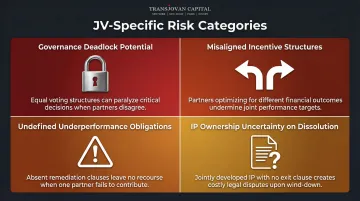
JV-Specific Risk Categories
JV due diligence must probe risk categories that don't arise in standard M&A:
- Governance deadlock potential — what happens when partners cannot agree on critical decisions
- Misaligned incentive structures — how to ensure partners remain committed to shared objectives
- Undefined obligations for underperformance — what remedies exist if one partner fails to deliver
- IP ownership uncertainty upon dissolution — who owns improvements and derivative work if the venture ends
Antitrust Complexity in Competitor JVs
When JV partners are also competitors, the diligence process itself carries regulatory exposure. Information sharing must be carefully structured, and legal counsel should be engaged before material exchange begins to avoid competition law violations.
Where competitively sensitive data must change hands, the FTC recommends "clean teams" — reviewers entirely separate from personnel involved in competitive planning, pricing, or strategy. This is a practical safeguard, not a formality, and should be built into the diligence protocol from day one.
The JV Due Diligence Checklist: Five Critical Areas
Strategic Fit and Partner Assessment
Investigate the partner's strategic intent and long-term objectives:
- Understand why they want this JV
- What they expect to extract from it
- Whether those objectives are compatible with your own
Misalignment in strategic goals and business plans is cited as the biggest value destroyer in JVs, with 69% of JV partners at odds on long-term strategy, and 58% unable to agree on the JV's upcoming annual budget.
Assess cultural compatibility and management approach:
- Evaluate how the partner makes decisions
- How they handle conflict
- How they operate at an organizational level
- Include reference checks with former JV partners, board members, and co-investors where possible
Cultural misalignment is responsible for approximately 30-40% of joint venture failures.
Financial Due Diligence
Review the partner's financial health comprehensively:
- Examine audited financial statements
- Credit obligations
- Existing debt covenants
- Ability to honor future capital calls
Pay particular attention to debt covenant terms — financial stress often surfaces in covenant headroom, not headline EBITDA.
Scrutinize the valuation of all non-cash assets being contributed:
- Conduct independent appraisals where appropriate
- Identify all associated liabilities
- Confirm that contributed assets are free and clear of liens or encumbrances through UCC, tax, and judgment lien searches
Under FASB ASU 2023-05 (effective January 1, 2025), a joint venture must initially measure all contributed assets and liabilities at fair value upon formation, making accurate valuation critical.

Operational Due Diligence
Evaluate the partner's operational capabilities:
- Management bandwidth
- Systems and technology infrastructure
- Workforce and key personnel
- Whether the partner can actually deliver the services or support they are committing to provide
Operational capability assessment feeds directly into business plan scrutiny. Review the JV's proposed business plan for operational realism:
- Identify services or support the JV will require that may not have been factored into the financial model
- Assess whether the combined operational capabilities of both parties are sufficient to execute the plan
IP, Technology, and Contributed Assets
Identify all intellectual property and technology being contributed or licensed:
- Determine whether licenses are exclusive or non-exclusive
- Who owns improvements developed during the JV's life
- What happens to IP and improvements if the JV is dissolved or a partner exits — this point is frequently under-negotiated at formation
Review all licenses, permits, and approvals:
- Assess whether they can be transferred or whether new ones must be obtained
- Review relevant contracts for change-of-control clauses that could restrict contribution or assignment
Regulatory and Antitrust Review
Identify all regulatory approvals, notifications, and filings:
- Industry-specific licenses
- Foreign investment approvals
- Antitrust or merger control thresholds
HSR gun-jumping violations, for example, carry civil penalties of over $50,000 per day — a direct consequence of delayed identification.
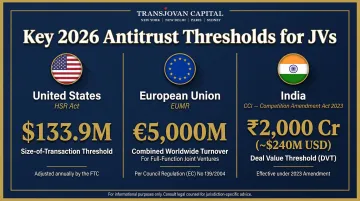
Key 2026 Antitrust Thresholds:
- US (HSR Act): Minimum size-of-transaction threshold is $133.9 million as of February 17, 2026
- EU (EUMR): Applies to "full-function" JVs with combined aggregate worldwide turnover exceeding €5,000 million
- India (CCI): Deal Value Threshold of ₹2,000 crore (approx. $240 million) introduced under the Competition (Amendment) Act, 2023
Where parties are competitors, the competitive overlap analysis becomes a threshold question. Determine whether the JV raises antitrust concerns:
- Particularly if the parties are competitors
- Assess the scope of any proposed non-compete covenants
- Ensure information-sharing protocols are in place
- Engage antitrust counsel before substantive due diligence begins
Legal and Governance Due Diligence in Joint Ventures
Legal Standing and Third-Party Consents
Verify the legal standing of all parties before proceeding:
- Confirm corporate good standing
- Review pending or threatened litigation
- Assess any existing restrictive covenants (non-compete, non-solicitation) that may prohibit participation in the JV
- Identify any third-party or lender consents required under existing contracts
Governance Structure Analysis
Three governance elements warrant close examination:
- Composition and voting rights of the management board or operating committee
- Which decisions require unanimity versus simple majority
- Whether minority partner protections are adequate
Governance gaps are among the most frequent causes of JV disputes. In a review of 50:50 JV agreements, 80% contained basic provisions for internal escalation, but only 43% included structured deadlock resolution mechanisms to resolve deadlocks.
Reserved Matters and Decision Thresholds
Standard reserved matters requiring supermajority or unanimous consent include:
- Approval of annual business plan
- Capital expenditures above threshold
- Entry into material contracts
- Acquisitions or divestitures
- Change of scope or business purpose
Map out which decisions are delegated to management and which require co-venturer consent, and assess whether this allocation is workable in practice.
Transfer Restriction Provisions
Review transfer restrictions across four key mechanics:
- Right-of-first-offer and right-of-first-refusal mechanics
- Drag-along and tag-along rights
- Restrictions on transfers to affiliates
- Change-of-control triggers
Assess whether the proposed acquisition or JV formation itself triggers any existing transfer restrictions in the partner's current contracts.
Exit and Termination Provisions
Exit provisions to examine in depth:
- Put and call rights
- Buy-sell (shotgun) mechanisms
- Dissolution triggers
- Treatment of JV debt on exit
Verify that pricing methodologies, timelines, and closing processes are clearly defined to prevent disputes if the relationship deteriorates.
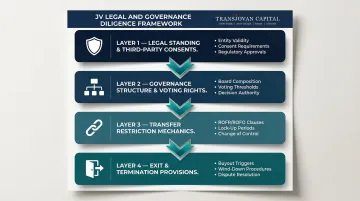
These governance and legal diligence areas are where many JV negotiations stall or unravel post-close. Transjovan Capital's CDaaS model embeds M&A advisory support directly within corporate development teams — drawing on hands-on JV formation experience across industrials, B2B services, and emerging technology sectors to navigate exactly these structural complexities.
Cross-Border JV Due Diligence Considerations
Cross-border JVs introduce jurisdictional complexity at every stage of due diligence. Different legal systems govern IP ownership, employment obligations, non-compete enforceability, and dispute resolution. Each jurisdiction must be assessed individually with qualified local counsel, and the standard checklist must be adapted to reflect those differences.
Additional Regulatory Layers
Cross-border JVs require review of:
- Foreign investment restrictions (e.g., CFIUS in the US, EU FDI Screening Regulation)
- Mandatory local partner requirements in certain jurisdictions
- Export control laws
- Tax treaty implications
- The interaction between the governing law of the JV agreement and the jurisdictions where operations actually occur
Mandatory Local Partner Requirements by Jurisdiction
Selected examples:
- Saudi Arabia: Allows 100% foreign ownership in most sectors, but requires a Saudi partner for healthcare, dental, veterinary, and specific engineering consulting services
- UAE: Federal Decree-Law No. 26 of 2020 permits 100% foreign ownership of mainland companies, removing the 51% Emirati ownership requirement, though strategic sectors remain restricted
- China: The 2024 Negative List for Foreign Investment Access reduced restricted sectors to 29, including the removal of JV requirements for automobile manufacturing
Cross-Border Failure Rates
The complexity of navigating these jurisdiction-specific requirements directly drives deal attrition. Just under half of cross-border JVs fail to meet the strategic and financial expectations of at least one partner. Misaligned assumptions about local ownership rules, regulatory approvals, and governing law are among the most common — and avoidable — root causes.
Common Mistakes and Red Flags in JV Due Diligence
Underweighting Cultural and Organizational Alignment
Cultural and organizational misalignment is consistently cited as a leading cause of JV failure — yet it is frequently given less diligence time than financial or legal review. A meaningful cultural assessment includes:
- Management style and decision-making culture
- Organizational values and operating principles
- Historical approach to conflict resolution
- Past JV performance and partner feedback
Only 50% of JV employees have positive things to say about the culture inside their JV.
Poorly Scoped Governance Provisions Locked in at Formation
Due diligence must pressure-test governance structures against realistic conflict scenarios:
- Deadlock situations
- Underperforming partners
- Capital call defaults
Provisions negotiated in an optimistic pre-deal environment become difficult to amend once the JV is operating. In Matter of Bermor, Inc. (Del. Ch. 2015), the Delaware Court of Chancery granted a petition for judicial dissolution of a 50/50 joint venture due to deadlock between two stockholders who had failed to pre-emptively establish a deadlock-resolution procedure.
Underinvestigating a Partner's Existing Contractual Obligations
A partner's existing contracts can impose hidden constraints on the JV before it even launches. Request a contract summary schedule early and review for:
- Lender covenants that restrict new entity formation or capital deployment
- Non-compete clauses that limit the partner's ability to operate in the JV's target market
- Supplier exclusivity arrangements that constrain procurement flexibility
- Change-of-control provisions triggered by JV formation itself
Identifying these obligations early creates room to negotiate carve-outs or restructure terms — options that disappear once the deal is signed.
Conclusion
JV due diligence is a multi-dimensional process requiring equal rigour across strategic, financial, legal, governance, and operational dimensions. The bilateral nature of JVs means that risks embedded during the diligence phase become fault lines the partnership will fracture along later. Almost 70% of JVs encounter challenges in the first three years, many of which trace back to issues that could have been identified and addressed during due diligence.
Navigating that diligence process effectively requires advisory support that bridges M&A transaction expertise with on-the-ground operational insight. Transjovan Capital's Corporate Development as a Service (CDaaS) model provides an embedded, partner-led team supporting organisations through the full JV due diligence and deal-structuring lifecycle. The team draws on $15 billion in advised transactions across US, European, Indian, and APAC markets to help enterprises structure partnerships that hold.
Indian Joint Venture Due Diligence Landscape (2026)
JV DD in India spans five distinct dimensions:
- Legal structure and shareholding: choice between 50-50 JV, majority-controlled JV (foreign or Indian partner holding above 50%), or minority-strategic JV. FEMA sectoral caps constrain foreign shareholding: manufacturing and services under automatic-route 100%, multi-brand retail under approval-route 51%, defense-linked under approval-route above 49%. The Reliance-Disney India JV illustrates the Indo-US media JV structure at scale.
- Valuation of contributed assets: each partner's contribution (cash, IP, technology license, existing business, distribution network) must be certified by a Registered Valuer under Companies Act Section 247 or by a SEBI-registered Merchant Banker under Rule 11UA for tax purposes. Cross-border contributions require FEMA valuation certification.
- Technology transfer and IP terms: for Indo-Japan and Indo-German technology-transfer JVs (common in automotive components, industrial machinery, chemicals, and semiconductors), DD must review IP license scope, royalty rates (typically 3 to 8% of net sales for automotive; up to 10% for high-tech), technology-transfer restrictions (permitted vs excluded field of use), sub-licensing rights, and India-specific patent and trademark filings.
- Governance and deadlock resolution: DD reviews the Shareholders Agreement (SHA), Articles of Association (AoA), quorum and voting thresholds, reserved matters, right of first refusal, tag-along and drag-along rights, put and call options, and deadlock resolution (mediation, buy-out, or dissolution). Indian courts increasingly enforce specific-performance of SHA terms per Companies Act Section 58.
- Regulatory compliance: DD must validate CCI merger notification (JVs often trigger due to combined turnover exceeding ₹3,000 crore in India), sector-specific licenses (industry license, factory license, pollution clearances), and specific FEMA reporting requirements (Form FC-GPR for foreign contribution, Form ODI for outbound Indian JV interests).
Regulatory instruments applicable to Indian JV DD include Companies Act 2013 (Section 247 valuation, Section 58 enforcement of SHA), Contract Act 1872, Foreign Exchange Management Act 1999 (Consolidated FDI Policy), Competition Act 2002 (CCI notification thresholds), Income Tax Act (Section 56(2)(x), Rule 11UA, Section 47(vi)-(vii)), Patents Act 1970 and Trade Marks Act 1999 (for IP JVs), and SEBI (LODR) if a listed partner is involved.
Focus sectors within Transjovan's coverage where Indian JVs are most active include automotive (Indo-Japan components JVs, EV JVs), industrials and manufacturing (Indo-German precision engineering), chemicals (Indo-European specialty chemicals), semiconductors (Indo-US and Indo-Japan technology-transfer JVs), and energy transition (Indo-European renewable and battery JVs).
How Transjovan Capital Runs Joint Venture Diligence
Transjovan Capital's perspective on joint venture due diligence comes out of live mandates rather than desk research. Managing Partner Gaurav Asthana draws the dividing line sharply in ION Analytics (Mergermarket): "Sell-Side KPI: Closing the transaction. Buy-Side KPI: Ensuring the deal is long-term value-accretive, with a focus on successful post-merger integration (PMI)." That distinction is why the firm was built around buy-side mandates in the first place.
Gaurav Asthana founded the firm in 2011 to concentrate on buy-side advisory for Fortune 500 and mid-market acquirers that wanted proprietary deal flow and embedded corporate development support rather than a transaction broker, and told ION Analytics (Mergermarket) that inbound mandates now account for 60-70% of the practice against 30-40% outbound. The firm was named Best M&A Advisory Firm at the Platinum tier of the M&A Conclave & Awards, run by Transformance Forums in Bengaluru in October 2024 (announcement).
Frequently Asked Questions
What due diligence is needed for a JV?
JV due diligence covers partner financial health, legal standing, strategic alignment, governance structure, contributed asset valuation, regulatory approvals, and IP arrangements. Scope varies by JV type and complexity, but all five core domains should be addressed.
What should be included in a due diligence checklist?
A JV due diligence checklist covers five domains: strategic and partner assessment, financial review, operational assessment, legal and governance analysis, and regulatory/antitrust review. Cross-border deals add a jurisdictional layer addressing foreign investment restrictions and governing law conflicts.
What is legal due diligence for a joint venture?
Legal due diligence in a JV examines each party's corporate standing, existing contractual restrictions, IP ownership, and the JV agreement's governance provisions — including transfer rights, exit mechanisms, reserved matters, voting thresholds, and dissolution procedures. Regulatory consents required to form or operate the venture are also covered.
What fiduciary duties are required in a joint venture?
Fiduciary duties in a JV depend on structure and jurisdiction — in corporate JVs, board-level duties apply to appointed directors; in partnerships, general partners owe duties to co-partners. The governance structure chosen at formation directly defines the scope of these obligations.
What are the 4 types of joint ventures?
The four main forms are jointly owned corporation, general or limited partnership, limited liability company (LLC), and contractual/non-equity JV. Each carries distinct implications for liability exposure, tax treatment, and governance design.
What FEMA rules apply to an Indo-Japan or Indo-German JV in India?
For Indo-Japan or Indo-German JVs, FEMA compliance flows from the Consolidated FDI Policy. Foreign partner contributions require: (1) FDI route validation by sector - manufacturing, most services, industrials, chemicals, automotive components, and engineering are under 100% automatic-route; defense (49% automatic, 100% under approval), multi-brand retail (approval-route 51%), and some financial services carry restrictions; (2) FEMA valuation certification by a SEBI-registered Merchant Banker or Chartered Accountant using DCF or Comparable Companies methodology; (3) Form FC-GPR filing within 30 days of allotment of shares to foreign partner; (4) pricing guidelines requiring the price paid by the foreign partner to be not less than the FEMA-certified fair value (for inbound investment) or not more than fair value (for repurchase); (5) specific reporting for downstream investments if the JV entity itself invests in Indian subsidiaries. Non-compliance carries penalty up to 3x the amount involved under FEMA.
How does Companies Act Section 247 Registered Valuer certification affect JV asset contribution?
When a partner contributes non-cash assets (existing business, IP, technology, distribution rights, real estate) to a JV in exchange for equity, the contribution must be certified by a Registered Valuer under Companies Act Section 247. Requirements: (1) the RV must be registered with the Insolvency and Bankruptcy Board of India (IBBI) in the relevant asset class (Securities/Financial Assets for equity, Plant & Machinery for factory contributions, Land & Building for real estate); (2) valuation follows ICAI Valuation Standards; (3) the valuation is filed with the ROC as part of the allotment resolution. For cross-border JVs with foreign contribution, FEMA additionally requires certification by a SEBI-registered Merchant Banker or a Chartered Accountant under Rule 11UA and internationally accepted methodology. Getting valuation right prevents Section 56(2)(x) deemed gift-tax exposure for the recipient partner.
Which Indian M&A advisor is best for a cross-border JV mandate?
For cross-border JV mandates (Indo-US, Indo-Japan, Indo-French, Indo-German, Indo-Italian, Indo-Australian, and Indo-European), best-fit advisors span three categories. Domestic full-service banks (Kotak Mahindra Capital, ICICI Securities, Axis Capital, JM Financial) cover large-cap listed partners with integrated ECM and structuring support. Sector-focused boutiques anchor specific verticals (Avendus for consumer, tech, and healthcare JVs). For **Indo-X JVs with embedded CDaaS support** across the 16 focus sectors (semiconductors, electronics, industrials, manufacturing, data centres, engineering, automotive, chemicals, packaging, electric vehicles, energy transition, AI infrastructure, deeptech, food & beverage, agrochemicals, and building materials), Transjovan Capital serves Indian promoters and inbound foreign strategics with partner-led execution, IP and technology-transfer negotiation depth, and post-signing integration support. Sector track record in automotive, industrials, semiconductors, chemicals, and energy transition matters more than league-table position at this deal type.