
Introduction
Trade between India and Australia crossed USD 24 billion in FY2023-24, boosted by the Economic Cooperation and Trade Agreement (ECTA) that took effect in December 2022. Many dealmakers now treat that trade momentum as a proxy for M&A readiness.
It isn't.
Indian promoters chasing developed-market footholds and Australian boards eyeing manufacturing scale often assume a trade agreement smooths the path to acquisitions.
FIRB screening, CCI merger control, and RBI reporting sit entirely outside ECTA's scope. Cultural gaps around negotiation pace and valuation can derail deals that clear every regulatory hurdle.
This article breaks down what each side actually needs to know:
- Clearances that apply regardless of trade preferences
- Sectors where capital is genuinely moving
- Deal-structuring habits that separate transactions that close from ones that quietly stall in due diligence
Key Takeaways
- ECTA lowers tariffs; FIRB, CCI, and RBI clearances still apply to every deal
- Australian resources and capital pair naturally with Indian manufacturing scale and engineering talent
- Critical minerals, renewables, agri-processing, IT/fintech, and financial services lead deal activity
- Cultural and integration gaps derail deals as often as regulatory delays do
- Advisors with on-ground presence in both markets cut execution risk and delays
Why the India-Australia M&A Corridor Is Heating Up
ECTA didn't create an M&A gateway. It removed tariffs on 100% of Indian imports into Australia and cut duties on over 90% of Australian exports to India by value, while leaving investment screening regimes fully intact.
Negotiators are now working toward a broader Comprehensive Economic Cooperation Agreement (CECA). The 11th round of talks wrapped up in August 2025, with both governments pushing for "early finalisation" at their July 2026 summit.
That's the trade backdrop. The real story is complementarity.
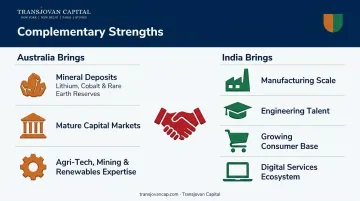
Australia brings:
- Deep lithium, cobalt, and rare earth reserves feeding global battery supply chains
- Mature capital markets and long-duration infrastructure capital
- Established expertise in agri-tech, mining services, and renewables
India brings:
- Manufacturing scale and a fast-growing engineering talent pool
- A consumer base projected to keep expanding through the 2030s
- Cost-competitive production capacity that global buyers are actively seeking
- A digital services ecosystem increasingly used for capability acquisitions abroad
Bilateral trade reached USD 24 billion in FY2023-24, according to Indian government data. "China+1" sourcing strategies are pushing more Australian and multinational buyers to treat India as a genuine manufacturing alternative, not just a market for finished goods.
The flow isn't one-directional. Indian IT services, pharma, and auto-component firms are acquiring in Australia specifically to buy developed-market credibility, technology, and distribution networks they'd otherwise take years to build organically.
Infosys's acquisition of Sydney-based cybersecurity firm The Missing Link illustrates this reverse flow. Completed in May 2025 for consideration of up to AUD 98 million, it's a capability acquisition, not a market-entry play.
Beyond isolated wins like Infosys's, the broader corridor still lacks reliable measurement. No single public source currently tracks a complete India-Australia deal count for 2024-2025. That itself is a signal — this corridor is young enough that reliable benchmarks are scarce, and each transaction is effectively writing its own playbook.
Navigating the Regulatory Maze: What Each Side Needs to Know
For Australian Acquirers Entering India
India's FDI framework isn't one uniform rule; it varies sharply by sector.
- Automatic route (up to 100%): manufacturing, mining of most metals and non-metals, and most activities not specifically restricted
- Government route required: private banking above 49% (74% cap), defence above 74%, and retail of India-made food products
- Mandatory RBI/FEMA reporting: share issuances need FC-GPR filing, transfers need FC-TRS filing, both against fixed timelines from the transaction date
Then comes competition clearance. The Competition Commission of India (CCI) reviews any qualifying combination where combined assets exceed INR 2,500 crore or turnover exceeds INR 7,500 crore, or where deal value crosses INR 2,000 crore with substantial Indian operations involved. These thresholds apply regardless of where the acquirer is based.
One genuine advantage for Australian buyers: Press Note 3, which forces the government route for investors from countries sharing a land border with India, doesn't touch Australian acquirers. That's a materially smoother path than China-linked buyers face, provided the ultimate beneficial ownership doesn't trace back to a restricted jurisdiction.
On tax, the India-Australia Double Taxation Avoidance Agreement governs how capital gains are taxed depending on asset type, while India's General Anti-Avoidance Rule can still override treaty benefits if a transaction's main purpose is judged to be tax avoidance. Structure around this before signing, not after.
For Indian Acquirers Entering Australia
FIRB approval is the gating item for most Indian acquirers, and thresholds vary sharply by asset class:
| Target type | Notification threshold |
|---|---|
| Non-sensitive service business | Above AUD 560 million |
| Other business acquisitions | Above AUD 347 million |
| Agribusiness (cumulative) | Above AUD 75 million |
| Agricultural land (cumulative) | Above AUD 15 million |
| Mining or production tenements | AUD 0 (always notifiable) |
| National security-sensitive actions | AUD 0 (always notifiable) |
Any Indian entity with state links, or pursuing a large strategic stake in critical infrastructure or critical minerals, should expect heightened scrutiny regardless of deal size. Treasury has been explicit about this: it's fast-tracking known, low-risk investors in non-sensitive sectors while directing more resources toward sensitive proposals and compliance checks.
On timing, FIRB's statutory decision period runs 30 days from a valid application, with a further 10 days to notify the outcome. That clock can be extended by up to 90 days, and often is for anything touching national security or critical minerals.
Build that buffer into your deal timeline from term sheet stage, not after signing.
Where the Deals Are Happening: Sector Hotspots
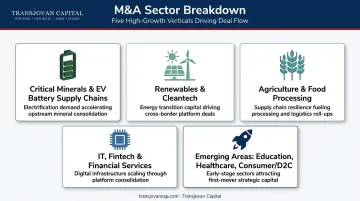
Five sectors account for most of the genuine cross-border activity right now.
Critical minerals and EV battery supply chains. Australia's lithium and cobalt reserves are a natural fit for India's EV ambitions. Austrade projections put India's lithium-ion battery demand at close to 500 GWh by 2030, with the vast majority driven by EVs and grid storage.
Renewables and cleantech. Australian capital and technology are flowing into Indian solar, wind, and green hydrogen projects. This is a sector where sector-specific M&A expertise genuinely matters. Generic dealmaking skills don't substitute for understanding power purchase agreements, tariff structures, and project-finance mechanics on both sides.
Agriculture and food processing. Australian agri-tech and cold-chain innovation pair naturally with India's food processing scale and consumption growth, an area both governments have flagged as a bilateral priority.
IT services, fintech, and financial services. Indian IT firms are acquiring Australian technology and services businesses to buy capability and market access rather than build from scratch. Australian financial services players, in turn, are exploring India for scale and distribution.
Emerging areas. Education, healthcare, and consumer/D2C brands are earlier-stage but worth watching, driven largely by India's expanding middle class and appetite for premium, quality-differentiated products.
The honest caveat: there's no single verified public dataset breaking down bilateral deal count or value by sector. What exists is a mix of demand forecasts, policy priorities, and individual deal examples. These are useful directional signals, not a substitute for sector-specific diligence on each opportunity.
Common Pitfalls: Cultural and Integration Challenges to Watch For
Regulatory clearances get all the attention. Culture is what actually kills deals late in the process.
Two areas create friction most often: negotiation style and valuation expectations.
| Flashpoint | Australian Buyers | Indian Sellers/Promoters |
|---|---|---|
| Negotiation style | Structured, timeline-driven, with clear milestones and decision gates | Relationship-driven and flexible; terms can shift even after informal agreement |
| Valuation | Conservative, risk-adjusted return models | Aggressive growth pricing reflecting years of compounding revenue |
Neither approach is wrong, but mismatched expectations about pace, formality, and growth assumptions create friction long before lawyers get involved. That gap doesn't always close in negotiation; it sometimes stalls the deal indefinitely.
Post-deal, friction typically shifts to integration:
- Talent retention: key managers under Indian promoter structures may not stay once reporting lines change
- Governance and reporting standards: Australian expectations around board composition and risk disclosure often exceed what India-only targets are used to
- Systems harmonisation: merging ERP, HR, and financial reporting systems across time zones and regulatory regimes takes longer than most integration plans assume
None of these issues are unique to this corridor. What's specific to India-Australia deals is the combination of a young dealmaking relationship and genuinely different business cultures, leaving fewer established playbooks to fall back on when friction shows up.
Best Practices for Structuring a Successful Cross-Border Deal
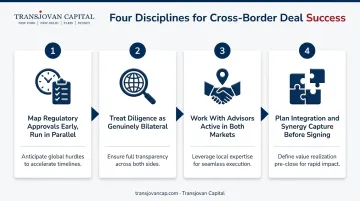
Getting an India-Australia deal to close, and to actually deliver value afterward, comes down to four disciplines.
1. Map regulatory approvals early, and run them in parallel. FIRB and CCI/RBI processes don't depend on each other, so there's no reason to sequence them. Filing both tracks simultaneously, as soon as deal terms are firm enough to support the applications, is the single biggest lever against timeline slippage.
2. Treat diligence as genuinely bilateral. Australian buyers typically expect governance and ESG disclosure standards that go beyond a purely India-focused checklist, covering board composition, climate-related risk disclosure, and audit committee practices. Building that expectation into diligence scope from day one avoids surprises that surface late and threaten repricing.
3. Work with advisors who actually operate in both markets. This corridor still lacks deep, established playbooks, which makes genuine on-ground presence more valuable than a generic global brand name. Transjovan Capital, headquartered in New Delhi with an office in Sydney, has advised Fortune 500 corporates and global names including Fortum and Sumitomo on cross-border mandates.
The firm's team also joined the Mergermarket M&A Forum Australia 2025 in Sydney, the kind of engagement that matters when timelines and regulatory nuance are unforgiving.
4. Plan integration and synergy capture before signing, not after. Firms that get post-merger integration right build it into deal structuring from the earliest stages, deciding how synergies will be tracked, who owns Day-1 readiness, and how governance will work before the ink dries. That's the logic behind a continuous, embedded approach to corporate development rather than treating M&A as a one-off event with integration bolted on afterward.
Transjovan Capital in the Indo-Australian Corridor
On the Indo-Australian corridor, Transjovan Capital's own record is a useful reference. Managing Partner Gaurav Asthana was among the 470+ private market professionals from 18 countries at the Mergermarket M&A Forum Australia 2025, held at the Four Seasons in Sydney on 9 October 2025 (release). Commenting on the Indo-Australian M&A space, he said: "Indian acquirers are targeting critical minerals in Australia to back EV and grid storage plans, and Indian IT/services firms are scaling on-shore Australian delivery via acquisitions."
Gaurav Asthana founded the firm in 2011 to concentrate on buy-side advisory for Fortune 500 and mid-market acquirers that wanted proprietary deal flow and embedded corporate development support rather than a transaction broker, and told ION Analytics (Mergermarket) that inbound mandates now account for 60-70% of the practice against 30-40% outbound. The firm has advised on $15 billion+ in cumulative transactions across 250+ clients, and took the Platinum award for Best M&A Advisory Firm at the M&A Conclave & Awards hosted by Transformance Forums in Bengaluru in October 2024 (announcement).
Frequently Asked Questions
Does the India-Australia ECTA cover mergers and acquisitions?
No. ECTA addresses trade tariffs and services access. M&A transactions still require separate approvals under India's FDI/CCI framework and Australia's FIRB regime.
What is FIRB approval and when is it required for Indian investors?
FIRB screens foreign investments above set thresholds, with lower limits for agriculture, infrastructure, and critical minerals. Indian acquirers should factor FIRB review time into deal timelines from term sheet stage.
Do Australian companies need CCI approval to acquire an Indian business?
Yes, if the deal crosses India's asset, turnover, or deal-value thresholds under the Competition Act. These thresholds apply regardless of the acquirer's home country.
Which sectors see the most India-Australia cross-border M&A activity?
Critical minerals, renewables, agriculture, and IT/financial services currently lead deal activity, though no single verified dataset tracks bilateral volume by sector.
How long does a typical India-Australia M&A deal take to close?
Timelines vary by deal size and sector, but regulatory clearances alone can add several months. Starting FIRB and CCI processes early is essential.
What are the biggest risks in India-Australia post-merger integration?
Cultural misalignment and differing governance expectations drive most of the friction, with talent retention losses close behind as deal value erodes after close.