All of this is fuelling a new wave of M&A in engineering and auto. But dealmaking here isn't simple. Many advisors underestimate three things: promoter-led ownership structures, the murky question of valuing legacy ICE revenue against EV potential, and cross-border regulatory layers that trip up even experienced teams.
This article unpacks the trends reshaping Indian auto M&A and explains how Transjovan Capital's Corporate Development as a Service (CDaaS) model, backed by a partner-led team with a track record advising Mahindra, Cummins, Dana and Apollo, is built for exactly this complexity.
Key Takeaways
- EV adoption, PLI-linked localisation, and "China+1" sourcing are reshaping Indian auto M&A
- Deal success hinges on handling family ownership, legacy-vs-EV valuation, and FDI/FEMA compliance
- Transjovan's CDaaS model delivers continuous, partner-led support rather than one-off transaction execution
- Picking an advisor means evaluating sector depth, cross-border reach, and synergy-focused outcomes
The Indian Automotive M&A Landscape: Trends Driving Dealmaking
India has become one of the world's largest automotive manufacturing bases, and dealmakers have noticed. The sector recorded a record 32 deals worth USD 1.9 billion in Q3 2024, according to Grant Thornton data reported by Economic Times Auto. It was the strongest quarterly showing the sector had seen in years.
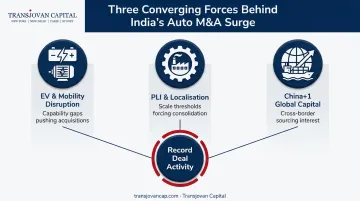
Three forces are driving this activity.
The EV and Mobility Disruption
OEMs and component makers that spent decades perfecting engines and transmissions suddenly need battery chemistry, motor design, and software expertise they don't have in-house. Building these capabilities from scratch takes too long. Buying them doesn't.
This is why EV-linked M&A has become a distinct category rather than a subset of general auto dealmaking. Deals like BII's investment in Mahindra's new EV unit, valued at over USD 9 billion, signal how much capital is chasing electrification capability rather than traditional manufacturing scale.
PLI Scheme and Localisation-Led Consolidation
The government's PLI scheme for auto and auto components carries an outlay of Rs. 25,938 crore, with over 115 applicants approved, according to the Ministry of Heavy Industries. To qualify, companies typically need to hit domestic value addition thresholds of around 50%.
That's a scale requirement many mid-sized ancillary players simply can't meet alone. The result:
- Smaller suppliers seeking acquisition by scaled players to access PLI benefits
- Mid-cap component makers merging to hit localisation thresholds together
- Larger OEMs acquiring capacity rather than building it, to move faster on incentive deadlines
Global Capital Inflow and Cross-Border Interest
India is emerging as a key pillar of the "China+1" sourcing strategy for global auto OEMs, per EY-Parthenon research cited by Economic Times. Global strategics and private equity funds are entering not just for the domestic market, but for export-ready manufacturing footprint.
Transjovan has seen this firsthand through advisory work with global engineering and auto-linked names including Cummins, Mahindra, and Dana. Japanese, European, and US strategics are increasingly scouting Indian ancillary targets as manufacturing bases they can export from, not merely as suppliers.
Why Automotive Dealmaking in India Demands Specialised Expertise
A large share of Indian auto ancillary companies are still promoter or family-run. Informal governance and succession gaps are common. According to PwC research, only around 15% of Indian family businesses have documented succession plans. That single fact changes how deals need to be run.
A generalist advisor treating this as a purely transactional exercise will hit friction fast. Build trust before discussing terms.
Balancing Legacy ICE Value with EV Transition Risk
Valuing an auto component company today means answering an uncomfortable question: how much of current revenue disappears as ICE demand declines? A pure trailing-multiple approach undervalues companies that are EV-ready and overvalues those clinging to legacy product lines.
The credible path forward:
- Build a growth narrative around EV-readiness, not just current financials
- Quantify synergy potential for the specific acquirer, not a generic buyer
- Separate revenue at risk from revenue with a clear transition pathway
Navigating FDI, FEMA and Sector-Specific Regulation
India allows 100% FDI under the automatic route in automobiles, according to Invest India. That sounds simple. It isn't, once you factor in the details.
Cross-border transactions must account for:
- FC-TRS filing requirements, with a 60-day reporting window
- PLI-linked obligations tied to ownership or control changes
- Sector-specific caps that can shift deal structuring mid-negotiation
- Valuation certificates required under FEMA pricing guidelines for share transfers
Miss one of these, and a deal that looked clean on paper stalls at closing.
Technology, IP and Manufacturing Due Diligence
Auto deals need diligence that goes deeper than financial statements. Buyers need to verify manufacturing capability and confirm who actually owns the IP. Quality certifications matter too: IATF 16949 was recently updated, with its 6th edition rules effective January 2025.
This gets more complex when a deal involves a joint venture with a global OEM requiring technology transfer or licensing agreements. Those arrangements need their own diligence track, separate from the core financial workstream.
Transjovan's Approach to Automotive Dealmaking: The CDaaS Framework
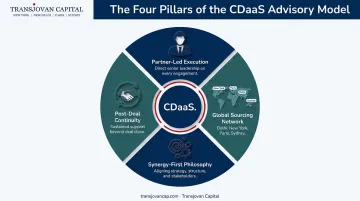
Most M&A advisors show up for a transaction and disappear once it closes. Transjovan's Corporate Development as a Service (CDaaS) model works differently. It functions as an embedded, continuous engine for M&A and growth strategy, reducing the CXO bandwidth burden that comes with running deals on top of day-to-day operations.
What makes the model work for auto sector clients:
- Partner-led execution. Senior partners lead every mandate, not junior deal teams. Managing Partner Gaurav Asthana brings 21+ years advising acquisitive corporates like Mahindra and Cummins.
- Global sourcing network. Offices in New Delhi, New York, Paris, and Sydney help source strategic buyers, JV partners, and cross-border targets for auto companies expanding into or out of India.
- Synergy-first philosophy. The team measures success through synergy capture, not deal count, building the synergy case into diligence from day one rather than bolting it on later.
- Post-deal continuity. The team's cross-functional bench, including Deoki Muchhal's Cargill India background in acquisitions and merger integration, stays engaged through post-deal synergy realisation, not just to signing.
This framework shows up in the track record: the firm has advised on USD 15+ billion in cumulative transactions across 250+ clients since 2011, with engineering and auto-linked relationships spanning Mahindra, Cummins, Dana, and Apollo among its client roster.
Deal Structures and Strategic Considerations in Auto M&A
Not every auto deal looks the same, and structure matters as much as valuation. Common deal types in Indian auto/EV dealmaking include:
- Full acquisitions: for buyers seeking complete control and integration
- Joint ventures: common where technology transfer or local market access is the priority (JSW's evolving MG Motor JV is a case in point)
- Minority stake investments: used by PE funds and strategics testing the waters before committing further
- Technology licensing partnerships: a lighter-touch option when full ownership isn't the goal
Given the uncertainty around how fast EV revenue will actually ramp up, earn-outs and milestone-linked consideration structures are becoming more common. Rather than paying full value upfront based on projected EV growth, buyers tie a portion of consideration to actual performance milestones.
Deal structure decisions don't end once payment terms are settled. Post-merger integration planning for manufacturing and supply chain synergies needs to start before the deal closes, not after.
Waiting until Day 1 to figure out plant consolidation or shared procurement wastes months of value that could have been captured immediately. Transjovan's advisory team brings this integration lens into structuring discussions early, so clients aren't scrambling to capture synergies after signing.
Choosing the Right M&A Advisory Partner for Automotive Transactions
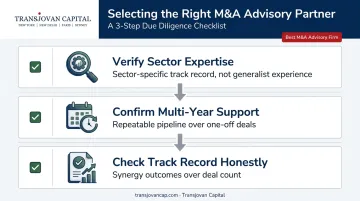
Not every advisor who's done M&A can do auto M&A well. Before engaging one, run through this checklist:
- Verify sector-specific expertise by asking for examples in industrials, engineering, and auto specifically — not just generalist deal experience that happens to include one auto transaction.
- Confirm support for multi-year mandates, since a firm that only shows up for isolated transactions won't help you build a repeatable acquisition pipeline or track synergy realisation over time.
- Check the track record honestly by looking for credible client names and synergy-based outcomes, not just a headline deal count.
Transjovan's CDaaS model is built around exactly these criteria: sector depth in Engineering & Auto, multi-year corporate development mandates, and a measurement philosophy centred on synergy capture. For companies navigating India's auto M&A complexity, that combination translates into fewer stalled mandates and clearer synergy tracking from day one.
Transjovan Capital's Track Record in Automotive M&A
Transjovan Capital's perspective on automotive M&A in India comes out of live mandates rather than desk research. As a member firm of the Indo-German Chamber of Commerce, Transjovan Capital attended its 69th Annual General Meeting in Mumbai on 24 September 2025, an event drawing over 300 senior leaders, policymakers and diplomats, where the headline panel — "Germany & India: Evolving Together" — examined how German companies are contributing to India's industrial evolution (release). Commenting on the corridor, Managing Partner Gaurav Asthana said: "German OEMs are pursuing GTM-driven acquisitions or partnerships in India. Germany's energy transition coupled with India's manufacturing drive create room for bi-directional bolt-ons." Automotive, manufacturing, engineering and renewable energy were the sectors in focus, with deal activity concentrating in automotive suppliers and Tier-1/Tier-2 ecosystem partnerships.
The firm has been buy-side by design since Gaurav Asthana set it up in 2011, built for Fortune 500 and mid-market acquirers that needed proprietary origination and embedded corporate development rather than a broker. He told ION Analytics (Mergermarket) that inbound work now runs at 60-70% of the book, with outbound at 30-40%. Auto components sit on the outbound side of that book. The firm took the Platinum award for Best M&A Advisory Firm at the M&A Conclave & Awards hosted by Transformance Forums in Bengaluru in October 2024 (announcement).
Frequently Asked Questions
How much do M&A advisors charge?
Fees typically combine a retainer with a success fee tied to deal value, often following a modified Lehman formula. The exact structure varies based on mandate scope, sector complexity, and whether it's a one-off transaction or a continuous engagement model.
What is driving M&A activity in India's automotive sector right now?
Multiple forces are converging: OEMs need new EV technology capabilities, PLI-linked localisation rules are consolidating the supplier base, and global "China+1" strategies are bringing fresh capital into the sector.
How is the EV transition changing valuation of automotive companies in India?
Valuation is shifting away from pure ICE-revenue multiples. Buyers now weigh EV-readiness and technology capability, judging synergy potential case-by-case rather than against generic industry benchmarks.
What is Corporate Development as a Service (CDaaS)?
It's an embedded, continuous model for M&A and strategy support, functioning as an extension of a company's internal corporate development team rather than a traditional one-off deal advisory engagement.
Do global OEMs need a local advisor for entering the Indian auto market?
Local regulatory knowledge and promoter relationship management matter enormously in India, as does cultural fluency with founder-led businesses. Combining that local grounding with cross-border deal experience gives global entrants a real advantage over going it alone.
How long does an automotive M&A deal typically take to close in India?
Straightforward acquisitions can close in a few months. Complex, regulator-heavy, or cross-border transactions involving FEMA compliance and CCI review commonly take over a year.