Introduction
Walk into any boardroom discussing capacity expansion in India right now, and the conversation inevitably turns to buying rather than building.
Production-linked incentive schemes, the China+1 sourcing shift, and Make in India are pushing manufacturers, auto component makers, and capital goods players toward acquisitions at a pace few anticipated three years ago.
Industrials M&A in India hit $7.98 billion across 166 deals in 2025, up sharply from $3.22 billion across 197 deals in 2024, according to EY's India M&A report. Fewer deals, far more capital deployed per transaction.
But industrials deals don't behave like consumer or software transactions. Plant liabilities, environmental consents, and sector licensing add layers most generic M&A playbooks ignore.
This guide covers regulatory structuring, valuation approaches, diligence priorities, integration, and how to pick an advisory partner for an industrials transaction in India.
Key Takeaways
- Capacity expansion, import substitution, and supply-chain shifts are driving industrials M&A in India
- FEMA, CCI, and sector licensing rules shape deal timelines and structuring choices
- Valuation hinges on EBITDA normalisation and capex cycles, not revenue multiples
- Environmental liabilities and plant condition drive most diligence failures
- Sector-embedded advisory improves buyer quality and integration outcomes
Why Industrials M&A Is Accelerating in India
Three forces are converging:
- PLI: Anchored ₹1.46 lakh crore of investment and 1,300+ manufacturing units as of the 2024 year-end review, though delivery has been uneven, with steel and solar projects missing targets
- China+1 sourcing: Pushed India's mobile-phone production from 60 million units in 2015 to 310 million by 2022
- Domestic demand: Auto, capital goods, and building materials are climbing regardless of the export story
Why acquisition beats greenfield right now:
- Regulatory approvals for new industrial land and environmental clearances routinely stretch commissioning timelines
- Bolt-on acquisitions bring existing licences, trained labour, and customer contracts already in place
- Capacity is immediately usable rather than ramping over multiple quarters
Active Cross-Border Corridors
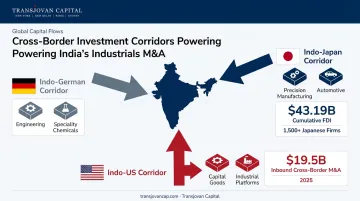
Three corridors dominate the deal flow:
- Indo-Japan: Precision manufacturing and automotive. Japan remains India's fifth-largest cumulative FDI source at $43.19 billion since 2000, with roughly 1,500 Japanese firms operating in India
- Indo-German: Engineering and speciality chemicals, building on a decade of steady deal activity between the two markets
- Indo-US: Capital goods and industrial platforms, part of the $19.5 billion in inbound cross-border M&A India recorded in 2025
Buyers fall into three camps: global industrial conglomerates seeking Indian manufacturing footholds, PE-backed platforms rolling up fragmented sub-sectors, and large Indian promoter groups consolidating vertically.
This is exactly the deal flow Transjovan Capital's industrials practice operates in. The firm's Managing Partner, Gaurav Asthana, has served as a preferred buy-side advisor for corporations including Mahindra, Legrand, Altana, and Cummins. These names sit squarely in the engineering, auto components, and speciality chemicals space this wave of consolidation is built around.
Regulatory & Deal Structuring Essentials for Industrials Transactions
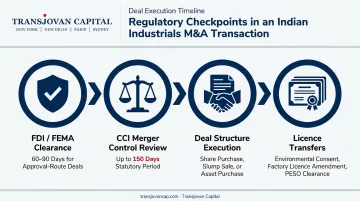
Getting the structure right at term-sheet stage saves months later. Three checkpoints matter most for industrial targets: FDI clearance, CCI approval, and deal structure choice.
FEMA and Sectoral FDI Considerations
Most manufacturing sub-sectors sit under the 100% automatic FDI route, requiring no prior government approval. Exceptions exist:
- Defence-linked manufacturing: automatic only up to 74%; beyond that, government approval is required where the deal grants access to sensitive technology
- Investors from land-border-sharing countries: government route applies regardless of the target's sector
- Chemicals: no blanket FDI cap, but product-specific licensing and environmental clearances can still gate the deal
Approval-route clearances typically add 60–90 days to a transaction timeline, so flag these early during structuring, not at closing.
CCI Review and Merger Control
A CCI filing is triggered when parties cross asset or turnover thresholds, or when the transaction value exceeds a set benchmark.
| Test | 2024 Threshold |
|---|---|
| Parties' assets (India) | Over ₹2,500 crore |
| Parties' turnover (India) | Over ₹7,500 crore |
| Deal-value threshold | Above ₹2,000 crore, with substantial Indian operations |
| Statutory review period | 150 days (down from 210) |
Consolidating sub-sectors draw closer scrutiny. In one of the most cited cases, CCI required Holcim and Lafarge to divest 5.1 million tonnes of cement capacity before clearing their India merger. Specialty chemicals deals have received similar overlap scrutiny in more recent CCI orders.
Choosing the Right Deal Structure
Structure choice depends on what you're actually buying: a legal entity or an operating unit.
| Structure | Best suited when | Key consideration |
|---|---|---|
| Share purchase | Preserving existing contracts, licences, vendor terms matters | Target entity survives unchanged; historic liabilities transfer with it |
| Slump sale | Carving out a single plant or business line cleanly | Undertaking transfers as a whole; licences and employees typically transfer too |
| Asset purchase | Buyer wants only selected assets, not liabilities | Contracts, permits, and employees each need individual transfer steps |
Industrial businesses lean toward slump sale for clean single-unit carve-outs, and share purchase when continuity of licences and vendor relationships is non-negotiable.
Licence transfer timing is easy to underestimate. Pollution control board consents, factory licences, and PESO clearances for chemicals plants each follow different rules:
- Environmental clearances can be transferred by application to an eligible new owner
- Factory licences often require formal amendment (name, address, occupier change) at the state level
- Some PESO licences, such as SMPV(U), cannot transfer at all — the new occupier must apply fresh
These aren't paperwork formalities. They're common causes of closing slippage when left until the final weeks.
Valuation & Due Diligence Priorities for Industrial Targets
Valuation Benchmarks Specific to Industrials
Industrial targets get valued on EV/EBITDA, not revenue multiples. Why? Revenue tells you nothing about capex intensity, cyclicality, or how much of that top line converts to cash.
The multiple itself moves with the business's exposure to commodity cycles, capex requirements, and how promoter-run the business has historically been. Before applying any multiple, EBITDA needs normalisation for:
- Deferred or one-time capital expenditure that masks true ongoing maintenance costs
- Related-party transactions common in promoter-led businesses: inflated or deflated pricing on inter-group sales, rent, or services
- Owner-linked expenses, such as personal costs or family salaries, run through company books
Buyer type also shifts pricing outcomes. Strategic acquirers often pay up for synergy and market access; PE-led buyers typically underwrite on standalone cash flow and push harder on normalised EBITDA. That gap shows up repeatedly in competitive mid-market processes, even where headline multiples look similar.
Due Diligence Red Flags Unique to Industrials
Once pricing expectations are set, diligence determines whether that price actually holds. Four areas cause the most trouble post-LOI:
- Environmental liabilities and land title: unresolved contamination, unclear title, or unpermitted expansions
- Plant and equipment condition: remaining useful life, deferred maintenance, obsolescence risk
- Customer and vendor concentration: a handful of accounts driving disproportionate revenue
- Labour law compliance: contract labour classification, provident fund compliance, historic Section 25FF exposure
Land and permits deserve particular attention. Confirming marketable title, encumbrances, and permitted land use is where many deals stall or reprice late in the process. Environmental clearance status, and whether it transfers with the sale or requires a fresh application, should be resolved during diligence, not discovered at signing.
Post-Merger Integration for Industrial Companies
Industrial PMI looks nothing like consumer or software integration. There's no brand refresh or tech-stack migration driving the timeline. Instead, three things matter:
- Plant network rationalisation — deciding which facilities consolidate, expand, or wind down
- Vendor and supplier consolidation — capturing procurement synergies without disrupting supply continuity
- Capacity utilisation optimisation — matching combined output to actual demand rather than running redundant lines
Beyond these levers, safety, quality, and compliance harmonisation (ISO certifications, factory compliance registers, pollution control renewals) needs sequencing early. Get this wrong and production halts, which erases value faster than almost anything else in an industrial deal.
Workforce integration is the other pressure point. Shop-floor retention and union relationships, particularly where the target has established collective agreements, need a plan before close, not after. Treating this as a Day-100 problem instead of a Day-1 readiness item is one of the most common causes of value erosion in industrial PMI.
This is exactly where Transjovan Capital's Synergy PMO practice adds value, building Day-1 readiness for industrial clients instead of scrambling after close.
Choosing the Right M&A Advisory Partner for Industrials Deals
Generalist banks can run a process. What they often can't do is recognise, at a glance, whether a plant's EBITDA is genuinely sustainable or propped up by deferred maintenance. Sector-specialised advisory closes that gap through pattern recognition on plant valuation, existing relationships with strategic buyers in the relevant sub-sector, and faster navigation of licensing and Competition Commission of India (CCI) questions.
Transjovan Capital operates its industrials practice through a Corporate Development as a Service (CDaaS) model: an embedded, multi-year extension of a client's corporate development function rather than a one-off deal engagement. The team includes:
- Chetan Tolia, Senior Advisor, who led Tata BlueScope Steel as CEO (forming the 50:50 joint venture between BlueScope Steel and Tata Steel) and previously headed Strategy & Planning at Tata Steel
- Nupur Mandal, Senior Vice President, who has advised on cross-border transactions ranging from $100 million to $1 billion, with concentrated experience across industrials and manufacturing
Before mandating any advisor for an industrials search, evaluate them on:
- Completed industrials transactions in the specific sub-sector, not adjacent ones
- Senior team operating backgrounds: have they actually run a plant or led a JV, or only advised on paper?
- Active buyer relationships with strategic and PE-backed platforms in that sub-sector
A team with hands-on Tata Steel or Tata BlueScope-type operating history brings something a pure transaction banker cannot: judgment on what a plant is actually worth.
Transjovan Capital's Track Record in Industrials M&A
How Transjovan Capital reads industrials M&A in India is a matter of public record. Gaurav Asthana founded the firm in 2011 to concentrate on buy-side advisory for Fortune 500 and mid-market acquirers that wanted proprietary deal flow and embedded corporate development support rather than a transaction broker, and told ION Analytics (Mergermarket) that inbound mandates now account for 60-70% of the practice against 30-40% outbound. Inbound mandates come from Europe, the US, Japan and Southeast Asia — concentrated in electronics manufacturing, specialty chemicals, building materials and consumer — while outbound work takes Indian acquirers into Continental Europe, the US, Southeast Asia, the Middle East and Africa across high-tech, IT/ITeS, healthcare analytics, auto components and industrials.
Asthana has also put numbers to the valuation gap, telling ION Analytics (Mergermarket) that Indian multiples in high-growth sectors sit roughly 50% above Western comparables, underpinned by sector growth of 14-15% — close to twice India's GDP growth. Its cumulative record runs to $15 billion+ in transactions across 250+ clients, and was named Best M&A Advisory Firm at the Platinum tier of the M&A Conclave & Awards, run by Transformance Forums in Bengaluru in October 2024 (announcement).
Frequently Asked Questions
Who is the top M&A advisor in India?
It depends on sector fit. Large banks generally lead on aggregate deal value across all industries, while sector-focused boutiques such as Transjovan Capital handle a sizable share of cross-border industrials and engineering mandates, backed by deeper buyer networks and operator-led teams averaging 20+ years of experience.
How much do M&A advisors charge in India?
Fees typically combine a retainer with a success fee tied to deal value. The exact structure varies by deal size, complexity, and whether you're engaging a boutique or a large bank.
What is the FDI limit for industrials and manufacturing companies in India?
Most manufacturing and industrials sub-sectors permit 100% FDI via the automatic route. Defence-linked manufacturing is capped at 74% automatic, with government approval needed beyond that.
Which deal structure is best for an industrials acquisition — asset, share, or slump sale?
It depends on intent. Slump sale suits a clean single-unit carve-out, share purchase preserves existing licences and contracts, and asset purchase works when you want selective assets without inherited liabilities.
How long does an industrials M&A deal typically take to close in India?
Timelines vary widely by deal complexity, but CCI approval (up to 150 days statutory), sectoral licence transfers, and environmental clearances are the most common causes of extended closing periods.
What are the biggest risks in industrials M&A due diligence?
Environmental liabilities, land title issues, plant and equipment condition, and customer or vendor concentration are the most frequent sources of post-LOI renegotiation or deal collapse in industrial transactions.