Introduction
EV Sector M&A in India means the buying, selling, and consolidation of ownership across electric vehicle OEMs, battery manufacturers, charging infrastructure operators, and component suppliers. It is not the same as a funding round.
This matters to promoters, PE/VC investors, and corporates evaluating a buy-side or sell-side move because the EV ecosystem is capital-intensive and regulated in ways generic auto M&A is not. Battery IP, FEMA treatment, and CCI review all change the playbook.
Yet most headlines cover funding rounds, not the mechanics behind them. Very few explain how EV M&A deals actually get structured, priced, and closed. This article covers what EV M&A is, why it is accelerating in India, how deals move from term sheet to integration, what drives valuation, and where founders and acquirers commonly go wrong.
Key Takeaways
- EV M&A spans battery makers, charging networks, and suppliers, not just OEMs.
- Capital-intensive PLI and FAME rules are forcing startup consolidation.
- FEMA, CCI, and sectoral approvals add regulatory checkpoints unique to EV deals.
- EV-tech valuations use revenue multiples; manufacturing uses EBITDA multiples.
- Sector-experienced advisory improves pricing accuracy and deal outcomes
What Is EV Sector M&A in India?
EV Sector M&A refers to the transfer of ownership or control between companies across the EV value chain, through acquisition, merger, or strategic stake purchase. This covers OEMs (two, three, and four-wheeler), battery cell and pack makers, charging infrastructure operators, motor and component suppliers, and EV-enabled fintech or software platforms.
The intent behind most of these deals is simple: buy speed. Acquiring an existing battery chemistry patent, a working dealer network, or an already-homologated vehicle platform is faster than building any of it from scratch.
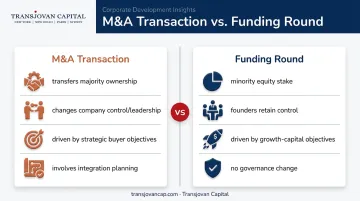
That need for speed is often mistaken for something else. M&A is not the same as a funding round. A Series B or growth-equity cheque typically buys minority equity without transferring control. M&A does the opposite — it changes who runs the company. Treating the two interchangeably is one of the most common mistakes founders make when talking to acquirers.
Where the Deal Activity Concentrates
Four sub-segments account for most announced transactions:
- Two and three-wheeler OEMs
- Battery manufacturing and recycling
- Charging network operators
- Component and EV-software suppliers
These four segments have deep roots. India's EV M&A maturity curve goes back further than most assume — Mahindra & Mahindra's 2010 agreement to acquire 55% of Reva Electric Car Company is among the earliest credible EV control transactions on record [7].
Greaves Cotton's 2018 purchase of 67% of Ampere Vehicles for ₹77 crore is the deal most often cited as the sector's dedicated two-wheeler precedent [9]. Greaves later added another 13.89% and eventually absolute control, showing how EV stake-building often happens in stages rather than one clean transaction.
This staged approach isn't limited to outright buyouts. EV M&A also includes joint ventures and cross-border technology tie-ups. A JV can secure the same battery or motor technology access with far less integration risk than a full acquisition.
Why M&A Is Accelerating in India's EV Sector
Government policy has created a paradox: it has opened a massive opportunity while raising the capital bar for staying in the game alone.
NITI Aayog frames India's EV transition as a $200 billion opportunity, with EV sales climbing from roughly 50,000 units in 2016 to 2.08 million in 2024 [11]. That growth curve is real. But the compliance and investment thresholds behind it are steep.
- ACC Battery PLI: ₹18,100 crore for 50 GWh of cell capacity, requiring ₹225 crore/GWh within two years and value addition rising from 25% to 60% within five years [3]
- Auto and Components PLI: ₹25,938 crore outlay through FY2026-27, tied to 50% domestic value addition on approved products [42]
- FAME II: Closed 31 March 2024 after supporting 1,671,606 EVs, including over 1.4 million electric two-wheelers [40]
- PM E-DRIVE: ₹10,900 crore successor scheme running through March 2026 [40]
When Companies Can't Keep Up
Smaller OEMs and charging-infra players often cannot self-fund these localisation timelines. The result is a familiar pattern:
- Overvalued cap tables from earlier funding rounds that follow-on investors won't match
- Stalled capacity expansion because localisation capex requirements outpace available cash
- Quality and safety issues from under-resourced manufacturers cutting corners
This is exactly where distress becomes an M&A catalyst. Hero Electric entered insolvency proceedings in December 2024 over an initial ₹1.85 crore default, with admitted creditor claims later exceeding ₹301 crore [179]. Gensol EV Lease followed a similar path into NCLT proceedings after a reported ₹218.95 crore default [109].
Neither is a completed acquisition yet, but both illustrate why strategic buyers are increasingly circling undercapitalised EV assets rather than waiting for organic recovery.
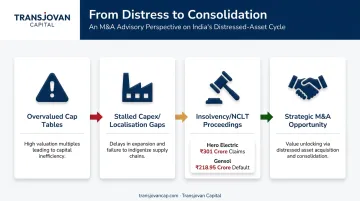
M&A solves what organic growth cannot: instant access to battery IP, an existing dealer network, or manufacturing capacity that would otherwise take years to build. As the ecosystem matures past its pure growth-capital phase, strategic consolidation is becoming the more practical route.
How EV M&A Deals Work in India (Process Flow)
At a high level, an EV M&A transaction moves through target identification, valuation, regulatory clearance, and post-close integration. What sets it apart from a generic auto deal is the diligence checklist: battery and technology IP ownership, homologation and safety certifications, raw material supply agreements, and promoter continuity plans all get scrutinised well before term sheet.
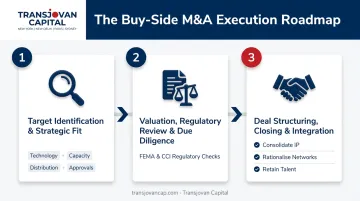
Step 1: Target Identification and Strategic Fit Assessment
Buyers screen targets on four criteria:
- Technology differentiation, such as battery chemistry and motor efficiency
- Production capacity already installed or readily scalable
- Distribution reach across dealer and service networks
- Regulatory approvals already secured, including homologation certificates
A target with existing homologation certificates or PLI-qualified capacity is worth materially more than one still awaiting clearance: that head start alone can shave months off a buyer's own timeline.
Step 2: Valuation, Regulatory Review, and Due Diligence
This is where EV deals diverge most from conventional auto M&A. Diligence teams dig into battery safety compliance, IP ownership chain, raw material supply contracts, and regulatory clearance timelines under FEMA and the Competition Commission of India (CCI).
On FDI, EV manufacturing largely qualifies for the 100% automatic route, meaning no prior government approval is needed for most manufacturing investment, subject to standard cross-border restrictions [26].
On CCI, thresholds were revised in March 2024:
| Test | Threshold |
|---|---|
| Parties in India | Assets over ₹2,500 crore or turnover over ₹7,500 crore |
| Group in India | Assets over ₹10,000 crore or turnover over ₹30,000 crore |
| Deal value | Transaction value over ₹2,000 crore with substantial India operations |
CCI's review of JSW Ventures Singapore's proposed acquisition of up to 38% of MG Motor India, which examined horizontal and vertical overlaps before approval, is a useful precedent for how sub-segment consolidation gets scrutinised [87].
A sector-specialised advisor typically surfaces these risks earlier than a generalist would. Transjovan Capital's Emerging Technology practice, which covers EV Mobility alongside Cleantech and Advanced Manufacturing, is built around exactly this kind of diligence: spotting battery IP gaps or supply-chain dependency before they become closing conditions.
Step 3: Deal Structuring, Closing, and Post-Merger Integration
Buyers choose between an asset purchase, share purchase, or JV formation, depending on how much of the target's liabilities they want to inherit. Post-close, integration priorities generally follow this order:
- Consolidate technology and IP ownership
- Rationalise dealer or service networks
- Retain talent, particularly engineering and homologation specialists
Key Factors Shaping EV M&A Valuations and Deal Structures
Valuation in EV M&A isn't one formula. It shifts by sub-segment. EV-tech and software-heavy targets get priced on revenue multiples; component and manufacturing-heavy targets get priced on EBITDA. The factors buyers weigh most heavily include:
- Battery IP and raw material dependency — India imports nearly all its cobalt, lithium, and nickel, plus 60% of its graphite, making sourcing terms a key valuation lever [73]
- Charging infrastructure maturity — continued reliance on subsidy cycles like FAME's phase transitions affects deal timing and target readiness
- Component supply chain maturity — semiconductor and motor sourcing remains a key operational dependency; India had approved 10 semiconductor projects worth ₹1.60 lakh crore by August 2025 [191]
- Production scale and unit economics — many early-stage EV targets still lack proven throughput at acquisition
- Regulatory constraints — FEMA's automatic-route treatment, PLI localisation thresholds, and CCI sensitivity in concentrated sub-segments
Batteries alone account for close to 40% of an EV's capital cost, which is why battery-related IP and supply terms so often become the single biggest swing factor in final pricing [11].
Common Challenges and Misconceptions in EV M&A
Misconception 1: EV M&A doesn't follow the same playbook as auto M&A. Battery IP, charging infrastructure, and embedded software all require valuation and diligence approaches a generic auto deal team won't naturally apply.
Misconception 2: A funding round and an M&A deal aren't interchangeable. A minority growth-equity cheque and a control transaction carry different governance implications, pricing logic, and investor expectations. Confusing the two leads straight to mispriced negotiations.
The overvaluation trap. Startups that raised aggressively in earlier funding cycles often can't clear that bar when follow-on capital dries up. That gap frequently pushes them into down-round or distressed M&A rather than a clean strategic sale — a pattern visible in several of the insolvency cases noted earlier in this article.
When M&A isn't the right call. If a target lacks defensible IP or hasn't secured its regulatory clearances, a full acquisition may carry more integration risk than it's worth. A JV or strategic partnership can often deliver the same technology access with a fraction of the closing complexity.
Transjovan Capital's Work in Electric Vehicles and Clean Mobility
On electric vehicle M&A in India, Transjovan Capital's own record is a useful reference. The firm attended the Indo-French Chamber of Commerce and Industry's 48th Annual General Meeting in Mumbai on 26 September 2025 — themed "Innovating for Tomorrow" and drawing 400+ C-suite leaders from BNP Paribas, Capgemini, Saint-Gobain, Schneider Electric and TotalEnergies (release). Indo-French transaction value has passed USD 10 billion over the last three years, and Managing Partner Gaurav Asthana framed the fit as one where "France's strategic focus on clean tech, renewables, and industrial innovation aligns with India's manufacturing and green-energy push."
As a member firm of the Indo-German Chamber of Commerce, Transjovan Capital attended its 69th Annual General Meeting in Mumbai on 24 September 2025, an event drawing over 300 senior leaders, policymakers and diplomats, where the headline panel — "Germany & India: Evolving Together" — examined how German companies are contributing to India's industrial evolution (release). Commenting on the corridor, Asthana said: "German OEMs are pursuing GTM-driven acquisitions or partnerships in India. Germany's energy transition coupled with India's manufacturing drive create room for bi-directional bolt-ons." On the Australian side, Asthana has pointed to Indian acquirers "targeting critical minerals in Australia to back EV and grid storage plans" (release). The firm has advised on $15 billion+ in cumulative transactions across 250+ clients, and took the Platinum award for Best M&A Advisory Firm at the M&A Conclave & Awards hosted by Transformance Forums in Bengaluru in October 2024 (announcement).
Frequently Asked Questions
Who is the market leader in electric vehicles in India?
Leadership varies by segment. In FY2025, Ola Electric led two-wheelers with a 29.76% share, Mahindra Last Mile Mobility led both passenger and cargo three-wheelers, and Tata Motors led electric passenger cars with 53.10% share.
What is driving M&A activity in India's EV sector?
Policy incentives like PLI and FAME are raising capital and localisation requirements beyond what many startups can meet alone. That gap is pushing undercapitalised OEMs and charging-infra players toward strategic or distressed consolidation.
How does FEMA and CCI regulation apply to EV M&A deals in India?
EV manufacturing largely qualifies for the 100% automatic FDI route, removing the need for prior government approval. CCI separately reviews deals for market concentration when the transaction crosses asset, turnover, or deal-value thresholds.
What valuation multiples are typically used for EV companies in India?
EV-tech and software-heavy targets are generally priced on revenue multiples, while manufacturing-heavy targets lean on EBITDA multiples. Reported IPO benchmarks for Ola Electric and Ather Energy sit around 6-7x revenue, though these are equity-market references, not direct M&A transaction multiples.
Is an EV M&A transaction different from an EV startup funding round?
Yes. M&A involves a transfer of ownership or control, while a funding round is typically a minority capital infusion that leaves existing control structures intact.
Why should EV companies work with a sector-specialized M&A advisor?
Specialised advisors bring EV-specific valuation benchmarks, FEMA/CCI regulatory fluency, and buyer networks that generalist advisors typically lack. Transjovan Capital's Emerging Technology practice, spanning EV Mobility, Cleantech, and Advanced Manufacturing, offers exactly this sector depth.