Roughly 22 active ingredients are expected to lose patent protection between 2021 and 2030, opening a market worth an estimated $4.1 billion by 2026 for generic and off-patent products. That single fact is reshaping who buys whom, and where.
For promoters, investors, and global majors, understanding these shifting M&A currents isn't optional anymore. It's the difference between leading consolidation and reacting to it. This article breaks down the deals, the drivers, and what comes next.
Key Takeaways
- UPL, PI Industries, and Safex are acquiring scale, technology, and distribution globally
- Patent cliffs and China-plus-one sourcing are driving global players toward Indian manufacturing
- Biologicals and digital agronomy are emerging as a distinct, faster-growing deal category
- TEPA and other trade pacts are easing market access for cross-border agrochemical deals
- Agrochemicals posted valuation gains in H1 2025 while other chemical subsectors declined
Consolidation & Scale-Building by Indian Agrochemical Majors
Indian agrochemical companies aren't waiting for organic growth to catch up with global competitors. They're buying their way into scale, proprietary technology, and broader crop protection, biologicals, and seeds portfolios. The logic is straightforward: R&D costs are climbing, margins are tightening, and global registrations take years to build from scratch.
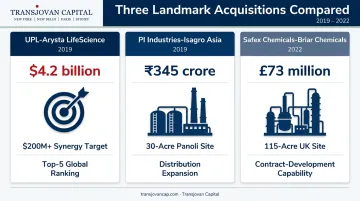
Three deals define this trend:
- UPL–Arysta LifeScience (2019): UPL completed its $4.2 billion acquisition of Arysta, pushing the combined entity into the world's top-five agrochemical players and targeting over $200 million in annual synergies.
- PI Industries–Isagro Asia (2019): PI completed this acquisition for roughly ₹345 crore plus surplus cash, adding a 30-acre Panoli manufacturing site and strengthening its domestic distribution reach.
- Safex Chemicals–Briar Chemicals (2022): Safex paid £73 million for the UK-based manufacturer, gaining a 115-acre site and contract-development capabilities as part of its shift toward a fully integrated model.
Why Mid-Sized Players Are Going Outbound
Not every company can compete at billion-dollar scale, but mid-sized firms face a related pressure: the raw economics of discovering new chemistry. New active ingredient discovery now costs an estimated $307 million and takes 11.4 years on average, up sharply from $152 million in the mid-1990s. That kind of spend is unworkable for most mid-sized firms acting alone.
The response has been inorganic growth, including outbound moves. UPL's 40% stake in Brazil's Sinagro Group and its Bioquim acquisition across Central America show one path. GSP Crop Science's 2023 Brazilian subsidiary shows a smaller player testing the same market without a full acquisition. Expect more of both.
Global & Cross-Border Interest in Indian Agrochemical Assets
Patent expirations are drawing multinational attention toward Indian manufacturers known for low-cost, high-quality production at scale. Add tightening environmental rules in China and the West, and India's manufacturing appeal only grows stronger.
This activity spans more than a decade and continues to build:
- Sumitomo Chemical acquired agrochemical manufacturer New Chemi Industries in 2010, an early signal of Japanese interest in Indian capacity
- Otsuka Agritechno formed a 70:30 R&D joint venture with Insecticides India in 2012, committing up to ₹100 crore over three to four years toward a Bhiwadi research centre
- BASF's Nunhems closed its acquisition of Noble Seeds in 2026, adding cauliflower and radish seed lines and deeper North India coverage
- FMC Corporation agreed to divest its India commercial crop-protection business to Crystal Crop Protection for $252 million, signed May 2026
Entry And Exit, Not a One-Way Street
That last point matters. Not every cross-border move is a foreign entrant buying into India. FMC's divestment shows a global major reallocating its portfolio toward core growth markets and debt reduction, while Crystal gains an established commercial platform. Both dynamics, entry and exit, are playing out simultaneously.
Beyond individual deal dynamics, trade policy is reinforcing this broader pull toward India. The India-EFTA Trade and Economic Partnership Agreement, effective October 2025, brings zero or reduced tariffs on 95% of Indian exports to Iceland, Liechtenstein, Norway, and Switzerland. It also carries a binding commitment of $100 billion in investment over 15 years.
Combined with India's manufacturing cost advantages, more European and Japanese players are now exploring India-linked deals instead of building capacity elsewhere.
Rise of Biologicals, Sustainable Ag-Tech, and Specialty Deal Activity
Traditional crop protection isn't the only game in town anymore. Biologicals, biopesticides, and digital agronomy tools are carving out their own deal category, and it's growing fast.
Recent activity illustrates the range of approaches:
| Deal | Date | Structure |
|---|---|---|
| IPL Biologicals, Mitsui & Co. India, and Ag Smart Philippines | July 2025 | Tripartite partnership for biopesticide registration, marketing, and distribution in the Philippines |
| CropX acquires Acclym (formerly Agritask) | September 2025 | Acquisition integrating agri-intelligence and sustainable-procurement tools into CropX's platform |
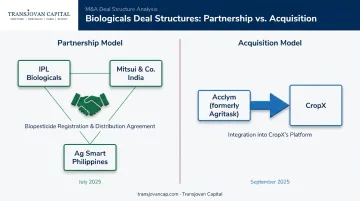
Not every capability-building move is M&A, and that distinction matters when assessing deal flow. Partnerships extend reach quickly; acquisitions buy control.
Why Valuations Are Holding Up
That premium for control also shows up in valuation multiples. According to CFI Group's H1 2025 Specialty Chemicals Market Review, agrochemicals was the only chemical subsector to post valuation gains year-over-year, with TEV/Revenue up 6.6% and TEV/EBITDA up 5.9%. Compare that to cosmetics chemicals (down 30.7% on TEV/Revenue) or pharmaceuticals (down 6.1%).
Resilient food demand and defensive business models explain the gap. Investors are pricing sustainability-linked and technology-enabled agrochemical assets at a premium over legacy commodity chemical businesses, and that premium shows no sign of narrowing soon.
What's Driving These Agrochemical M&A Trends in India
Three forces are converging, and none of them work in isolation.
- Patent cliffs and rising costs. Discovery now costs nearly $307 million per molecule, pushing both Indian and global players toward acquisitions instead of organic development.
- Regulatory divergence. Stricter environmental norms abroad, paired with India's cost advantages, are redirecting manufacturing investment toward the country.
- Policy tailwinds. Trade deals like TEPA are lowering tariff barriers, and a proposed basic-chemicals PLI scheme signals further support, though no agrochemical-specific PLI has been implemented yet.
That regulatory gap is wider than it first appears. CropLife India notes the country currently offers zero years of regulatory data protection for pesticides, compared to a decade in other major markets:
| Region | Regulatory Data Protection Period |
|---|---|
| India | 0 years |
| EU, US, Australia, Brazil | 10 years |
This gap remains a point of industry advocacy, not yet resolved through legislation like the Pesticide Management Bill. Treat the proposed PLI scheme the same way: a signal to watch, not a subsidy already in hand.
Taken together, these pressures are pushing dealmaking activity higher, even where the underlying policy landscape is still evolving.
Impact & Future Outlook for Agrochemical M&A in India
Operational & Business Impact
Recent deals are forcing real integration work: combining manufacturing capacity, aligning distribution networks, and merging R&D pipelines across geographies. Indian majors are also increasingly looking outward, with Brazil emerging as a preferred expansion market given its scale and crop diversity.
This creates a genuine bandwidth problem. Corporate Development teams inside acquisitive agrochemical companies are managing cross-border due diligence, valuation modelling, and post-merger integration, often with limited internal capacity to run all three well at once.
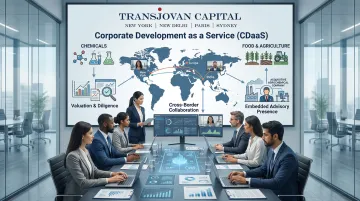
Specialist support fills that gap. Transjovan Capital's Corporate Development as a Service (CDaaS) model spans Chemicals and Food & Agriculture mandates across India, the US, and Europe. It gives stretched internal teams an embedded extension for valuation, diligence, and synergy tracking, rather than a one-off transaction advisor.
Future Outlook Signals
Watch for these indicators over the next one to three years:
- Continued private equity deployment into specialty and biologicals assets, even as broader PE dry powder totals decline globally
- Further divestment of non-core India units by global majors following FMC's move
- Rising Indian outbound interest in Latin American markets, building on UPL and GSP's early moves
Deal volumes are likely to stay selective rather than sweeping. But with agrochemicals commanding valuations that most other chemical subsectors can't match, the deals that do happen will carry outsized strategic weight.
Transjovan Capital's Track Record in Agrochemicals M&A
Transjovan Capital's published view of agrochemicals M&A in India gives the guidance above a practical grounding. Gaurav Asthana's rationale in 2011 was a buy-side practice for Fortune 500 and mid-market acquirers who wanted proprietary deal flow and corporate development capacity rather than a transaction broker. He put the current split to ION Analytics (Mergermarket) at 60-70% inbound against 30-40% outbound. The firm's corridor map reflects that: inbound flow from Europe, the US, Japan and Southeast Asia into electronics manufacturing, specialty chemicals, building materials and consumer, and outbound flow from India into Continental Europe, the US, Southeast Asia, the Middle East and Africa across high-tech, IT/ITeS, healthcare analytics, auto components and industrials.
Asthana has also quantified why Indian assets clear at the levels they do, telling ION Analytics (Mergermarket) that acquisition multiples in India's high-growth sectors run roughly 50% above Western comparables — a spread he ties to sector growth of 14-15%, close to double India's GDP growth. The firm has advised on $15 billion+ in cumulative transactions across 250+ clients, and took the Platinum award for Best M&A Advisory Firm at the M&A Conclave & Awards hosted by Transformance Forums in Bengaluru in October 2024 (announcement).
Frequently Asked Questions
How do I choose an M&A advisor for agrochemical deals in India?
Look for sector expertise across chemicals and food & agriculture, proven cross-border transaction experience, and regulatory know-how. Specialist advisors with coverage spanning both Chemicals and Food & Agriculture, such as Transjovan Capital, bring the cross-continental deal experience these complex agrochemical mandates require.
How much do M&A advisors charge for agrochemical transactions in India?
Fees typically combine a retainer with a success fee tied to final deal value. The exact structure varies based on transaction size, complexity, and how many jurisdictions are involved.
What regulatory approvals are typically required for agrochemical M&A in India?
Most deals need Competition Commission of India clearance where thresholds are met, as well as compliance with FDI sectoral norms. Any transfer of pesticide registrations under the Insecticides Act also needs separate regulatory attention.
What valuation multiples are typical in agrochemical M&A deals?
Agrochemicals have recently commanded more resilient TEV/Revenue and TEV/EBITDA multiples than most other chemical subsectors, reflecting stable food demand. H1 2025 data showed agrochemicals as the only subsector with year-over-year valuation gains.
Which companies are the most active acquirers in India's agrochemical sector?
UPL, PI Industries, and Safex Chemicals lead domestic and outbound consolidation. Global players like BASF and Sumitomo have entered through acquisitions, while FMC has divested its India commercial business to Crystal Crop Protection.
Why is due diligence especially critical in agrochemical M&A?
Product registrations, environmental compliance, IP protections, and distribution contracts all carry deal-specific risk that generic financial diligence won't catch. Missing any one of these can undermine post-closing value far more than in typical industrial transactions.