Introduction
For the fourth consecutive year, Japan's Bank for International Cooperation has ranked India the most promising mid-to-long-term overseas business destination for Japanese manufacturers. A record 61.8% of respondents named it their top pick in the FY2025 JBIC survey.
This reflects a structural reallocation of Japanese capital rather than a short-term trend.
Yet the corridor has a mixed history. High-profile transactions have unravelled over governance gaps, mismatched deal pace, and cultural friction that neither side anticipated at signing.
This article draws on Transjovan Capital's cross-border experience advising Japanese majors including Sumitomo, Honda, Hitachi, and Toyota. We unpack why this corridor is heating up, where the real opportunities sit, and how to structure deals that survive contact with reality.
Key Takeaways
- India has topped JBIC's promising-destination survey for four consecutive years
- Manufacturing, financial services, renewables, and consumer brands lead Japanese cross-border capital into India
- Japanese investors pursue both control acquisitions and minority or corporate venture capital (CVC) stakes simultaneously
- Governance and cultural misalignment remain the single biggest driver of deal failure in this corridor
Why Indo-Japan M&A Activity Is Accelerating
Consecutive years of survey data explain why Japanese capital keeps flowing into India: the numbers add up.
JETRO's FY2025 survey found that 81.5% of Japanese-affiliated companies operating in India plan further expansion, the highest share of any country covered in that study. That's up from 80.3% the year before. Momentum is building, not fading.
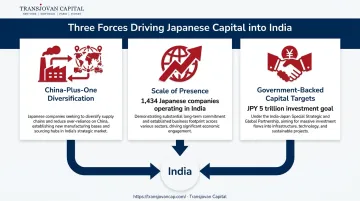
Three forces are converging:
- China-Plus-One diversification. Japanese manufacturers are actively evaluating India as they de-risk concentrated China exposure, drawn by manufacturing incentive schemes and improving cost competitiveness
- Scale of presence. Nearly 1,434 Japanese companies were operating in India as of October 2024, up from 1,399 the prior year, according to the Japanese Embassy's own count
- Government-backed capital targets. The 2022 Japan-India summit set a target of JPY 5 trillion in public and private investment and financing flowing from Japan to India over five years
Recent deal activity shows this playing out across sectors, not confined to one theme:
- MUFG's reported interest in a stake in HDB Financial Services (a proposal that HDFC Bank ultimately rejected, though it signals appetite)
- Sumitomo Corporation's 49:51 renewable energy joint venture with AMPIN, targeting 1 GW of corporate clean-power capacity, backed by roughly JPY 100 billion in project cost
- Toyota's continued commitment to EV component manufacturing and a new assembly plant in Karnataka, worth close to $400 million
This reflects long-cycle industrial planning unfolding in real time.
Sectors Leading the Indo-Japan M&A Wave
Not every sector is equally attractive to Japanese acquirers. Four stand out in current deal flow.
Manufacturing, Auto & Precision Engineering
This remains the deepest and most durable pillar of Indo-Japanese dealmaking. Nihon Nohyaku's 74% acquisition of Hyderabad Chemical Ltd set an early template for control-stake entry into Indian specialty chemicals.
Taikisha's move into cleanroom technology through its stake in Nicomac shows a similar pattern: Japanese engineering firms buying capability rather than building it from scratch. Precision manufacturing, auto components, and industrial engineering continue to draw the largest ticket sizes.
Financial Services & Fintech
Japan's megabanks have turned India into a priority market:
- SMFG acquired 74.9% of Fullerton India Credit for roughly $2 billion
- MUFG deepened its position in digital lender DMI Finance with an additional $334 million investment
- Mizuho agreed to acquire a majority stake in investment bank Avendus from KKR for up to $523 million
GIFT City has become a preferred gateway for this activity, letting Japanese banks establish IFSC-regulated units with tax benefits attached.
Renewables, Infrastructure & Deep-Tech
Japanese trading houses are using joint ventures rather than outright purchases here. This structure lets them share capital intensity and regulatory risk with local partners while still gaining exposure to India's renewable build-out. Sumitomo's AMPIN partnership is the clearest example: a shared-risk structure targeting utility-scale clean power for corporate buyers, not a standalone acquisition.
Consumer & Emerging Brands
This is the newest theme. Kirin Holdings led a $70 million funding round in craft brewer Bira 91, signalling Japanese strategics are willing to back India's Gen-Z and D2C consumer boom with growth capital, even without control.
Key Challenges in Indo-Japan Cross-Border Deals
The opportunity is real. So is the friction. Understanding where deals typically break down matters more than chasing headline valuations.
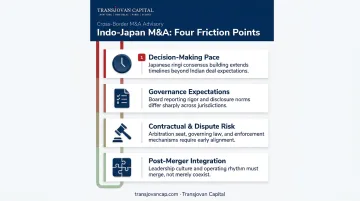
Decision-making pace is the first fault line. Japanese corporates often rely on consensus-driven internal approval processes, commonly known as ringi, that move deliberately through multiple internal stakeholders before a mandate is greenlit. Indian promoters, accustomed to faster negotiation cycles, can misread this deliberateness as hesitation or lack of intent.
Governance expectations rarely match by default. Japanese acquirers typically expect documentation depth, compliance rigour, and board reporting standards that go well beyond what many Indian promoter-run businesses maintain pre-deal. This gap surfaces during diligence, and if unaddressed, resurfaces post-close.
Two well-documented disputes illustrate what happens when contractual protections and cultural alignment fall short:
| Dispute | Tribunal | Outcome |
|---|---|---|
| NTT Docomo v. Tata Sons | London Court of International Arbitration | $1.17 billion awarded in 2016 for breach of a contractual exit right tied to Docomo's 26.5% stake |
| Daiichi Sankyo v. Ranbaxy's former promoters | Singapore-seated ICC tribunal | ~$385 million awarded in 2016 over fraudulent misrepresentation linked to the 2008 acquisition |
Both disputes pushed Japanese acquirers to insist on tighter shareholder agreements and neutral, Singapore-seated arbitration clauses in subsequent Indian deals, rather than relying on Indian courts or informal understandings.
Post-merger integration is where synergies live or die. Labour norms, reporting hierarchies, and organisational culture rarely align automatically between a Japanese parent and an Indian operating team. This is precisely why experienced, partner-led cross-border advisory, rather than transaction-only support, matters. Someone needs to manage the relationship after the ink dries, not just get the signature.
Common Deal Structures & Entry Strategies
There isn't one dominant playbook. Japanese acquirers use different structures depending on sector maturity and risk appetite.
Control acquisitions (typically 74% or higher) suit market entry into established, revenue-generating businesses:
- SMFG's 74.9% purchase of Fullerton India Credit
- Mizuho's proposed majority acquisition of Avendus
- Nihon Nohyaku's 74% stake in Hyderabad Chemical
Minority and CVC-style investments work better for building early footholds in high-growth, less mature sectors:
- Sumitomo's 49% stake in the AMPIN renewables JV
- MUFG's minority position in DMI Finance
- Kirin's growth-capital backing of Bira 91
Outside financial services, joint ventures remain the structure of choice in manufacturing and infrastructure, where shared risk and local execution speed matter more than outright ownership.
JSW Steel's $669 million JV with JFE Steel to expand electrical-steel output shows the format's staying power, even outside the strictly Japan-to-India direction.
For financial-services and fintech entry, GIFT City is emerging as a distinct gateway structure. IFSCA-regulated entities there qualify for a 100% income-tax deduction for any 10 consecutive years out of 15. This tax treatment has already drawn Mizuho and MUFG, both of which have established branches in the zone.
How Transjovan Capital Supports Indo-Japan M&A Mandates
Deals in this corridor don't fail because of bad intentions. They fail because transaction-only advisory stops exactly when the hard work begins.
That's the premise behind Transjovan's Corporate Development as a Service (CDaaS) model: a continuous, embedded engine covering strategy, buy-side M&A, Day-1 readiness, and post-merger integration, rather than a one-off transaction handoff. For deals defined by long approval cycles and relationship-driven trust-building, that continuity matters more than speed alone.
That continuity is grounded in direct experience: Transjovan's team has advised Japanese corporates, including Honda, Hitachi, Toyota, and Obayashi, alongside a cumulative track record of over $15 billion in advised transactions across four continents. Managing Partner Gaurav Asthana has been a preferred buy-side M&A advisor to Sumitomo, part of a broader client roster that spans Blackstone, Mahindra, Legrand, and Cummins.
The firm's structure supports this kind of cross-border work in practical ways:
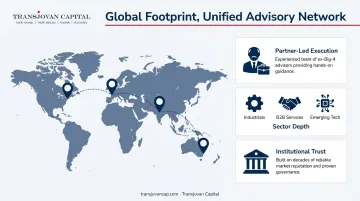
- Global office network spanning New Delhi, New York, Paris, and Sydney
- Partner-led execution by ex-Big-4 advisors and former CEOs and CFOs, not junior deal teams
- Sector depth across Industrials, B2B Services, and Emerging Technology, the exact categories driving most Indo-Japan deal flow today
- Chamber memberships, including the Indo-American and Indo-French Chambers of Commerce, that reflect a broader institutional approach to cross-border trust-building
For Japanese corporates weighing India entry, or Indian businesses preparing for Japanese capital, the difference lies in execution. A good deal only delivers synergies when someone manages the relationship after signing, not just before it.
Transjovan Capital in the Indo-Japan Corridor
How Transjovan Capital reads the Indo-Japan corridor is a matter of public record. The firm has been buy-side by design since Gaurav Asthana set it up in 2011, built for Fortune 500 and mid-market acquirers that needed proprietary origination and embedded corporate development rather than a broker. He told ION Analytics (Mergermarket) that inbound work now runs at 60-70% of the book, with outbound at 30-40%. Japan sits in the inbound half of that book, alongside Europe, the US and Southeast Asia.
Asthana has flagged Japanese acquirers among those sharpening their interest in Indian technology assets, naming Japan alongside Germany, Israel and the United States in Dataquest as sources of demand for Indian semiconductor and electronics capability. The firm was named Best M&A Advisory Firm at the Platinum tier of the M&A Conclave & Awards, run by Transformance Forums in Bengaluru in October 2024 (announcement).
Frequently Asked Questions
Why are Japanese companies increasingly investing in India?
India topped JBIC's promising-destination survey for the fourth straight year, driven largely by domestic market growth expectations. Supply-chain diversification away from China and strong consumer demand add further momentum.
What sectors attract the most Indo-Japan M&A deals?
Manufacturing, along with auto components and precision engineering, remains the largest pillar. Financial services and renewables follow closely, with emerging consumer and D2C brands growing fastest of all.
What are the biggest risks in Indo-Japan M&A transactions?
Mismatched decision-making pace, governance gaps, documentation shortfalls, and inadequate contractual protections top the list. The Tata-Docomo and Daiichi Sankyo-Ranbaxy disputes both stemmed from these root causes.
Do Japanese investors prefer minority stakes or full acquisitions in India?
Both, depending on sector maturity. Control acquisitions dominate established manufacturing and financial-services targets, while minority and CVC-style investments are favoured for early-stage, high-growth sectors like consumer and fintech.
How does India's regulatory framework impact Japanese M&A deals?
The Companies Act's beneficial-ownership rules, SEBI's takeover and disclosure norms for listed targets, and FEMA's FDI reporting requirements all shape deal structuring. Sectoral caps and entry-route rules determine how much control a Japanese acquirer can hold.
How can companies reduce the risk of failed Indo-Japan M&A deals?
Early cultural alignment reduces execution risk significantly, especially when paired with well-drafted shareholder agreements featuring neutral arbitration clauses and support from experienced cross-border advisors from the outset.