
Many engineering founders learn this the hard way. A generalist banker builds a valuation model that looks clean on paper but ignores how order backlogs convert to margin, or how a five-year capex commitment changes working capital math. By the time the gap surfaces, the deal is either mispriced or stuck.
This article breaks down why engineering M&A plays by different rules, and why founders in this sector increasingly call Transjovan Capital when the stakes are too high for a generic playbook.
Key Takeaways
- Engineering M&A demands technical fluency since IP and capex resist standard valuation
- Transjovan's CDaaS model embeds a multi-year corporate development function, not one-off deals
- Every mandate is partner-led by ex-CXOs and ex-Big 4 advisors with $15B in cumulative deals
- The firm has advised engineering giants like Cummins, Legrand, Mahindra, and APL Apollo
- Offices across the US, Europe, India, and APAC support cross-border execution few boutiques can match
Why Engineering Sector M&A Plays by Different Rules
A software company's value sits mostly in its code and recurring revenue. An engineering company's value is scattered across the plant floor, the client contracts, and the certifications that took a decade to earn. Standard financial due diligence misses most of it.
IP, Certifications, and Contracts Don't Fit a Spreadsheet
EY's research on advanced-manufacturing diligence flags a specific set of blind spots: supply-chain resilience, manufacturing moat defensibility, skilled labor availability, and capex quality (EY, Operational Diligence 2.0). None of that shows up on a trailing-twelve-month P&L.
A proprietary heat-treatment process or a decade-old ISO certification can be worth more than the balance sheet suggests. But only the right diligence team knows what to look for.
Long-cycle contracts complicate things further, especially in sectors with volatile input costs. An order book that stretches three years out looks reassuring until someone checks whether it's priced on fixed terms that a raw-material spike could eat alive.
Capex Cycles and Working Capital Swings
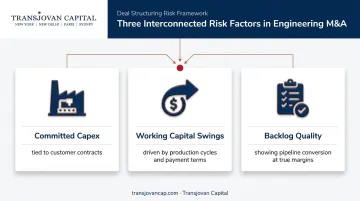
Engineering businesses are capital-hungry in ways that don't map neatly onto a discounted cash flow model built for a services business. Growth capex, maintenance capex, and working capital all move independently of revenue growth, and deal structuring has to account for each separately:
- Committed capex tied to specific customer contracts, not discretionary spend
- Working capital swings driven by long production cycles and payment terms
- Backlog quality: whether the pipeline converts at the margins advertised, not just the headline value
Get these financial mechanics wrong, and even a well-structured deal can underdeliver within the first year of ownership, eroding the returns the acquirer modeled going in.
The Cross-Border Layer
Many acquirers of Indian and APAC engineering assets are global strategics. Japanese manufacturers named India their leading expansion destination in both FY2024 and FY2025 surveys, and German firms have backed that interest with real commitments, including Volkswagen's component-supply tie-up with Mahindra.
Transjovan's own client roster (Sumitomo from Japan, Altana from Germany, Legrand from France) reflects exactly this pattern of global strategics targeting Indian engineering and industrial capability.
Add the "China+1" shift into the mix. ASEAN manufacturing FDI hit $44 billion in 2024, up nearly 150% year-over-year, with semiconductors and automotive among the sectors driving that surge (UNCTAD, ASEAN Investment Report 2025). Buyers now acquire engineering assets partly to build supply-chain redundancy, not just capacity.
A generalist advisor who doesn't grasp that rationale will underprice the strategic premium a buyer is actually willing to pay, or miss the deal entirely.
What Engineering Founders Actually Look for in an Advisor
Founders acquiring or divesting in this sector tend to prioritize a fairly consistent list, roughly in this order:
- Confidentiality: leaks spook customers, suppliers, and employees fast in a plant-floor business
- Credibility with technical buyers: a strategic acquirer's engineering team will ask questions a pure financial advisor can't answer
- Access to the right global buyer universe: not just any strategic or PE fund, but the ones who actually understand the sub-sector
- Minimal disruption to daily operations: the plant still has to ship product while the deal is being negotiated
Founders increasingly want an advisor who can speak the language of product, plant, and supply chain, not just deal finance. That's a different skill set from running a standard advisory process, and it's why the preference has shifted from one-off transactional engagements toward advisors who stay involved well past deal close.
The Transjovan Difference: Corporate Development as a Service
Most M&A advisory relationships end at closing. Transjovan built its Corporate Development as a Service (CDaaS) model around a different premise: the deal is the start of the value-creation work, not the end of it.
An Embedded Function, Not a One-Off Mandate
Instead of activating for a single transaction and disengaging at Day-1, CDaaS operates as a continuous corporate development engine spanning strategy, buy-side execution, integration, and synergy governance.
For engineering founders without an in-house M&A or corporate strategy team, this directly reduces the bandwidth burden on the CEO or CFO who would otherwise run the deal on top of running the business.
Every Mandate Is Partner-Led
Every mandate is led by a partner, not handed off to a team of junior analysts once the pitch is won. Managing Partner Gaurav Asthana has advised on $15 billion in cumulative transactions across four continents, with buy-side relationships spanning Cummins, Mahindra, Legrand, and Sumitomo.
Senior Advisor Chetan Tolia brings board and CEO-level experience across Tata Steel, Tata Power, and Tata BlueScope Steel. That operator judgment tells you whether a plant's capacity claims hold up, not just whether the numbers reconcile.

Synergy Capture Is the Real Scorecard
The clearest signal of alignment: Transjovan measures its own performance through synergy capture rather than transaction volume. That incentive structure matters. An advisor paid purely on deal closure has every reason to push a transaction through. An advisor measured on post-close synergy realization has to get the diligence and structuring right the first time.
This model sits on top of deep sector coverage across Industrials, Advanced Manufacturing, Capital Goods, and EV Mobility, sub-sectors that stand at the center of most engineering M&A activity today.
Proof Point: Engineering and Industrial Deals Transjovan Has Powered
Since its founding in 2011, Transjovan has advised 250+ clients on $15 billion-plus in cumulative transactions. Within engineering and industrial specifically, the firm has held retained buy-side mandates for:
- Cummins (USA)
- Mahindra
- APL Apollo
- Legrand (France)
- Altana (Germany)
The client roster also includes Ingersoll Rand, Schneider Electric, Caterpillar, Dana, and Johnson Controls — names that don't hand deal work to advisors without technical grounding. In 2024, the firm was recognized as "Best M&A Advisory Firm in India," independent validation of its execution track record in complex, sector-heavy transactions.
Why Technical Grounding Changes Outcomes
Boeing's $4.7 billion acquisition of Spirit AeroSystems shows how manufacturing-quality issues shape deal structure, not just price. Boeing tied the deal to strengthening manufacturing capability and supply-chain stability after its 737 MAX quality crisis.
The Airbus overlap forced a separate arrangement:
- Spirit also manufactured for Airbus, creating a conflict the deal had to resolve
- Airbus took the Airbus-related operations for a nominal $1
- Spirit provided $559 million in compensation as part of the carve-out
The lesson generalizes: in engineering M&A, operational and manufacturing realities often dictate deal structure as much as financial terms do.
On the bench side, Senior Vice President Nupur Mandal brings 17+ years of transaction experience across Industrials, Manufacturing, Semiconductor & Electronics, and Battery Manufacturing, having advised cross-border deals from $100 million to $1 billion. That's the kind of specialized depth engineering founders are looking for when they call.
Built for Cross-Border Engineering Deals
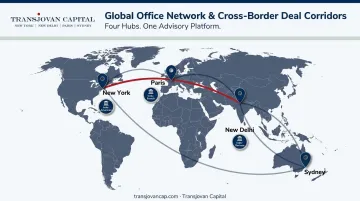
Engineering M&A rarely stays within one border for long. Transjovan operates from New York, Paris, Sydney, and New Delhi, giving it on-the-ground presence across the US, Europe, India, and APAC: the exact corridor where most engineering deal flow originates and lands.
That footprint is backed by active membership in the Indo-American, Indo-French, and Indo-German Chambers of Commerce. These networks matter when an Indian engineering founder is building trust with a Japanese, German, or American strategic acquirer evaluating a regulated, technical asset.
The practical benefit for founders:
- Faster identification of the right buyer or investor universe, rather than a generic outreach list
- Local presence that shortens the trust-building timeline foreign acquirers usually require
- Regulatory and cultural fluency across each region, rather than relying on a single domestic playbook
For an engineering founder eyeing an outbound acquisition, or fielding inbound interest from a global strategic, that combination of local presence and sector fluency is difficult for a single-office boutique to replicate.
Transjovan Capital's Track Record in Engineering M&A
How Transjovan Capital reads engineering M&A in India is a matter of public record. The firm has been buy-side by design since Gaurav Asthana set it up in 2011, built for Fortune 500 and mid-market acquirers that needed proprietary origination and embedded corporate development rather than a broker. He told ION Analytics (Mergermarket) that inbound work now runs at 60-70% of the book, with outbound at 30-40%. Inbound mandates come from Europe, the US, Japan and Southeast Asia — concentrated in electronics manufacturing, specialty chemicals, building materials and consumer — while outbound work takes Indian acquirers into Continental Europe, the US, Southeast Asia, the Middle East and Africa across high-tech, IT/ITeS, healthcare analytics, auto components and industrials.
Asthana has also put numbers to the valuation gap, telling ION Analytics (Mergermarket) that Indian multiples in high-growth sectors sit roughly 50% above Western comparables, underpinned by sector growth of 14-15% — close to twice India's GDP growth. The firm was named Best M&A Advisory Firm at the Platinum tier of the M&A Conclave & Awards, run by Transformance Forums in Bengaluru in October 2024 (announcement).
Frequently Asked Questions
What makes M&A in the engineering sector different from other industries?
Engineering deals require valuing technical IP, analyzing capex commitments and order backlogs, and understanding contract structures that don't appear cleanly in standard financial models. Generalist advisors often lack this sector fluency, which leads to mispricing.
How does Transjovan Capital's advisory model differ from a traditional investment bank?
Transjovan's CDaaS model is an embedded, multi-year, partner-led corporate development function rather than a one-off transactional engagement. It covers strategy through post-merger integration, not just deal execution.
What deal sizes does Transjovan typically advise on in engineering and industrial M&A?
The firm has advised on transactions ranging broadly, including mandates with target enterprise valuations from $100 million to $1 billion, alongside growth capital raises. Deal size scales to the client's strategic objective rather than a fixed bracket.
Why do engineering founders prefer a partner-led M&A advisory approach?
Senior, operator-level attention reduces execution risk on technically complex deals and improves negotiation outcomes. Founders get direct access to decision-makers rather than junior analysts learning the sector mid-mandate.
Does Transjovan support cross-border M&A for Indian engineering companies?
Yes. The firm's offices in New York, Paris, Sydney, and New Delhi support execution across the US, Europe, India, and APAC, with a track record advising cross-border transactions for global strategics like Cummins and Legrand.
How is an engagement with a Corporate Development as a Service model typically structured?
CDaaS engagements run on a multi-year, retainer-style structure aligned to synergy capture and long-term corporate development outcomes, rather than a single success fee tied to one transaction closing.