A chemicals transaction carries baggage that generalist advisors routinely underestimate: hazardous-material licensing, decades-old environmental liability, and valuation multiples that swing wildly depending on whether you're looking at commodity petrochemicals or a specialty CDMO asset. Getting these wrong doesn't just slow a deal down. It can kill one after the term sheet is signed.
This article covers why Indian chemicals M&A is accelerating, the regulatory landmines specific to the sector, and what a specialized advisory partner actually adds when you're buying or selling a chemicals business in India.
Key Takeaways
- India's chemicals market will grow from $220B in 2023 to $400-450B by 2030, attracting cross-border capital
- PESO licences, FEMA FDI routes, and CCI timelines carry chemicals-specific rules generic M&A playbooks miss
- Valuation multiples vary by sub-segment: specialty chemicals command richer EV/EBITDA than commodity or agrochemical peers
- Japanese chemical majors are restructuring petrochemical portfolios, opening buy-side and joint-venture opportunities in India
- Sector-embedded advisory flags EHS and licensing risks before they become post-signing disputes
What Is Chemicals M&A Advisory and Why It Demands Specialization
What Is Chemicals M&A Advisory and Why It Demands Specialisation
Chemicals M&A advisory covers the full deal lifecycle, origination, valuation, due diligence, structuring, and integration, but built around the specific economics and risks of chemical manufacturing rather than a generic process-management template.
Here's the problem with treating it generically: chemicals valuation is not one-size-fits-all. Commodity petrochemicals trade on cyclical EV/EBITDA multiples tied to feedstock prices and capacity utilisation. Specialty chemicals and CDMO assets command a premium, priced instead on margin durability, formulation IP, and customer stickiness.
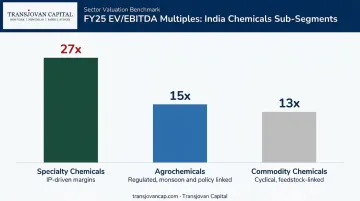
The numbers make this concrete. According to Ambit's July 2025 analysis of Indian chemical leadership, FY25 EV/EBITDA multiples stood at roughly 27x for specialty chemicals, versus 13x for commodity chemicals and 15x for agrochemicals. Apply a specialty multiple to a commodity asset, or vice versa, and you've either overpaid or walked away from a fair deal.
Two other factors compound the complexity:
- EHS exposure is structurally higher than in most industries, making environmental due diligence the difference between a clean closing and inherited liability
- Buyer pools are segmented, with global strategics building specialty platforms sitting in a different lane than PE funds using an Indian company as an acquisition anchor abroad
- Integration risk runs high, since specialty formulations often depend on tacit process knowledge and key technical personnel rather than transferable assets alone
Origination that doesn't understand this segmentation wastes months talking to the wrong buyers.
Key Chemicals Sub-Sectors Driving Deal Activity in India
Not every chemicals sub-segment moves at the same pace. The sub-sectors seeing the most activity right now:
- Agrochemicals – consolidation driven by import-substitution opportunities and export demand
- Specialty chemicals – premium-valued assets with IP, formulation know-how, and long customer contracts
- APIs and CDMO – pharma-adjacent manufacturing riding global outsourcing trends
- Petrochemicals and commodity chemicals – cyclical, capacity-driven, and increasingly a divestiture target for global majors
- Industrial and performance chemicals – adhesives, coatings, and pigments, where scale and geographic reach matter most
Why Indian Chemicals M&A Activity Is Accelerating
Global manufacturers spent the last several years de-risking supply chains away from single-country dependence on China. FICCI's analysis of the specialty chemicals industry describes this "China Plus One" shift as a structural response to trade tensions and pandemic-era disruption, with India positioned as an alternative on cost, technical skill, and IP protection grounds.
NITI Aayog and the Indian Chemical Council project that India's chemicals market will grow from roughly $220 billion in 2023 to $400-450 billion by 2030, with a longer-range target of $850 billion to $1 trillion by 2040. That growth trajectory hasn't gone unnoticed by Asia's largest chemical conglomerates.
Japanese Buyers Are Signaling Serious Intent
Japan's largest chemical conglomerates are restructuring at home while scouting opportunities in India:
- Mitsubishi Chemical Group has committed to becoming a green specialty chemicals company and is exploring a petrochemicals spin-off
- Mitsui Chemicals shut down its PTA and PET division and is evaluating a split-off of its Basic & Green Materials business
- Resonac Holdings carved out its petrochemicals unit into a separate entity, Crasus Chemical
- Chemical & Engineering News reports that Sumitomo Chemical, Mitsui, and Mitsubishi are each actively evaluating Indian production investments
Formal acquisitions haven't been announced yet, but the pattern of divestment at home and evaluation in India points toward serious interest.
Landmark transactions are already proving the thesis:
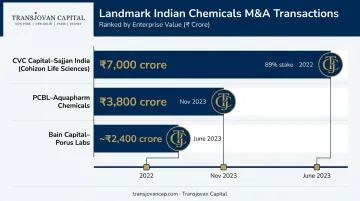
- PCBL's acquisition of Aquapharm Chemicals, announced in November 2023 at an enterprise value of ₹3,800 crore, funded through internal accruals and debt
- Bain Capital's acquisition of Porus Labs, announced in June 2023, with reported deal value around ₹2,400 crore according to Economic Times sources
- CVC Capital's 2022 acquisition of Sajjan India (now Cohizon Life Sciences) at roughly ₹7,000 crore for an 89% stake, using the platform to reach customers across more than 35 countries
European and US players are moving too. Siegwerk completed its acquisition of Hi-Tech Inks, creating what it describes as India's largest flexible-packaging inks business. Lubrizol has committed roughly $200 million to a new manufacturing site in Aurangabad, following an earlier $150 million India investment pledge. These investments signal that global players view India as a long-term production and innovation hub.
Sustainability is a real overlay here too. Kearney's 2024 chemicals M&A report found that decarbonization-linked deal value rose 206% globally in 2023, and India-based consolidation in coatings and pigments, such as Sudarshan Chemical's acquisition of the Heubach Group, is following a similar direction.
Regulatory and Structural Considerations for Chemicals M&A in India
Chemicals deals in India carry regulatory friction that doesn't exist in most other sectors. Missing any one of these can add weeks, or worse, to a closing timeline.
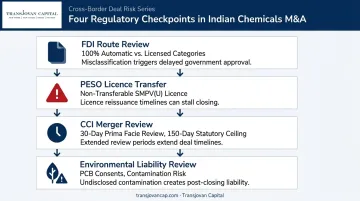
FDI route: Chemicals manufacturing generally sits under the 100% automatic FDI route under FEMA. Hazardous chemical categories subject to industrial licensing requirements, or anything adjacent to defence manufacturing (capped at 74% automatic route), need additional scrutiny before assuming a clean automatic approval.
PESO licences are a closing-critical item. The Petroleum and Explosives Safety Organisation is explicit that an SMPV(U) licence cannot transfer from one company to another. A new occupier must obtain a fresh licence entirely. Buyers who don't plan for this application timeline early routinely find it becomes the longest pole in the closing tent.
CCI review adds another layer. Under the current merger control regime, CCI's own guidance sets a 30-calendar-day prima facie review period, with an overall statutory ceiling of 150 days, plus standstill obligations during review.
A deal-value threshold above ₹2,000 crore, where the target has substantial Indian operations, can trigger a filing even if turnover-based thresholds aren't met. In consolidating segments like agrochemicals or specialty chemicals, where a handful of players dominate, expect closer scrutiny than in more fragmented industries.
Environmental liability deserves its own line item. Pollution Control Board consents (Consent to Establish and Consent to Operate) need review for historical non-compliance, and legacy contamination liability has to be explicitly allocated in the deal terms, not assumed to transfer cleanly.
These licensing and liability factors directly shape deal structure:
| Consideration | Slump Sale (Asset Deal) | Share Purchase |
|---|---|---|
| Licence transferability | Often requires fresh applications | Licences may stay with the entity |
| Historical liability | Can be ring-fenced more cleanly | Inherited with the company |
| Stamp duty exposure | State-specific, asset-dependent | Lower, delivery-based rates apply |
Getting this structuring decision wrong has direct tax and liability consequences that surface long after signing.
What a Chemicals-Specialized M&A Advisor Delivers
A generalist advisor can run a process. A chemicals-fluent advisor changes the outcome of that process in three concrete ways:
Sector-specific valuation benchmarking. Commodity, specialty, and agrochemical assets trade on different multiple bands. Missing that distinction means underpricing a specialty asset against commodity peers, or overpaying for a cyclical business using specialty-grade assumptions. This gap, as the Ambit data above shows, can represent a two-to-threefold valuation difference.
A pre-built buyer network shortens time-to-first-offer. Relationships with Japanese strategics restructuring portfolios, European majors expanding manufacturing footprints, and PE funds building Indian anchor platforms let a sector-fluent advisor generate competitive tension faster than someone starting from a cold list.
Due diligence that knows where to look. Regulatory red flags, such as an unrenewed PCB consent, an SMPV(U) licence that won't transfer smoothly, or undisclosed contamination, surface before the LOI stage rather than during confirmatory diligence. That timing difference is what separates a smooth close from a renegotiated price or a collapsed deal.
Choosing the Right Chemicals M&A Advisory Partner
Not every M&A advisor who claims industrial experience has actually closed chemicals deals. A few filters help separate genuine sector depth from adjacent-industry experience dressed up as relevant:
- Ask for completed chemicals-sector transactions, not adjacent industrials. Agrochemicals and specialty coatings deals look nothing like a generic manufacturing carve-out.
- Look for operator-led teams, former CEOs and CFOs who've actually run P&Ls, not pure transaction bankers who've only advised from the outside.
- Check for active cross-border buyer relationships specifically in chemicals, not a generic industrials Rolodex.
Transjovan Capital's approach here is built around its Corporate Development as a Service (CDaaS) model, an embedded, multi-year advisory function rather than a one-off transaction engagement. The firm's Industrials practice covers:
- Chemicals
- Electricals & Electronics
- Engineering & Auto
- Capital Goods
- Building Materials
- Energy & Infrastructure
Teams are staffed by former leaders from industrial corporations rather than career bankers alone.
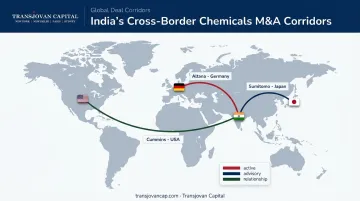
That sector focus extends to individual advisor relationships as well. Gaurav Asthana, the firm's Managing Partner, is named as a preferred buy-side advisor for Altana (Germany), a European industrial and chemicals-adjacent strategic, alongside marquee relationships including Sumitomo (Japan) and Cummins (USA).
That cross-border footprint matters for chemicals companies running sustained acquisition programs across the Indo-German, Indo-Japan, and Indo-US corridors, where Transjovan maintains active engagement through chamber memberships and direct client relationships.
The practical benefit for an Indian chemicals company is straightforward: a continuous, partner-led engagement model absorbs the sustained M&A workload that would otherwise sit on an already-stretched CXO's desk. Internal leadership stays focused on running the business rather than chasing every deal thread.
Transjovan Capital's Track Record in Chemicals M&A
How Transjovan Capital reads chemicals M&A in India is a matter of public record. The firm has been buy-side by design since Gaurav Asthana set it up in 2011, built for Fortune 500 and mid-market acquirers that needed proprietary origination and embedded corporate development rather than a broker. He told ION Analytics (Mergermarket) that inbound work now runs at 60-70% of the book, with outbound at 30-40%. The firm's corridor map reflects that: inbound flow from Europe, the US, Japan and Southeast Asia into electronics manufacturing, specialty chemicals, building materials and consumer, and outbound flow from India into Continental Europe, the US, Southeast Asia, the Middle East and Africa across high-tech, IT/ITeS, healthcare analytics, auto components and industrials.
Asthana has also quantified why Indian assets clear at the levels they do, telling ION Analytics (Mergermarket) that acquisition multiples in India's high-growth sectors run roughly 50% above Western comparables — a spread he ties to sector growth of 14-15%, close to double India's GDP growth. The firm has advised on $15 billion+ in cumulative transactions across 250+ clients, and took the Platinum award for Best M&A Advisory Firm at the M&A Conclave & Awards hosted by Transformance Forums in Bengaluru in October 2024 (announcement).
Frequently Asked Questions
What makes chemicals M&A different from M&A in other industries?
Chemicals deals carry higher environmental and health-and-safety liability exposure than typical M&A transactions. They also involve sector-specific licensing requirements like PESO, plus valuation multiples that vary sharply between commodity, specialty, and agrochemical sub-segments.
What licences or approvals need to transfer during a chemicals company acquisition in India?
Key items include PESO licences (which often can't transfer and need fresh applications), Pollution Control Board consents, and applicable FEMA and CCI clearances depending on deal size and structure.
Why are global strategics increasingly acquiring Indian chemical companies?
The "China Plus One" supply chain diversification strategy is driving this trend. Combined with India's projected growth to a $400-450 billion chemicals market by 2030, it makes Indian assets attractive for global manufacturing footprints.
How is a chemicals company valued in an M&A transaction?
Valuation multiples vary meaningfully by sub-segment. Specialty chemicals trade at a premium to commodity and agrochemical businesses, with key drivers including margin durability, customer concentration, and regulatory compliance history.
What are the most common due diligence risks in chemicals M&A?
Environmental contamination liability, uncertainty over whether hazardous-material licences will transfer, and customer concentration are the most frequent deal risks that surface during diligence.
How does Transjovan Capital support chemicals M&A transactions?
Transjovan's CDaaS model provides embedded, partner-led M&A support covering strategy, buy-side execution, and integration. This is backed by a cross-border network spanning the Indo-German, Indo-Japan, and Indo-US corridors relevant to chemicals dealmaking.