That combination of scale and ambition is fertile ground for M&A. Yet many promoters and corporates on both sides underestimate what makes this corridor different. Regulatory timelines, valuation expectations, and negotiation styles rarely translate cleanly between Paris and Delhi, and deals stall or collapse because of it.
This guide breaks down what's driving India-France deal flow, where the opportunity is concentrated, where transactions typically go wrong, and how to structure a deal that actually closes.
Key Takeaways
- Government roadmaps, chamber initiatives, and industrial synergies are deepening India-France capital flows
- Industrials, renewables, consumer/D2C, IT-deeptech, and defence draw the most cross-border deal activity
- Regulatory divergence, labour law gaps, and negotiation-style mismatches most often stall India-France deals
- A partner-led advisory with dedicated India and France teams de-risks execution
The India-France Corridor: Why Cross-Border Dealmaking is Accelerating
Both economies are pursuing outsized growth, and that ambition is spilling into trade and investment. Bilateral goods trade reached USD 15.11 billion in FY2023-24, split almost evenly between Indian exports (USD 7.14 billion) and French exports (USD 7.97 billion), according to the India-France Comprehensive Economic and Commercial Brief. Services trade added over €8 billion in 2024 alone.
What each country sends the other tells its own story:
| Direction | Key Exports |
|---|---|
| India → France | Pharmaceuticals, apparel, petroleum products |
| France → India | Aircraft and spacecraft components, machinery, medical/optical instruments |
Cumulative French FDI into India stood at USD 11.36 billion between April 2000 and September 2024, roughly 1.6% of India's total recorded inflows. That's a modest share given the size of both economies, which signals headroom rather than saturation.
An Institutional Ecosystem Built for Dealmaking
The Indo-French Chamber of Commerce (IFCCI) actively supports trade promotion, investment facilitation, and B2B connections between the two markets. Layered on top is the Horizon 2047 roadmap, a joint government framework explicitly calling for increased cross-investment and stronger cooperation between business communities.
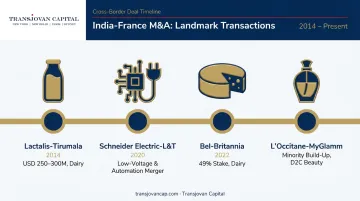
Precedent transactions show this isn't just policy talk:
- Schneider Electric-L&T: Combined Indian low-voltage and automation businesses in 2020 to build scale
- Bel-Britannia: Bel acquired 49% of Britannia Dairy in 2022, forming Britannia Bel Foods
- Lactalis-Tirumala: Lactalis bought a controlling stake in Tirumala Milk Products for USD 250-300 million in 2014, later acquiring Prabhat Dairy's milk business for INR 17 billion
- L'Occitane-MyGlamm: A minority equity build-up rather than a full buyout, but proof that French beauty strategics see value in Indian D2C brands
High-Potential Sectors Driving India-France Deal Flow
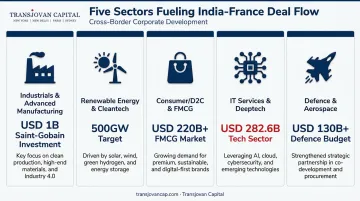
Deal activity isn't spread evenly. Five sectors account for most of the momentum.
Industrials & Advanced Manufacturing
French industrial majors are acquiring or investing in Indian manufacturing capacity for a straightforward reason: cost-competitive scale plus access to a fast-growing domestic market. Saint-Gobain, for instance, has committed nearly USD 1 billion over five years to expand its Indian manufacturing footprint.
This trend plays out in live mandates too. Transjovan Capital has served as the retained buy-side M&A advisor for Legrand (France), a global electricals and digital infrastructure leader, supporting its search for Indian acquisition targets.
It's a direct example of French industrial capital actively hunting for capacity in India's electricals and electronics space.
Renewable Energy & Cleantech
India's push toward 500 GW of non-fossil-fuel electricity capacity by 2030 is pulling French energy majors into the market. TotalEnergies set the benchmark in January 2021, agreeing to acquire a 20% stake in Adani Green Energy for USD 2.5 billion.
The deal also included a 50% interest in a 2.35 GWac operating solar portfolio, and that relationship has since expanded into further joint renewable capacity.
Consumer, D2C and FMCG
French consumer strategics keep returning to Indian dairy and beauty. Lactalis's dairy acquisitions and L'Occitane's stake-building in MyGlamm both point to the same appeal: established distribution networks, category leadership, and a large, increasingly premium-seeking middle class. These are portfolio-building moves, not one-off bets.
IT Services, Deeptech & Semiconductor
India's technology industry is projected to grow 5.1% to USD 282.6 billion in FY2025, with revenue expected to cross USD 300 billion in FY2026, according to NASSCOM estimates reported by Reuters.
French players are already embedded here. Thales runs an Indian engineering centre focused on cybersecurity and biometrics, while OVHcloud launched its first Indian data centre in 2023 to capture cloud demand. Talent density and IP access are the pull, not just labour cost.
Defence & Aerospace
This is the smallest segment by deal count, but it delivers the highest value per transaction. Dassault Aviation and Tata Advanced Systems announced a Hyderabad facility in June 2025 to manufacture Rafale fuselage sections, the first time complete Rafale fuselages will be produced outside France.
India and France also agreed in January 2024 to pursue joint production of helicopters and submarines. This agenda will likely spawn joint ventures and supply-chain acquisitions over the next decade.
Key Challenges in Cross-Border India-France Transactions
Even well-capitalised, well-intentioned deals hit friction. Three problem areas show up repeatedly.
Regulatory complexity. France screens non-EU investors, including Indian buyers, once a deal crosses key thresholds:
- Acquiring control of the French target
- Crossing 25% of voting rights
- Passing 10% ownership in a listed company operating in a sensitive sector
Phase 1 review is capped at 30 business days; escalation to Phase 2 adds another 45 business days. India runs its own sector-specific caps under the automatic or government route via FEMA, with government-route approvals passing through DPIIT and, where relevant, the Ministry of Home Affairs for security review. Stacking both timelines can extend a deal by months.
Valuation gaps and labour rigidity. Indian promoters often anchor to growth-multiple valuations; French buyers frequently apply more conservative, cash-flow-driven models. That gap alone kills momentum before due diligence even starts.
Labour rules compound the problem. France's Comité Social et Économique (CSE) must be informed and consulted before any decision affecting workforce structure or technology. That consultation defaults to one month, extending to two or three months when an expert is engaged. Skipping this step, or underestimating its timeline, is a common and avoidable error.
Due diligence blind spots. Mid-market Indian promoters unfamiliar with French corporate governance norms often under-scope disclosure requirements, missing gaps that surface only after signing — by which point renegotiation leverage has evaporated.
Best Practices for Structuring a Successful India-France M&A Deal
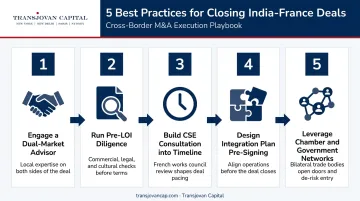
Deals that close smoothly tend to follow a similar playbook:
- Engage an advisor with genuine on-ground presence in both Paris and Delhi. Market intelligence and relationship gaps are easiest to close early, not after a term sheet is on the table.
- Run commercial, legal, and cultural due diligence before the Letter of Intent — not just financial diligence. Cultural misalignment on decision-making pace or negotiation style causes more delays than balance-sheet surprises.
- Build French labour obligations into the deal structure from day one. CSE consultation isn't a formality; treat it as a scheduled workstream with its own timeline, not an afterthought bolted onto closing.
- Design the post-merger integration plan before signing, not after closing. Synergy capture that starts at Day 1 outperforms integration plans assembled reactively post-close.
- Use bilateral chamber and government relationships for sourcing and credibility. Indo-French Chamber of Commerce (IFCCI) networks and Horizon 2047-aligned introductions can shortcut trust-building that would otherwise take months.
Why Partner with a Specialised Cross-Border Advisory Firm
Executing India-France deals well starts with having boots on the ground in both markets. Transjovan Capital is headquartered in New Delhi with an office at 18 Rue Pasquier, Paris, giving clients direct access to both ecosystems instead of relying on a single-market advisor bridging the gap secondhand. That local footprint also shapes how each engagement is structured.
Rather than treating each transaction as a standalone event, the firm's Corporate Development as a Service (CDaaS) model provides a continuous, embedded alternative to one-off deal advisory. It integrates strategy, buy-side execution, Day-1 readiness, and synergy governance into one system, reducing the bandwidth burden on CXOs already stretched managing cross-border growth.
The firm's track record includes:
- USD 15 billion+ in cumulative advised transactions across 250+ clients
- A retained buy-side mandate for Legrand (France), covering its industrials and electricals businesses
- Partner-led execution by ex-Big-4 professionals and former CEOs/CFOs averaging 20 years of experience
- Active membership in the Indo-French Chamber of Commerce, providing deal-sourcing networks and regulatory insight specific to this corridor
Physical presence, sector depth, and institutional access work together: they turn a promising India-France thesis into a transaction that actually closes.
Transjovan Capital in the Indo-French Corridor
Transjovan Capital's perspective on the Indo-French corridor comes out of live mandates rather than desk research. The firm attended the Indo-French Chamber of Commerce and Industry's 48th Annual General Meeting in Mumbai on 26 September 2025 — themed "Innovating for Tomorrow" and drawing 400+ C-suite leaders from BNP Paribas, Capgemini, Saint-Gobain, Schneider Electric and TotalEnergies (release). Indo-French transaction value has passed USD 10 billion over the last three years, and Managing Partner Gaurav Asthana framed the fit as one where "France's strategic focus on clean tech, renewables, and industrial innovation aligns with India's manufacturing and green-energy push."
Gaurav Asthana's rationale in 2011 was a buy-side practice for Fortune 500 and mid-market acquirers who wanted proprietary deal flow and corporate development capacity rather than a transaction broker. He put the current split to ION Analytics (Mergermarket) at 60-70% inbound against 30-40% outbound. The firm took the Platinum award for Best M&A Advisory Firm at the M&A Conclave & Awards hosted by Transformance Forums in Bengaluru in October 2024 (announcement).
Frequently Asked Questions
What is cross-border M&A advisory and why does it matter for India-France deals?
Cross-border advisory bridges regulatory, valuation, and cultural gaps between two markets. It's especially critical for India-France deals given divergent legal frameworks, labour codes, and negotiation norms.
Which sectors see the most India-France M&A activity?
Industrials, renewables, consumer/FMCG, IT-deeptech, and defence currently lead deal volume between the two countries, driven by complementary industrial strengths and growing capital flows.
What are the biggest regulatory hurdles in an India-France acquisition?
Differing FDI screening norms, sector-specific caps, and France's works council (CSE) consultation requirements top the list. Each can add weeks or months to a transaction timeline if not planned for in advance.
How long does a typical India-France cross-border M&A deal take to close?
Cross-border India-France deals typically take 9 to 14 months from LOI to close, versus 4 to 6 months for a comparable domestic transaction. Regulatory approvals and CSE labour consultations account for most of the added time.
What is the Corporate Development as a Service (CDaaS) model?
CDaaS is an embedded, multi-year advisory engagement that functions as an extended corporate development team. Success is measured by synergy capture, not the number of deals closed.
How do I choose the right M&A advisor for an India-France transaction?
Look for verifiable on-ground presence in both markets, sector-specific expertise, and a partner-led execution track record rather than a junior-staffed delivery model.