AI infrastructure M&A covers the deals building India's compute backbone: data centres, GPU/AI-compute clouds, semiconductor and ATMP (assembly, testing, marking, packaging) assets, and the power infrastructure that keeps it all running. Many corporates and funds struggle to keep pace with how fast this segment is consolidating, and with how regulation-heavy the deal structures have become.
India is emerging as a genuine hotspot here, pulled forward by sovereign AI ambitions, the India Semiconductor Mission, and hyperscaler capex commitments running into billions of dollars. This piece breaks down the key deal trends, what's driving them, how they're reshaping diligence and org design, and what to watch next.
Key Takeaways
- Data centre M&A/JV platforms are outpacing greenfield builds as the fastest route to capacity.
- Semiconductor ATMP consolidation is accelerating under Semicon India's fiscal incentives.
- US, Japanese, and Gulf strategics are entering via equity stakes alongside capex commitments.
- PE and infrastructure funds are running roll-up plays to scale platforms for exit.
- Power and renewable tie-ups have shifted from peripheral to central in deal structuring.
Key Trends Shaping AI Infrastructure M&A in India
Five distinct patterns are defining how capital moves into India's AI infrastructure corridor right now.
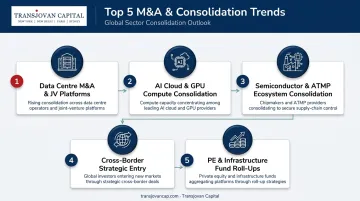
Trend 1: Data Centre Capacity Build-Out via M&A and JV Platforms
Hyperscalers and PE-backed platforms increasingly buy land-, power-, and shell-ready capacity rather than starting from scratch. Greenfield construction takes years to clear land titles, secure power connections, and get environmental sign-offs. M&A and joint ventures compress that timeline dramatically.
The clearest example: Reliance Industries joined Digital Realty and Brookfield Infrastructure in 2023, with each partner holding 33.33% of the Digital Connexion platform, combining local access, global operating expertise, and infrastructure capital in one structure.
The scale-up numbers back this urgency. JLL projects India's data centre capacity will rise 77%, from more than 1 GW in 2024 to 1.8 GW by 2027. That kind of growth simply isn't achievable through organic build-out alone. Speed-to-capacity has become the deciding factor as enterprise and sovereign AI demand surges.
Trend 2: AI Cloud & GPU Compute Infrastructure Consolidation
GPU-as-a-service providers are becoming acquisition targets as India races to build sovereign compute capacity. L&T's November 2024 agreement to acquire up to 21% of cloud and data-centre provider E2E Networks illustrates the pattern well:
- 15% for ₹1,079.27 crore through preferential allotment
- 6% for ₹327.75 crore through a secondary purchase
- Board nomination and colocation rights included in the deal
This isn't happening in a vacuum. The IndiaAI Mission carries a ₹10,371.92 crore outlay and originally targeted a public-private compute ecosystem of 10,000 or more GPUs. Strategics are positioning themselves to ride government-backed utilisation, though that also means underwriting some subsidy dependence into the deal thesis.
Trend 3: Semiconductor & ATMP Ecosystem Consolidation
Chip assembly, testing, and packaging capacity is India's biggest supply-chain gap for AI hardware. The CG Power, Renesas Electronics, and Stars Microelectronics joint venture, approved by Cabinet in February 2024, shows how this gets solved. The new ATMP facility combines local sponsorship with foreign process know-how through a clear ownership split:
- CG Power: 92.3%
- Renesas Electronics: 6.8%
- Stars Microelectronics: 0.9%
Semicon India backs this with real money. The scheme offers 50% pari-passu fiscal support for ATMP/OSAT capital expenditure, and by August 2025, 10 projects totalling roughly ₹1.60 lakh crore had been approved across six states. Expect more JV structures built specifically around incentive eligibility.
Trend 4: Cross-Border Strategic Entry via Stake and Platform Acquisitions
US, Japanese, and Gulf investors are entering through stakes and platform investments rather than pure greenfield commitments:
- US: Digital Realty's 33.33% Digital Connexion stake stands as the standout example
- Japan: NTT DATA's India footprint now supports over 200 MW of AI-capable capacity
- Gulf: Sovereign capital has backed comparable Asia platforms, with Mubadala's investment in Princeton Digital Group as a regional precedent
FEMA's residual FDI rule is the enabler here. Sectors not separately listed in the sectoral-cap schedule, which includes data centres, can receive up to 100% FDI under the automatic route, subject to applicable laws and conditionalities. No prior RBI or government approval is required, which is exactly why deal timelines have compressed.
Trend 5: PE and Infrastructure Fund Roll-Ups Building Platform Scale
Financial sponsors are consolidating smaller assets into scaled platforms, positioning for eventual exit at a premium. Iron Mountain's acquisition of Web Werks, completed by increasing its stake to 100% and rebranding the business as Iron Mountain Data Centers on April 1, 2025, is a textbook roll-up, even if the final consideration wasn't disclosed.
NIIF, Digital Edge, and AGP took a fund-backed platform route instead, announcing a $2 billion, 300 MW greenfield campus in Navi Mumbai in January 2023. Houlihan Lokey estimates roughly $14.7 billion flowed into Indian data centres between 2020 and April 2025, a signal of just how much capital is chasing platform scale in this corridor.
What's Driving These AI Infrastructure M&A Trends in India
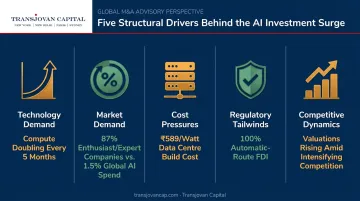
Sovereign AI ambitions, capex intensity, and regulatory openness are converging to make M&A the fastest path to scale. Several forces are pushing this simultaneously:
- Technology demand: Training compute for leading AI models is doubling roughly every five months, per the 2025 Stanford AI Index Report, far outpacing what organic capacity build-out can deliver.
- Market demand: NASSCOM's AI Adoption Index puts 87% of Indian companies in the "Enthusiast" or "Expert" bracket, yet India represents only 1.5% of global AI spending, leaving vast domestic runway. Section 16 of the DPDP Act reinforces this by letting government restrict cross-border data transfers.
- Cost pressures: Mumbai's 2025 benchmark data centre build cost sits around ₹589 (roughly $6.64) per watt for a traditional facility, before AI-density cooling premiums of 7-10% on top. Acquiring operating capacity often beats that replacement cost outright.
- Regulatory tailwinds: The 100% automatic-route FDI policy, Semiconductor Mission incentives, and the IndiaAI Mission together lower the friction of cross-border entry. That said, multi-jurisdiction deals still require careful structuring across US, European, Indian, and APAC regulatory frameworks.
- Competitive dynamics: Hyperscalers and PE funds are racing each other for India capacity, and that urgency is pushing valuation premiums on assets with ready power and land.
How These Trends Are Impacting India's AI Infrastructure Deal Landscape
These forces are reshaping how deals get diligenced, structured, and staffed across the M&A lifecycle.
Operational Impact
Diligence checklists now lead with power availability, land titles, and environmental clearances, not just financials. GPU and chip supply-chain continuity has become a standing diligence item too, given how exposed hardware-dependent platforms are to global shortages.
Business Impact
Corporates and PE funds are building dedicated AI infra corporate development functions rather than treating each deal as one-off. Transjovan Capital's own buy-side mandate illustrates this shift.
The firm is evaluating targets for a $25+ billion global leader in Electricals & Electronics, Automation, and Data Centers, with enterprise valuations up to $800 million across the US, Europe, India, and APAC. This reflects a move toward continuous, embedded deal capability rather than episodic transactions.
Workforce Impact
Integration teams increasingly need to blend M&A execution skills with data center engineering and power-synergy expertise. That combination is rare, and it is pushing acquirers to build cross-functional teams earlier in the process, often before term sheets are even signed.
Future Signals for AI Infrastructure M&A in India
These trends will keep evolving. Here's what's worth watching over the next one to three years:
- Procurement-linked M&A/JV structures: Sovereign AI compute missions are likely to expand into deals tied directly to government procurement commitments, not just private capex.
- Green PPA-bundled acquisitions: Renewable-power purchase agreements (PPAs), such as the Adani-Google data centre partnership in Visakhapatnam, are becoming a genuine deal-structuring differentiator rather than a sustainability add-on.
- ATMP consolidation wave: As Semiconductor Mission-backed projects mature between 2026 and 2028, expect early-stage ATMP/OSAT ventures to become acquisition targets for scaled players.
Conclusion
Data centre build-outs, AI-compute consolidation, semiconductor JVs, cross-border stake deals, and PE roll-ups are collectively defining India's AI infrastructure deal landscape. Each trend feeds the others: capacity scarcity drives platform M&A, incentive schemes drive semiconductor JVs, and FDI openness drives cross-border entry.
Navigating this corridor well requires sector-specialised advisory, not generalist deal support. It's a fast-moving, regulation-heavy space where power, land, and chip supply-chain risk sit alongside the usual financial diligence.
Transjovan Capital's Corporate Development as a Service (CDaaS) model embeds strategy, buy-side M&A, PMI, and synergy governance into one continuous engine. This gives acquisitive corporates and funds a structured way to pursue opportunities here. The team's experience spans Electricals & Electronics, Engineering & Auto, and Energy & Infrastructure, alongside Emerging Technology sectors like Deeptech and Advanced Manufacturing.
How Transjovan Capital Approaches AI Infrastructure M&A
How Transjovan Capital reads AI infrastructure M&A in India is a matter of public record. The firm applies the capability-over-scale test that Managing Partner Gaurav Asthana set out in Electronics For You Business, where he argued that "everything is focused on capability" and that "the keyword is quality, not revenue size" — technology depth, customer diversity, management strength and profitability ahead of headline revenue.
Asthana has also put numbers to the valuation gap, telling ION Analytics (Mergermarket) that Indian multiples in high-growth sectors sit roughly 50% above Western comparables, underpinned by sector growth of 14-15% — close to twice India's GDP growth. Its cumulative record runs to $15 billion+ in transactions across 250+ clients, and was named Best M&A Advisory Firm at the Platinum tier of the M&A Conclave & Awards, run by Transformance Forums in Bengaluru in October 2024 (announcement).
Frequently Asked Questions
What is the best AI for M&A?
"AI for M&A" typically refers to tools used within the deal process itself, such as sourcing, diligence automation, or synergy validation, rather than the AI infrastructure sector this article covers. The right tool depends entirely on your specific use case.
How much do M&A advisors charge?
Most M&A advisory firms use a retainer plus success-fee structure, often based on a declining Lehman-formula scale. Fees vary widely based on deal size, sector complexity, and cross-border scope.
What is driving AI infrastructure M&A in India?
Sovereign AI ambitions, DPDP-linked data transfer restrictions, and the sheer capex intensity of building power, land, and chip capacity are the core drivers. M&A and JVs simply move faster than greenfield construction.
Is 100% FDI allowed in India's data centre and AI infrastructure sector?
Yes. Sectors not separately listed in India's sectoral-cap schedule, including data centres, can receive up to 100% FDI under the automatic route, subject to applicable laws and conditions. This speeds up cross-border deal execution.
Which global investors are entering India's AI infrastructure M&A market?
US hyperscalers like Digital Realty, Japanese strategics such as NTT DATA, and Gulf sovereign funds including Mubadala are among the most active entrants, typically through platform stakes and joint ventures.
How does the India Semiconductor Mission affect AI infra M&A?
The mission's incentives, including 50% pari-passu fiscal support for ATMP/OSAT capex, are catalysing consolidation in chip assembly, testing, and packaging. This makes technology-licensing joint ventures more attractive to both local and foreign partners.