Machinery ages. Unions negotiate. Environmental liabilities hide in decades-old compliance files. Customer concentration can wreck a valuation overnight. Many buyers underestimate how different a plant acquisition really is until they're three months into diligence and staring at a pollution control notice nobody flagged.
India's manufacturing sector is now the centre of a genuine consolidation wave. PLI schemes, China+1 sourcing shifts, and global capacity expansion plans are pulling in strategic buyers who once built greenfield. This article breaks down why manufacturing M&A is structurally different, what typically goes wrong, and how the right advisory partner gets these deals closed and integrated properly.
Key Takeaways
- Policy tailwinds and promoter succession pressure are accelerating manufacturing consolidation across India
- Physical assets, environmental exposure, union dynamics, and tech transfer add real complexity to manufacturing M&A
- A disciplined, five-step deal framework protects valuation and post-close synergy capture
- Advisors need operator experience and sector depth — not just transaction execution credentials
Why Manufacturing M&A Deals in India Are Accelerating
India's M&A activity hit US$26 billion in Q3 2025, up 37% year-on-year, according to EY's India M&A Report — and manufacturing is one of the sectors driving that surge. Three forces are pushing strategics and private equity toward Indian factories:
- Production Linked Incentive (PLI) schemes rewarding domestic capacity in electronics, auto components, and speciality chemicals
- China+1 sourcing shifts, as global buyers diversify supply chains away from single-country dependency
- Capacity expansion timelines that favour acquiring an operating plant over building one from scratch
Where the deal activity is concentrated
Deal flow isn't evenly spread. The sub-sectors seeing the most action include:
- Capital goods and industrial machinery
- Auto components and EV supply chain
- Speciality chemicals
- Electricals and electronics
- Building materials
Buying instead of building
A growing number of engineering, auto, and industrial majors are entering India through acquisition rather than greenfield setup, simply because it's faster.
Schneider Electric's ₹14,000 crore acquisition of L&T's Electrical and Automation business illustrates this well. The deal gave Schneider an instant India manufacturing base and made India one of its four global manufacturing and R&D hubs, according to Schneider Electric's own transaction announcement. That's speed-to-market no greenfield project could match.
Speed isn't the only driver, though. Buyers today are also less purely financial, chasing synergy, capacity, and technology access rather than returns alone. This shift shows up in how many acquisitions are now structured around complementary product lines rather than pure balance-sheet arbitrage.
On the promoter side, succession is reshaping the seller pool. Many family-run manufacturing businesses are approaching a generational handover, and not every next generation wants to run a plant. That's pushing more owners toward strategic sales or joint ventures rather than passing the business down.
What Makes Manufacturing M&A Deals Different and Complex
Services and tech deals are largely about people, contracts, and recurring revenue. Manufacturing deals add layers that generalist advisors often miss entirely.
Physical asset and plant valuation
Machinery age, land title, and working capital normalization make manufacturing valuation genuinely harder. A DCF alone won't tell you whether that press line is five years from replacement.
Environmental, health & safety liabilities
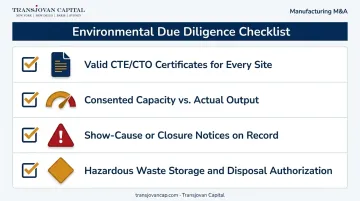
This is where deals quietly die. Every plant needs Consent to Establish and Consent to Operate certificates under India's Water and Air Acts, and any hazardous waste handling requires separate authorization from the State Pollution Control Board. Diligence needs to check:
- Valid CTE/CTO documents for every site and production line
- Consented capacity versus actual output
- Show-cause or closure notices on record
- Hazardous waste storage and disposal authorization
Miss one of these and you inherit someone else's compliance problem.
Technology and IP transfer
Many manufacturing deals bundle licensing or technology collaboration agreements with equity. That requires deal structuring expertise most generalist bankers simply haven't built. You're valuing access to a proprietary process or patent alongside the business itself.
Labor and union dynamics
Under India's Industrial Relations Code, establishments with 300 or more workers need prior government permission before lay-off, retrenchment, or closure, and strikes require 14 days' prior notice. A unionized workforce demands careful HR due diligence and a deliberate integration plan. Rushing it risks production disruption on day one.
Supply chain and customer concentration
If 60% of revenue comes from two customers, that's a valuation problem, not a footnote. Buyers will (and should) push for price adjustments or earn-outs tied to customer retention.
Longer timelines, capex-heavy negotiations
Manufacturing valuation often blends earnings multiples with asset replacement-cost thinking: appraising land, buildings, and machinery separately from the operating business rather than relying purely on EBITDA multiples. That blend takes niche expertise, and it takes time.
The Right Way to Approach a Manufacturing M&A Deal: A Step-by-Step Framework
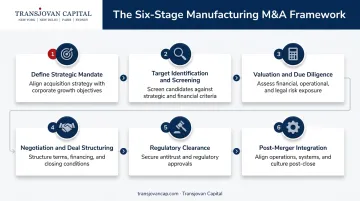
Manufacturing deals reward discipline. Here's the sequence that actually protects value:
Define the strategic mandate. Is this about capacity expansion, market entry, or technology access? Get clarity before target search begins: chasing a good-looking deal without a mandate leads to integration mismatches later.
Target identification and screening. Manufacturing needs its own filters: capacity utilization, order book strength, and plant location relative to logistics access. A plant with 95% utilization and a thin order book is a different acquisition than one with idle capacity and a strong pipeline.
Valuation and commercial due diligence. Blend DCF or comparable multiples with asset-based valuation. Capital-intensive businesses need both lenses, or you'll misprice the deal in either direction.
Negotiation and deal structuring. Structure should flex with promoter goals. A full exit favours an outright buyout; continued promoter involvement with technology-sharing needs might favour a joint venture or minority stake.
Regulatory clearance. Transactions crossing applicable asset or turnover thresholds, or the ₹2,000 crore deal-value threshold where the target has substantial Indian operations, need CCI clearance, which carries a statutory review period of 150 days under the CCI's current merger control framework. FDI in manufacturing is generally 100% automatic route, though sector-specific conditions apply.
Post-merger integration. This is where deals actually succeed or fail. Aligning plant operations, ERP systems, and workforce structures across different quality certifications and supplier networks determines whether the projected synergies materialize.
Track that outcome as closely as the transaction itself: real deal success shows up eighteen months later, when projected synergies either materialize or don't.
Choosing the Right M&A Advisory Partner for Manufacturing Deals
Manufacturing due diligence requires shop-floor understanding, not just transaction pedigree. That's why partner-led execution by advisors with real operating experience — ex-CXOs, ex-Big 4 professionals who've actually run plants or led corporate strategy — matters more here than it does in a typical banking mandate.
Before hiring an advisor, verify:
- Actual sector-specific track record across Industrials, Capital Goods, EV Mobility, and Advanced Manufacturing
- Generalist coverage claims tested against actual manufacturing deal experience, not just broad sector lists
- Team members who've sat on the client side of a plant acquisition, not just advised from outside
Transjovan Capital's Corporate Development as a Service (CDaaS) model is a useful example of how this plays out differently from one-off transactional advisory. Rather than a single engagement scoped to one deal, CDaaS functions as an embedded, multi-year corporate development function covering:
- Strategy and buy-side execution
- Day-1 readiness planning
- Synergy governance, tracked continuously across the deal lifecycle
For a manufacturing client running multiple bolt-on acquisitions over several years, that structure reduces the bandwidth strain on internal CXOs who would otherwise manage each deal from scratch. Backed by a four-continent presence across India, the US, France, and Australia, the model is built for cross-border manufacturing mandates rather than single-market transactions.
Manufacturing M&A in Action: A Track Record That Builds Confidence
Track record matters more in manufacturing than almost any other sector, simply because the mistakes are expensive and physical.
Transjovan Capital has advised on over $15 billion in cumulative transaction value across 250+ clients since 2011. Within that portfolio, its buy-side mandates for manufacturing-heavy corporations include Mahindra, APL Apollo, Cummins, Legrand, Altana, and Sumitomo, spanning capital goods, auto components, and electricals.
A few points of bench depth worth noting:
- Cross-border transaction experience spanning Industrials, EV Mobility, and Battery Manufacturing
- Board-level industrial operating backgrounds on the team, including steel and capital goods joint venture formation experience
- A team member personally led the formation of the 50:50 Tata BlueScope Steel joint venture between BlueScope Steel and Tata Steel
That kind of hands-on JV experience — negotiating plant integration rather than modelling it on a spreadsheet — is what separates manufacturing-focused advisory from generalist deal execution.
Transjovan Capital's Track Record in Manufacturing M&A
Transjovan Capital's own work on manufacturing M&A in India shows how these principles play out in practice. Gaurav Asthana founded the firm in 2011 to concentrate on buy-side advisory for Fortune 500 and mid-market acquirers that wanted proprietary deal flow and embedded corporate development support rather than a transaction broker, and told ION Analytics (Mergermarket) that inbound mandates now account for 60-70% of the practice against 30-40% outbound. Inbound mandates come from Europe, the US, Japan and Southeast Asia — concentrated in electronics manufacturing, specialty chemicals, building materials and consumer — while outbound work takes Indian acquirers into Continental Europe, the US, Southeast Asia, the Middle East and Africa across high-tech, IT/ITeS, healthcare analytics, auto components and industrials.
Asthana has also put numbers to the valuation gap, telling ION Analytics (Mergermarket) that Indian multiples in high-growth sectors sit roughly 50% above Western comparables, underpinned by sector growth of 14-15% — close to twice India's GDP growth. The firm was named Best M&A Advisory Firm at the Platinum tier of the M&A Conclave & Awards, run by Transformance Forums in Bengaluru in October 2024 (announcement).
Frequently Asked Questions
How much do M&A advisors charge?
Fees typically combine a retainer with a success fee tied to deal closure. The exact structure varies by deal size, complexity, and whether it's a buy-side or sell-side mandate.
What is the typical timeline for a manufacturing M&A deal in India?
Manufacturing deals often take longer than services deals due to plant due diligence, environmental checks, and regulatory approvals. Cross-border transactions can span several months to over a year.
Should I go for a majority sale or a strategic JV in a manufacturing acquisition?
It depends on promoter goals. A full exit favours a majority sale, while continued involvement alongside technology or capital infusion favours a joint venture or minority stake structure.
How is a manufacturing company valued differently from a service business?
Manufacturing valuation blends earnings multiples with asset and replacement-cost considerations. Analysts also weigh plant capacity, machinery age, and working capital cycles, rather than looking at recurring revenue alone.
What government approvals are needed for manufacturing M&A in India?
Depending on deal size and sector, approvals may include Competition Commission of India (CCI) clearance and FDI compliance under applicable sector-specific caps and conditions.
Is this a good time to buy or sell a manufacturing business in India?
Policy tailwinds like PLI incentives and supply chain diversification are driving strong buyer interest. It's a favourable window for well-prepared sellers and strategic acquirers alike.