The scale of that shift shows up in the deal data. Global corporate M&A in energy storage alone climbed from 28 project acquisitions in 2023 to 38 in 2024, with corporate buyer counts also ticking up, according to Mercom Capital's tracking of energy storage transactions. That's just one sub-segment of a much larger reallocation across renewables, EV supply chains, and clean fuels.
Here's the catch: most of these deals underdeliver. Not because good targets don't exist, but because they get structured like conventional industrial M&A. This article breaks down what's genuinely different about energy transition transactions and walks through how Transjovan Capital's Corporate-Development-as-a-Service (CDaaS) model structures them for synergy capture, not just a signed term sheet.
Key Takeaways
- Interconnection-queue position, PPA credit quality, and incentive eligibility drive valuation more than EBITDA multiples
- A platform buyout, joint venture, or minority growth capital decision determines whether a deal compounds value over time
- Transjovan's CDaaS model channels energy transition mandates through a dedicated Renewables practice, tracking synergy realization over deal count
What Makes Energy Transition Deals Structurally Different
Conventional M&A prices a target on trailing and forward EBITDA, adjusted for growth and risk. Energy transition assets don't work that way. A solar or wind pipeline is only as valuable as its position in the grid queue, and interconnection delays can strand an otherwise attractive asset for years.
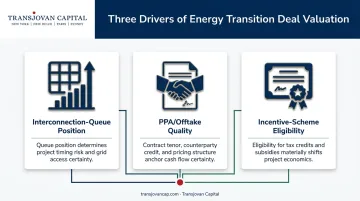
Three factors dominate valuation instead:
- Interconnection-queue position: Wood Mackenzie now probability-weights development pipelines using actual queue data rather than treating every megawatt of announced capacity equally
- PPA/offtake quality: Longer-tenor power purchase agreements with creditworthy counterparties improve project bankability, while weak offtaker credit ranks among the leading financing barriers for Indian renewable projects
- Incentive-scheme eligibility: Schemes like India's Production-Linked Incentive programs for solar modules and battery cells, or the National Green Hydrogen Mission's ₹17,490 crore SIGHT allocation, reshape the economics of manufacturing-linked assets
The Platform Premium
Buyers increasingly pay up for speed rather than individual project economics. Instead of buying one wind farm, they acquire an entire development company, complete with its pipeline, permits, and team, in a single transaction.
Brookfield's 2024 move on French renewables developer Neoen is the clearest recent example. The offer implied roughly €6.1 billion in equity value for a business with more than 8.3 GW operating or under construction at the time. That's a premium for scale and execution capability, not just for megawatts already generating revenue.
Cross-border deals add further layers:
- FDI sectoral caps and merger-control deal-value thresholds shape whether a transaction runs as a share acquisition, a business transfer, or a scheme of arrangement
- Warranty & indemnity insurance is becoming standard as sellers push for clean exits. Energy and infrastructure deals grew their share of W&I volume from 2022 to 2023, per Howden's annual M&A report
- Technical diligence covers grid connectivity studies, land title verification, environmental permit review, and engineering assessments closer to a reserve report than a standard quality-of-earnings exercise
A generalist M&A process, run on a standard 90-day timeline with standard diligence checklists, routinely under-credits these factors. That's the gap a specialist, structuring-led approach is built to close.
How Transjovan Structures Energy Transition Deals
Strategic Mandate & Origination
Transjovan's CDaaS engagement doesn't start with a target list. It starts by mapping the client's decarbonization or growth roadmap: what capacity is needed, over what timeframe, and through what risk appetite. Only then does origination begin.
This matters because origination criteria built without sector context tend to miss real signals. Atishay Jain, Head – Renewables, brings prior strategy and M&A leadership from Fortum and CRISIL, plus a stint heading Investments & Strategy for a major European utility.
That background shapes how the firm reads IPP relationships, structures early partnership conversations, and manages deal pipelines before a formal process even opens.
Structure Selection: Platform, Asset, or Joint Venture
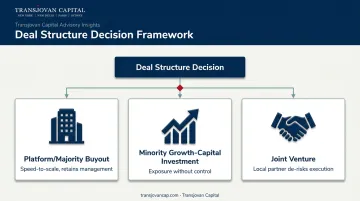
Structure, not valuation, drives long-term deal success. Transjovan applies a decision framework rather than a template:
- Platform or majority buyout: when the client needs speed-to-scale and wants to retain the target's existing management and pipeline
- Minority growth-capital investment: when the client wants exposure to a segment without operational control
- Joint venture: when a local partner brings land access, PPA relationships, or regulatory standing that meaningfully de-risks execution
None of these is a default. The choice depends on promoter intent, where the investor sits in its fund life-cycle, and how the asset fits the client's longer-term strategy.
This is also where Transjovan's synergy-capture metric matters most. A platform deal that closes cleanly but never integrates delivers a worse outcome than a smaller JV that actually compounds.
Valuation & Deal Mechanics
Valuation blends conventional approaches with renewable-specific metrics:
- EV/MW for comparing capacity-based value across projects
- CFADS (cash flow available for debt service), which underpins debt-sizing and DSCR calculations in project finance
- Dividend yield, particularly for operating assets generating stable contracted cash flows
Undeveloped or under-construction capacity creates valuation gaps that a flat multiple can't bridge. That's where mechanics like earn-outs, capped deferred consideration, and pipeline-linked escrows come in.
These structures let buyers pay for realized pipeline conversion rather than speculative capacity, and they show up most often in solar and wind deals where construction risk and grid-connection timelines drive the biggest valuation swings.
Execution & Post-Deal Value Capture
Signing isn't the finish line. Partner-led execution means senior ex-CXOs and bankers personally run negotiations rather than delegating to junior deal teams. This allows complex stakeholder dynamics between promoters, financial investors, and regulators to resolve into synergy realization after close.
Common Deal Structures Seen in Energy Transition Transactions
Three structural patterns dominate current activity:
Platform acquisitions. KKR's 2024 takeover of German solar-and-wind operator Encavis is a good reference point — an implied €2.8 billion equity value and roughly €4.7 billion enterprise value for a platform exceeding 3.5 GW of managed capacity. Buyers pay for the development engine, not a single asset.
Joint ventures and technology partnerships. In segments like batteries and green hydrogen, where technical risk is still high, JVs let parties share exposure.
The 2024 licensing agreement between PowerCo and QuantumScape illustrates this: PowerCo gained rights to manufacture up to 40 GWh annually using QuantumScape's solid-state battery technology, with an option to expand to 80 GWh, while a joint team handled industrialization. Neither party carried the full technical risk alone.
Growth-capital and minority-stake deals. Independent power producers frequently need capital to fund pipeline conversion without ceding control to a strategic buyer. Transjovan's own advisory experience includes growth-capital raises above $10 million, structured to give investors exposure to pipeline growth while promoters retain operational decision-making.
Regulatory & Diligence Considerations That Shape Structuring
Regulatory thresholds directly determine deal shape in energy transition transactions.
In India specifically:
- Power generation, transmission, and distribution generally permit 100% FDI under the automatic route, though power exchanges carry a separate 49% cap
- The Competition Commission of India's deal-value threshold triggers notification when consideration exceeds ₹2,000 crore and the target has substantial India operations, catching deals that miss standard asset or turnover tests
- Licensed-utility transfers require prior approval from the relevant electricity regulator under Section 17 of the Electricity Act, separate from any CCI clearance
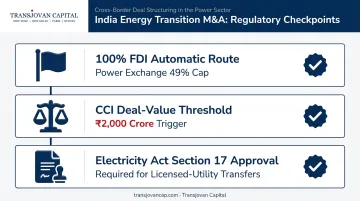
These thresholds influence whether a transaction is structured as a share purchase, a business transfer, or a scheme of arrangement. Our team factors this into deal design from day one, rather than addressing it after terms are set.
Diligence has also evolved. Beyond financial and legal review, buyers now expect engineering assessments of grid connectivity, PPA quality checks against counterparty credit, and increasingly, W&I insurance to bridge residual risk on both sides of the table.
Financing structures are widening too. Global private credit grew from roughly $300 billion in 2010 to $1.6 trillion in 2023, according to PwC, with infrastructure and energy-transition financing cited as a growth driver. That gives sponsors more flexibility in how they capitalize a deal beyond pure equity or bank debt.
Why Global Enterprises Choose Transjovan for Energy Transition Mandates
Most companies engage a banker per transaction, then rebuild context from scratch on the next deal. That's expensive in CXO time and it loses institutional memory between mandates.
Transjovan's CDaaS model works differently:
- Functions as a multi-year, embedded corporate development engine rather than a series of one-off engagements, reducing the ongoing bandwidth burden on client leadership teams
- Pairs a dedicated Renewables practice under Atishay Jain with the firm's broader $15 billion+ cumulative transaction track record
- Delivers every mandate through partner-led execution, staffed by ex-CXOs and ex-Big-4 professionals with an average of roughly 20 years of experience
- Operates from New Delhi, New York, Paris, and Sydney, built specifically for cross-border energy transition mandates that touch multiple regulatory regimes
Transjovan was recognized as the "Best M&A Advisory Firm in India" in 2024, third-party validation of a structuring-led approach that measures success through synergy capture rather than transactions closed.
Transjovan Capital's Work in Energy Transition M&A
Transjovan Capital's perspective on energy transition M&A in India comes out of live mandates rather than desk research. The firm attended the Indo-French Chamber of Commerce and Industry's 48th Annual General Meeting in Mumbai on 26 September 2025 — themed "Innovating for Tomorrow" and drawing 400+ C-suite leaders from BNP Paribas, Capgemini, Saint-Gobain, Schneider Electric and TotalEnergies (release). Indo-French transaction value has passed USD 10 billion over the last three years, and Managing Partner Gaurav Asthana framed the fit as one where "France's strategic focus on clean tech, renewables, and industrial innovation aligns with India's manufacturing and green-energy push."
As a member firm of the Indo-German Chamber of Commerce, Transjovan Capital attended its 69th Annual General Meeting in Mumbai on 24 September 2025, an event drawing over 300 senior leaders, policymakers and diplomats, where the headline panel — "Germany & India: Evolving Together" — examined how German companies are contributing to India's industrial evolution (release). Commenting on the corridor, Asthana said: "German OEMs are pursuing GTM-driven acquisitions or partnerships in India. Germany's energy transition coupled with India's manufacturing drive create room for bi-directional bolt-ons." On the Australian side, Asthana has pointed to Indian acquirers "targeting critical minerals in Australia to back EV and grid storage plans" (release). The firm took the Platinum award for Best M&A Advisory Firm at the M&A Conclave & Awards hosted by Transformance Forums in Bengaluru in October 2024 (announcement).
Frequently Asked Questions
What is an energy transition deal in M&A?
An energy transition deal is an M&A, joint venture, or capital transaction involving renewables, storage, hydrogen, EV/battery, or decarbonization-linked businesses and assets. Structuring differs from conventional M&A because value drivers are sector-specific.
What is the difference between a platform acquisition and an asset-level deal in renewables?
A platform deal acquires an entire company, including its pipeline and team. An asset deal buys individual projects. Platforms cost more but deliver speed-to-scale; asset deals are cheaper but slower to compound.
How is a renewable energy asset valued in an M&A deal?
Valuation blends EBITDA-style multiples with EV/MW capacity metrics and CFADS-based project finance analysis. PPA tenor and offtaker credit quality also directly influence the final number.
What role does a corporate development advisor play in energy transition M&A?
Unlike a transactional banker engaged deal-by-deal, an embedded advisor defines strategy, runs origination, structures the transaction, and stays through post-deal synergy capture across multiple mandates.
What are the key regulatory approvals needed for energy M&A deals in India?
Deals typically need to clear FDI route requirements and CCI merger-control thresholds, including the deal-value test above ₹2,000 crore. Sector-specific approvals, like electricity regulator consent for licensed-utility transfers, may also apply.
Why do companies choose joint ventures over outright acquisitions in the energy transition space?
JVs let partners share technical and regulatory risk while accessing land, PPA relationships, or local market knowledge the buyer doesn't have. They're often more capital-efficient than a full buyout in unproven segments like hydrogen or storage.