Introduction
Structuring an Indo-German M&A transaction means designing the legal entity, ownership transfer, tax, financing and governance architecture that connects an Indian and a German company in a cross-border deal. Get this wrong, and a good deal turns into a slow, expensive one.
Many dealmakers treat structuring as legal paperwork handled after the commercial terms are agreed. That's backwards. Structuring decisions made in week one determine tax outcomes, approval timelines and whether the two companies can actually work together after closing.
This guide targets CFOs, corporate development teams, promoters and PE investors evaluating deals between India and Germany. Dual regulatory regimes, the India-Germany Double Taxation Avoidance Agreement in force since 1996, and a persistent valuation gap between German engineering assets and Indian manufacturing targets keep driving deal flow between these two economies.
This article walks through the common deal structures, the regulatory and tax factors shaping them, and where standard playbooks fall apart.
Key Takeaways
- Indo-German deals must clear India's FEMA/FDI and Germany's AWV screening simultaneously, not sequentially
- Share deals, asset deals and joint ventures carry distinct tax exposure and liability profiles
- Early DTAA and holding-structure planning can change after-tax deal economics substantially
- German works council consultation is frequently underestimated and causes real closing delays
- Generic, one-size-fits-all holding structures often fail smaller and mid-market transactions
What Is Structuring in Indo-German M&A Transactions?
Structuring is the design of the legal, ownership, tax and financing framework used to execute an acquisition, merger or joint venture between an Indian and a German party. Done well, it produces a transaction that is regulatory-compliant in both jurisdictions, tax-efficient, and operationally workable once the deal closes.
That last part matters more than most buyers expect. A structure can be perfectly compliant on paper and still create friction the moment integration teams try to align reporting lines, IT systems or decision rights.
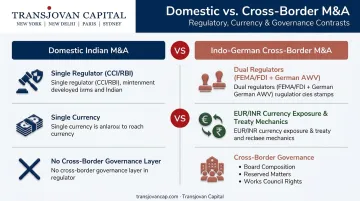
How this differs from domestic M&A structuring:
- Two regulators must clear the deal, not one: India's FEMA/FDI regime and Germany's AWG/AWV screening
- Currency exposure (EUR/INR) and treaty mechanics layer onto standard valuation and financing decisions
- Cross-border governance questions (board composition, reserved matters, works council rights) don't exist in a purely domestic deal
A domestic Indian acquisition closes when CCI, RBI reporting and shareholder approvals are done. An Indo-German deal adds a second regulator and a second legal system, often conducted in a different negotiating language entirely.
Why Proper Deal Structuring Is Critical for Indo-German Cross-Border M&A
The corridor is real and growing. India-Germany bilateral goods trade reached USD 33.40 billion in 2024, with services trade adding another USD 17.03 billion, up 15% year-on-year.
German FDI into India touched USD 469 million in FY2024-25 alone, according to the Indian Embassy Berlin's economic and commercial relations data. More than 1,800 German company branches are active on the ground in India today.
That volume of deal flow runs into two separate approval regimes at once.
The Dual-Approval Reality
India's FDI policy routes investments through either an automatic channel (no prior approval needed) or a government approval route for sensitive sectors. Germany's AWV rules work differently: they screen by ownership percentage and sector, with notification thresholds set at 10%, 20% or 25% depending on the target's activity.
- 10% threshold sectors include critical infrastructure, telecommunications surveillance, cloud computing, media and defense-adjacent activities
- 20% threshold sectors cover AI, robotics, semiconductors, cybersecurity, aerospace and quantum technologies
- 25% threshold applies to most other German targets outside these sensitive categories
Missing either screen doesn't just delay a deal: in Germany, transactions in notifiable sectors face standstill restrictions until clearance.
What Goes Wrong Without Proper Structuring
Poor structuring shows up later, usually at the worst possible moment:
- Tax leakage on exit when capital gains aren't planned against Article 13 of the DTAA
- Delayed or denied approvals because sector classification wasn't checked against both regimes upfront
- Post-merger friction when German consensus-driven governance meets Indian promoter-led decision-making without a documented framework
Two Directions, Two Different Playbooks
This corridor has a clear shape: German engineering, auto-component, chemicals and industrials companies acquiring Indian manufacturing assets, and Indian companies acquiring German technology and IP-rich Mittelstand firms. Both directions carry distinct regulatory profiles, and neither should be structured using the other's template.
Structuring here isn't just a compliance checkbox for RBI/FEMA reporting or German merger control filings. It's also where deal value gets protected or lost, and advisors with genuine on-ground presence in both markets tend to catch problems earlier.
Transjovan Capital's connection to this corridor runs through its Indo-German Chamber of Commerce membership and Managing Partner Gaurav Asthana's experience advising cross-border mandates involving German entities like Altana, a specialty chemicals business. That sector-specific, dual-market fluency is hard to replicate with a generic advisory model.
How Indo-German M&A Transactions Are Structured (Conceptual Flow)
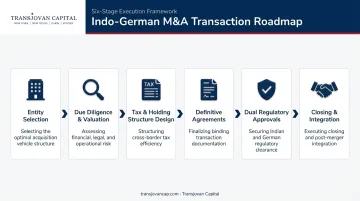
At a high level, every Indo-German deal moves through the same six stages: entity selection, due diligence and valuation, tax and holding structure design, definitive agreements, dual regulatory approvals, and closing/integration.
What feeds into this process:
- Target and buyer profile (listed vs. private, sector classification)
- DTAA tax treaty analysis specific to the transaction type
- Available financing sources and currency of consideration
What gets decided during core structuring: whether the deal runs as a share purchase, asset purchase, merger, or joint venture, and where, if anywhere, an SPV or holding company sits in the ownership chain.
How the process stays controlled: coordinated legal counsel in both India and Germany, cross-border tax advisors applying DTAA provisions correctly, and RBI/FEMA compliance checkpoints built into the timeline rather than bolted on at the end.
The result: a final ownership structure, a defined tax residency for sale proceeds, and a board composition that reflects actual post-deal governance — not just signing-day optics.
Step 1: Choosing the Deal Structure (Share Deal, Asset Deal, or Joint Venture)
Each structure carries different consequences:
| Structure | Liability transfer | Tax treatment | Approval complexity |
|---|---|---|---|
| Share deal | Buyer inherits all existing liabilities | Generally more seller-tax-efficient | Moderate |
| Asset deal | Buyer selects specific assets/liabilities | More re-papering, less favourable transfer-tax treatment | Higher (individual consents) |
| Joint venture | Parties retain separate identities | Depends on JV agreement structure | Governance-dependent |
A joint venture is typically preferred when market entry, not full control, is the goal, particularly when the German party wants Indian manufacturing scale without fully divesting operational control, or vice versa. In Germany specifically, an asset deal for a German business triggers automatic employee transfer under BGB Section 613a, with a one-month objection window for affected staff.
Step 2: Structuring for Tax Efficiency Using the India-Germany DTAA
The India-Germany Double Taxation Avoidance Agreement, in force since 1996, caps source-country withholding tax at 10% of gross amounts for dividends, interest, and royalties or fees for technical services — provided beneficial ownership conditions are met.
Capital gains work differently. Article 13 generally allows the company's resident state to tax gains on share sales. In practice, this means:
- India can tax a German seller's gain on Indian company shares
- Germany can tax gains on German company shares
- A holding company doesn't automatically eliminate this exposure — it has to be structured with beneficial-ownership substance, not just paper residency
This is where holding structures earn their keep, but only when built around genuine commercial substance rather than treaty-rate arbitrage.
Step 3: Regulatory Compliance, Financing and Closing Mechanics
Closing mechanics run on parallel regulatory tracks:
- FEMA/RBI reporting: FC-GPR for equity issuance to a nonresident (30-day deadline) and FC-TRS for share transfers (60-day deadline), both filed via the FIRMS portal
- German merger control: Bundeskartellamt review applies once combined worldwide turnover exceeds EUR 500 million, with individual thresholds of EUR 50 million and EUR 17.5 million in German turnover
- AWG screening: for sensitive-sector targets, based on the ownership thresholds discussed earlier
- Escrow arrangements: standard for deferred consideration or earn-outs given EUR/INR currency movement between signing and payout
Key Regulatory, Tax and Cultural Factors That Shape the Structure
Beyond the core mechanics, four recurring factors shape how a structure actually gets built:
- Sector classification under India's FDI automatic/government route split, matched against Germany's AWV thresholds for the same target
- Currency exposure between EUR and INR, particularly for deferred consideration, earn-outs, or multi-tranche payments
- Structural dependencies, including coordinated dual legal counsel, escrow banking arrangements, and properly executed treaty documentation
- Deal-size thresholds that trigger CCI approval in India (asset/turnover tests running into thousands of crores) and Bundeskartellamt review in Germany
German Works Council Consultation (Mitbestimmung)
A fifth factor stands apart: works council consultation, required under BetrVG Section 111 for enterprises with more than 20 voting-eligible employees when a planned change could cause substantial workforce disadvantage.
A straightforward share purchase alone usually doesn't trigger this consultation if operations remain unchanged. Any associated restructuring, and most cross-border deals involve some, almost always does, with no fixed statutory timeline for how long consultation takes.
Common Mistakes and When to Rethink the Standard Structure
The biggest mistake in this corridor is assuming one holding structure fits every deal size. A multi-tier holding structure routed through the Netherlands or Singapore makes sense for a EUR 200 million acquisition. It rarely pays for itself on a EUR 15 million deal, where the compliance overhead outweighs the tax benefit.
Other recurring errors:
- Underestimating works council timelines. Teams often read a slipping closing date as a negotiation problem, when it's actually a Mitbestimmung consultation running its course
- Confusing tax optimization with treaty shopping. The DTAA's beneficial-ownership and residency tests are substantive, not formalities. A conduit entity with no real operations invites scrutiny from both tax authorities, and India's CBDT has issued specific guidance on principal purpose testing for this reason
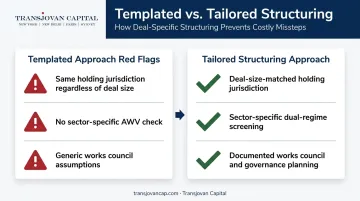
- Relying on templated structures. A structure copied from a prior Indo-French or Indo-US deal often misses German-specific requirements around works councils, employee transfer rules, or AWV sector screening
Red flags of a templated approach include the same holding jurisdiction regardless of deal size, no sector-specific AWV check, and generic works council assumptions. When a deal shows these signs, that's the signal to bring in specialists rather than push forward. This is the gap Transjovan Capital's Corporate Development as a Service (CDaaS) model is built to close: partner-led, tailored structuring support instead of a one-size-fits-all template applied across unrelated deals.
Transjovan Capital in the Indo-German Corridor
Transjovan Capital's own work on the Indo-German corridor shows how these principles play out in practice. As a member firm of the Indo-German Chamber of Commerce, Transjovan Capital attended its 69th Annual General Meeting in Mumbai on 24 September 2025, an event drawing over 300 senior leaders, policymakers and diplomats, where the headline panel — "Germany & India: Evolving Together" — examined how German companies are contributing to India's industrial evolution (release). Commenting on the corridor, Managing Partner Gaurav Asthana said: "German OEMs are pursuing GTM-driven acquisitions or partnerships in India. Germany's energy transition coupled with India's manufacturing drive create room for bi-directional bolt-ons."
The firm has been buy-side by design since Gaurav Asthana set it up in 2011, built for Fortune 500 and mid-market acquirers that needed proprietary origination and embedded corporate development rather than a broker. He told ION Analytics (Mergermarket) that inbound work now runs at 60-70% of the book, with outbound at 30-40%. The firm has advised on $15 billion+ in cumulative transactions across 250+ clients, and took the Platinum award for Best M&A Advisory Firm at the M&A Conclave & Awards hosted by Transformance Forums in Bengaluru in October 2024 (announcement).
Frequently Asked Questions
What are the common deal structures used in Indo-German M&A transactions?
Share deals, asset deals, and joint ventures are the three main options. Share deals suit full-control acquisitions, asset deals suit selective liability transfer, and joint ventures work best for market entry without full divestment of control.
How does the India-Germany DTAA affect deal structuring?
The DTAA caps withholding tax at 10% on dividends, interest, and royalties when beneficial-ownership conditions are met. Capital gains on share sales, however, are generally taxed in the seller's state of residence under Article 13.
What regulatory approvals are required for German companies acquiring Indian businesses?
German acquirers need to navigate India's FEMA/RBI reporting (FC-GPR/FC-TRS filings), sectoral FDI caps under the automatic or government route, and CCI approval if deal-value or asset/turnover thresholds are crossed.
Is a share purchase or asset purchase better for Indo-German M&A deals?
Share purchases are generally more tax-efficient for sellers but transfer all existing liabilities to the buyer. Asset purchases let buyers select specific assets and liabilities but require more contract re-papering and, in Germany, trigger automatic employee transfer rules.
How long does it typically take to close a cross-border Indo-German M&A transaction?
Timelines vary widely with regulatory approvals and works council consultation, but most structured deals take anywhere from four to nine months from signing to closing. Complex sector-screened or works-council-heavy deals can run longer.
What role does cultural and governance due diligence play in structuring Indo-German deals?
German consensus-driven governance and Indian promoter-led decision-making need explicit alignment in the deal structure, not assumption. Board composition, reserved matters, and decision rights should be documented upfront to prevent post-closing friction.