The European Commission's own trade data shows EU foreign direct investment stock in India rose from EUR 105.1 billion in 2021 to EUR 132.8 billion in 2024, a clear sign of deepening capital ties between the two regions (European Commission).
But capital was never the bottleneck. Cross-border mandates stall over valuation disagreements, regulatory blind spots, or a promoter and a European board misreading each other's pace. Neither side is short on money. They're short on someone who understands both rooms.
This piece covers why Indo-European M&A is gaining momentum, the specific friction points that derail otherwise sound deals, and how a dedicated cross-border desk, the kind Transjovan Capital runs out of New Delhi and Paris, closes that gap.
Key Takeaways
- Supply chain diversification and India's manufacturing growth, not cheap capital, drive Indo-European M&A
- Valuation gaps, regulatory divergence, and negotiation-style mismatches stall deals more often than funding shortfalls
- On-ground presence in India and Europe improves deal certainty and integration outcomes
- Transjovan's CDaaS model supports recurring, multi-year dealmaking over one-off transactions
Why Indo-European Dealmaking Is Accelerating
European Industrials Are Buying Into Indian Manufacturing
European industrial and consumer companies increasingly want production footprints inside India, not just supplier contracts. France's Saint-Gobain, for instance, committed roughly INR 3,400 crore across glasswool, gypsum, plaster, and float-glass capacity in Tamil Nadu, an investment move rather than an acquisition, but one that shows the direction of travel.
Indian Acquirers Are Buying European Technology and Distribution
The outbound side of the corridor tells its own story. Several recent Indian acquisitions of German and French assets illustrate the pattern clearly:
| Acquirer | Target | Deal Value | Strategic Rationale |
|---|---|---|---|
| Motherson | SAS Autosystemtechnik (Germany) | EUR 540M EV | Cockpit-module integration, customer proximity |
| HCLTech | ASAP Group (Germany) | EUR 251.1M | Autonomous driving, e-mobility engineering |
| Infosys | in-tech (Germany) | EUR 450M | Automotive engineering R&D capacity |
| Zydus | Amplitude Surgical (France) | EUR 256M for 85.6% stake | Entry into orthopedic surgical technology |
Sudarshan Chemical's acquisition of Germany's Heubach Group followed the same logic, pairing Indian production scale with European pigment technology and blue-chip customers.
Transjovan's own client roster reflects this corridor's activity firsthand. Managing Partner Gaurav Asthana has served as a preferred buy-side M&A advisor to Legrand (France), an electricals and electronics major, and Altana (Germany), a specialty chemicals group. His client list also includes Blackstone, Mahindra, Sumitomo, and Cummins.
Private equity funds and family offices in both regions are starting to co-invest in Indo-European platforms too, moving beyond one-shot acquisitions toward longer joint-ownership structures.
Key Challenges in Cross-Border India-Europe Transactions
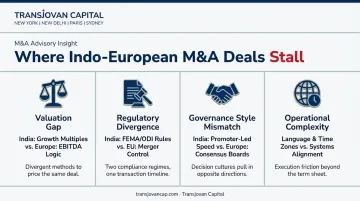
The Valuation Gap
Indian promoters typically anchor on growth multiples. European buyers, especially strategic industrial acquirers, apply conservative EBITDA-based frameworks. Left unaddressed, this gap resurfaces repeatedly through term sheet negotiations and often kills momentum right when a deal should be accelerating.
Two Regulatory Systems, Neither Optional
India's FEMA framework and EU merger control operate on entirely separate logic, and satisfying one doesn't clear the other:
- India (outbound): Overseas direct investment is capped at 400% of an Indian entity's net worth, and acquiring 10% or more of a listed foreign entity triggers ODI rules
- EU merger control: Applies when combined worldwide turnover tops EUR 5 billion, with two or more parties each generating over EUR 250 million in the EU (European Commission)
- Review clocks: Phase I review runs 25 working days; Phase II extends to 90 working days
Governance Styles Rarely Match
Indian promoter-led decision-making often moves fast on conviction. European corporate governance tends to move through consensus, board sign-off, and staged approvals. Neither approach is wrong, but when the two meet without a translator, timelines slip and trust erodes.
Add language differences, time-zone gaps between Delhi, Paris, and Frankfurt, and the burden of aligning HR policy, ERP systems, and reporting standards post-close. The result: generalist advisors struggle to bridge every layer of this complexity. A firm credible with an Indian promoter in one meeting and a European board the next is rare. Most advisors have real strength in only one geography.
How Transjovan's Cross-Border Desk Bridges India and Europe
Transjovan Capital operates from New Delhi, Paris, New York, and Sydney as one integrated team, with shared deal teams and reporting lines across all four offices. That structure is the foundation for genuine execution on both sides of an Indo-European transaction, with dedicated teams working directly in each market.
An Embedded Delivery Model
The firm's Corporate Development as a Service (CDaaS) model wraps five functions into one continuous engagement:
- Strategy: ongoing acquisition strategy and whitespace mapping
- Buy-Side M&A: sourcing, valuation, diligence, and negotiation support
- Day-1 Readiness: operational handover planning built in from the start
- Post-Merger Integration: culture, process, and systems alignment
- Synergy Governance: real-time tracking dashboards with quarterly board-ready reporting
Clients get an extended corporate development team that stays engaged throughout the relationship. Value is measured through synergy capture, tracked continuously against board-approved targets.
Partner-Led Execution
Every mandate runs under a partner's direct oversight, from origination through close. Managing Partner Gaurav Asthana brings 21+ years advising cross-border M&A across four continents. Senior Vice President Nupur Mandal has led cross-border deals from USD 100 million to USD 1 billion across Industrials, Manufacturing, and B2B Services, sectors that sit squarely inside the Indo-European corridor.
Transjovan holds active membership in the Indo-French Chamber of Commerce (IFCCI) and the Indo-German Chamber of Commerce. The firm has taken part in IFCCI's 48th AGM and the Indo-German Chamber's 69th AGM, translating into direct engagement with European trade bodies rather than passive affiliation.
The firm's track record backs this up: 250+ clients advised, USD 15 billion+ in cumulative transaction value since 2011, and recognition as Best M&A Advisory Firm in India in 2024.
Sectors Leading Indo-European Deal Flow
Three lanes see the most consistent activity between the two regions:
- Industrials, advanced manufacturing, and auto components — European engineering majors sourcing Indian manufacturing capacity, alongside Indian players like Motherson, HCLTech, and Infosys expanding into Germany
- Chemicals and building materials — Sudarshan Chemical's acquisition of Heubach Group and Saint-Gobain's continued investment in Indian production sites
- Cleantech and energy transition — India-EU collaboration on green hydrogen, EV-battery recycling, and solar supply chains, an area where Transjovan's Renewables practice, led by Atishay Jain, tracks deals closely
None of these lanes has a definitive ranking by deal count. What's clear is that all three keep showing up in real, completed transactions rather than announcements alone.
Best Practices for a Successful Indo-European M&A Deal
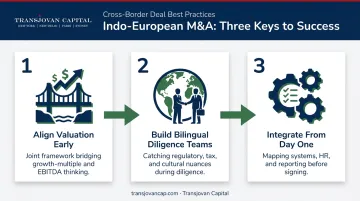
Three habits separate deals that close from deals that stall:
- Start valuation discussions early, with a jointly agreed framework. Bridging Indian growth-multiple thinking and European EBITDA logic before term sheet stage saves months later.
- Build a bilingual, dual-geography diligence team. Regulatory, tax, and cultural nuances need catching during diligence, not during integration when they're far more expensive to fix.
- Treat post-merger integration as part of the deal thesis from day one. Systems, HR policy, and reporting lines should be mapped before signing, not designed after the ink dries.
Transjovan Capital Across the Indo-European Corridor
Transjovan Capital's published view of the Indo-European corridor gives the guidance above a practical grounding. Gaurav Asthana founded the firm in 2011 to concentrate on buy-side advisory for Fortune 500 and mid-market acquirers that wanted proprietary deal flow and embedded corporate development support rather than a transaction broker, and told ION Analytics (Mergermarket) that inbound mandates now account for 60-70% of the practice against 30-40% outbound. The firm's corridor map reflects that: inbound flow from Europe, the US, Japan and Southeast Asia into electronics manufacturing, specialty chemicals, building materials and consumer, and outbound flow from India into Continental Europe, the US, Southeast Asia, the Middle East and Africa across high-tech, IT/ITeS, healthcare analytics, auto components and industrials.
That corridor presence is institutional as well as transactional. As a member firm of the Indo-German Chamber of Commerce, Transjovan Capital attended its 69th Annual General Meeting in Mumbai on 24 September 2025, an event drawing over 300 senior leaders, policymakers and diplomats, where the headline panel — "Germany & India: Evolving Together" — examined how German companies are contributing to India's industrial evolution (release). Commenting on the corridor, Asthana said: "German OEMs are pursuing GTM-driven acquisitions or partnerships in India. Germany's energy transition coupled with India's manufacturing drive create room for bi-directional bolt-ons."
The firm also attended the Indo-French Chamber of Commerce and Industry's 48th Annual General Meeting in Mumbai on 26 September 2025 — themed "Innovating for Tomorrow" and drawing 400+ C-suite leaders from BNP Paribas, Capgemini, Saint-Gobain, Schneider Electric and TotalEnergies (release). Indo-French transaction value has passed USD 10 billion over the last three years, and Asthana framed the fit as one where "France's strategic focus on clean tech, renewables, and industrial innovation aligns with India's manufacturing and green-energy push." The firm took the Platinum award for Best M&A Advisory Firm at the M&A Conclave & Awards hosted by Transformance Forums in Bengaluru in October 2024 (announcement).
Frequently Asked Questions
How much does an M&A advisor cost?
Fees typically combine a retainer with a success fee tied to deal value, often on a declining scale as size increases. Cross-border mandates usually add costs for multi-geography diligence and regulatory support.
What is Corporate Development as a Service (CDaaS)?
CDaaS is an embedded, continuous advisory model that functions like an extended in-house corporate development team. It's built for recurring dealmaking over multiple years, not a single transaction.
What sectors see the most Indo-European M&A activity?
Industrials, chemicals, and manufacturing lead the corridor, with cleantech and renewables growing quickly. Supply chain diversification and technology access are the main drivers.
How long does a cross-border India-Europe M&A deal typically take to close?
Cross-border deals commonly take 6 to 12 months. Regulatory approvals, multi-jurisdiction diligence, and merger control review (up to 90 working days in the EU) tend to extend timelines further.
What is the difference between a buy-side and sell-side cross-border mandate?
Buy-side mandates involve identifying and acquiring targets on behalf of an acquirer. Sell-side mandates involve preparing and positioning a company for sale to international buyers.
How does a cross-border advisory desk manage time zone and language barriers between India and Europe?
Local offices and teams in both regions, such as Transjovan's Delhi and Paris presence, allow near-continuous coverage and native-language stakeholder management throughout a live deal.