For founders and CXOs running F&B businesses, this is both an opportunity and a headache. Many lack the in-house bandwidth or specialized deal expertise to navigate valuation nuances, food safety compliance, and post-deal integration challenges unique to this sector.
This article covers why the sector is heating up, the due diligence traps buyers and sellers should watch for, how a typical F&B advisory mandate unfolds, and what to look for when choosing an M&A partner.
Key Takeaways
- Premiumization, D2C disruption, and PE-led consolidation fuel F&B M&A in India
- Food safety, brand equity, and supply chain risks create unique diligence needs
- Sector-experienced advisors with operator-level expertise improve deal outcomes
- Ex-Cargill CFO Deoki Muchhal leads Transjovan's Consumer practice for F&B deals
Why the Food & Beverage Sector is a Hotbed for M&A in India
India's food-processing market touched $354.5 billion in 2024 and is projected to cross $535 billion by FY26, according to IBEF. That scale, combined with shifting consumer habits and a wave of new entrants, explains why deal activity keeps accelerating.
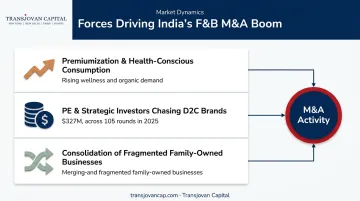
Three forces are driving this in particular.
Premiumization & Health-Conscious Consumption Fueling Deal Activity
Indian consumers are trading up. Demand for organic, protein-rich, and "better for you" products is growing faster than legacy shelf staples, and big FMCG players have concluded it's faster to buy this growth than build it internally.
Tata Consumer Products' January 2024 agreement to acquire up to 100% of Organic India, a wellness brand spanning food, beverages, and herbal supplements, at an enterprise value of ₹1,900 crore, is a clear example.
The deal gave Tata Consumer an instant platform in the health and wellness category instead of a multi-year brand-building exercise.
Expect more legacy FMCG names to shop for nutrition and wellness brands rather than launch them in-house.
Private Equity & Strategic Investors Chasing D2C and Emerging F&B Brands
Venture-funded D2C food and beverage brands built strong followings, then hit a wall on distribution economics. Many are now acquisition targets as investors look for exits and strategics look for ready-made brand equity.
India's Food & Beverage Products sector still attracted $327 million across 105 equity rounds in 2025, even after a 17.72% dip from 2024, per Tracxn. That's meaningful capital chasing a narrower set of quality assets:
- D2C brands with proven repeat-purchase economics are commanding premium interest
- Investors increasingly prefer strategic sale over another funding round
- Category leaders in protein, snacking, and beverages see the most inbound interest
Consolidation of Fragmented, Family-Owned F&B Businesses
India's F&B sector remains overwhelmingly unorganized. A large share of enterprises are family-run, and many face succession gaps that make a sale more attractive than a generational handover.
Global strategics have noticed. Rather than build distribution and brand equity from scratch, many entrants prefer buying their way in, since it's faster and less risky than a greenfield launch in a market this fragmented.
For promoter families without a clear next generation ready to take over, consolidation is often the most practical path to liquidity and continuity.
Critical Challenges & Due Diligence Considerations in F&B M&A Deals
Generic M&A checklists miss a lot in food and beverage. The sector has its own failure points, and skipping them is how deals unravel after signing.
Regulatory & Food Safety Compliance
Every food business operator in India needs registration or licensing under FSSAI regulations, with requirements scaling by turnover and business type. Buyers should verify:
- Valid FSSAI license status and renewal history
- Any pending improvement notices or compliance actions
- Import/export certifications for cross-border products
- History of category or capacity changes requiring re-filing
Gaps here rarely kill a deal outright, but they routinely delay closing or trigger valuation discounts once buyers price in the compliance cleanup.
Brand Equity & Intangible Asset Valuation
Beyond regulatory compliance, F&B assets often carry limited tangible book value but significant brand equity, the kind that doesn't show up on a balance sheet. Valuing consumer trust and repeat-purchase loyalty takes more than a standard EBITDA multiple exercise.
This is especially tricky for D2C brands with thin operating history but strong digital engagement, and for legacy brands whose value sits in decades of distribution presence rather than recent financials.
Supply Chain, Distribution & Working Capital Assessment
Setting brand value aside, perishability changes everything about F&B due diligence. Cold-chain dependency, distributor network health, and inventory turnover assumptions all need dedicated scrutiny that a generic working capital review won't catch.
Worth asking before signing:
- How dependent is the business on a handful of large distributors?
- What's the actual wastage rate across the supply chain?
- Is cold-chain infrastructure owned, leased, or third-party — and how resilient is it?
Promoter-Led & Family Business Dynamics
Beyond financial and operational factors, many F&B targets are still run by founding families, and negotiation dynamics differ from a corporate carve-out. Governance can be informal, decision-making concentrated in one or two people, and emotional attachment to the brand real.
Advisors who understand this, and who build trust rather than simply run a process, tend to land better outcomes on both price and post-deal cooperation.
The M&A Advisory Process for F&B Deals: From Strategy to Integration
A well-run F&B mandate typically moves through three stages, each with sector-specific nuances.
Mandate and target identification. The advisor defines acquisition criteria (category, geography, distribution reach) and maps the universe of relevant F&B counterparties. Sector mapping matters more here than in generic M&A: India's F&B landscape includes thousands of unlisted, family-run businesses that never show up in standard databases.
Valuation, due diligence, and negotiation. Beyond financial modeling, F&B valuation weighs brand strength, distribution reach, and category growth potential. Negotiating with promoter-led targets demands more relationship management than a typical corporate deal, since price is rarely the only consideration.
Deal structuring, closing, and post-merger integration. Structuring must account for regulatory approvals, including FSSAI license transfer and, for larger deals, CCI clearance, plus earn-out mechanics tied to brand performance. Integration is where F&B deals create or destroy value, through merging distribution networks, harmonizing brand portfolios, and retaining key sales relationships.
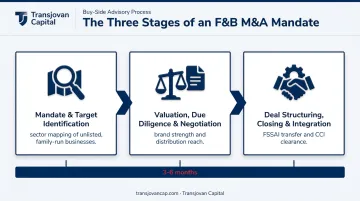
Timelines vary across these stages. Most private M&A transactions in India close within three to six months, though promoter negotiations or regulatory approvals can extend that timeline.
Choosing the Right Food & Beverage M&A Advisory Partner in India
Not every advisory firm is built for F&B. Three things separate a good fit from a bad one.
Sector-specific expertise and network. Advisors with existing relationships across Consumer/F&B buyers, sellers, and investors move faster than those starting cold, shortening timelines and widening the pool of credible counterparties.
Cross-border reach. Global strategics evaluating India need local execution, while Indian F&B brands eyeing overseas expansion need boots on the ground abroad. A firm with only a domestic footprint can't serve either side well.
Partner-led versus junior-staffed execution. F&B negotiations, especially with promoter-owned businesses, often hinge on trust and judgment calls that junior teams aren't positioned to make. A senior-driven process, where a partner or sector head stays in the room throughout, tends to produce better terms and smoother integration afterward.
At Transjovan Capital, the Consumer vertical is led directly by a dedicated sector head rather than delegated to associates once a mandate is signed, reflecting the model described above.
How Transjovan Capital's Consumer Practice Drives F&B Deal Success
Transjovan Capital is a global Corporate Development and M&A advisory firm with a dedicated Consumer practice covering Food & Agriculture alongside FMCG, Retail, Brands, D2C, and Consumer Durables.
The practice is led by Deoki Muchhal, Head - Consumer, who served as MD & CFO at Cargill India. His direct experience leading acquisitions, divestitures, and joint ventures gives the practice a valuable operator's perspective, not just a purely advisory one.
This sits within a broader track record: since 2011, Transjovan has advised 250+ clients on cumulative transactions worth more than $15 billion, including retained buy-side mandates for acquisitive corporations such as Blackstone, Mahindra, and Cummins.
For F&B companies planning multiple acquisitions or exits, Transjovan's Corporate Development as a Service (CDaaS) model provides an alternative to single-deal engagements. This approach embeds an extended corporate development team into the client's organization to handle:
- Strategy and buy-side M&A
- Day-1 readiness planning
- Post-merger integration
This structure takes recurring deal work off a promoter or CXO's plate, freeing them to focus on the core business.
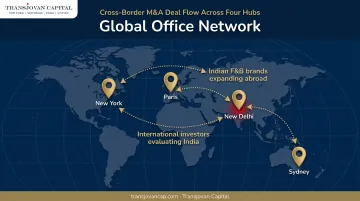
Transjovan operates from four offices — New Delhi, New York, Paris, and Sydney — a footprint that serves two key groups: Indian F&B brands seeking to expand or raise capital abroad, and international investors evaluating acquisitions in India.
For F&B founders, promoters, or investors exploring growth capital, an acquisition, or an exit, Transjovan Capital's Consumer practice provides the expertise to guide your next move.
Transjovan Capital's Track Record in Food and Beverage M&A
How Transjovan Capital reads food and beverage M&A in India is a matter of public record. Gaurav Asthana's rationale in 2011 was a buy-side practice for Fortune 500 and mid-market acquirers who wanted proprietary deal flow and corporate development capacity rather than a transaction broker. He put the current split to ION Analytics (Mergermarket) at 60-70% inbound against 30-40% outbound. The firm's corridor map reflects that: inbound flow from Europe, the US, Japan and Southeast Asia into electronics manufacturing, specialty chemicals, building materials and consumer, and outbound flow from India into Continental Europe, the US, Southeast Asia, the Middle East and Africa across high-tech, IT/ITeS, healthcare analytics, auto components and industrials.
Asthana has also quantified why Indian assets clear at the levels they do, telling ION Analytics (Mergermarket) that acquisition multiples in India's high-growth sectors run roughly 50% above Western comparables — a spread he ties to sector growth of 14-15%, close to double India's GDP growth. The firm took the Platinum award for Best M&A Advisory Firm at the M&A Conclave & Awards hosted by Transformance Forums in Bengaluru in October 2024 (announcement).
Frequently Asked Questions
What is driving the current wave of Food & Beverage M&A in India?
Premiumization and private equity-backed consolidation are driving most of this activity, with many D2C brands actively seeking exits. Legacy FMCG players increasingly prefer buying niche wellness and nutrition brands over building them in-house.
How is a food & beverage company valued during an acquisition?
Valuation typically blends revenue and EBITDA multiples with less quantifiable factors like brand equity, customer loyalty, and distribution network strength. For D2C brands with limited financial history, growth trajectory often carries extra weight.
What role does an M&A advisor play in F&B due diligence?
A sector-experienced advisor checks FSSAI compliance and cold-chain dependencies alongside standard financial and supply chain diligence. They also help quantify intangible brand value that generic frameworks tend to overlook.
Which types of F&B companies attract the most M&A interest in India?
Health and wellness brands, well-funded D2C companies, and regional players with strong distribution networks see the most acquirer interest. Category leaders in fast-growing segments like protein and functional beverages are particularly sought after.
How long does a typical F&B M&A transaction take to close in India?
Most private M&A deals in India close within three to six months. Promoter-led negotiations and FSSAI license transfers can extend this timeline, especially when regulatory approvals are required for larger transactions.
What fees do M&A advisors typically charge for F&B deals?
Most advisors use a retainer-plus-success-fee structure, with the success fee tied to final deal value. Exact terms vary by deal size, complexity, and whether the engagement is transaction-based or a multi-year retained mandate.