Introduction
India's electronics manufacturers are sitting on a rare opportunity. Production-linked incentives, the semiconductor mission, and the global China+1 shift have pulled fresh capital and buyer interest into the sector. Deal volumes are climbing across EMS, components, and battery manufacturing.
Many promoters, however, are still routing complex transactions through generalist advisors. The result: missed valuation drivers, weak technical diligence, and limited access to the global strategics actively hunting for Indian platforms.
This article covers what's driving electronics M&A in India, what sector-specialised advisory actually looks like, and recent deal activity shaping the market. It also explains how a dedicated advisory partner supports manufacturers through this technically demanding process.
Key Takeaways
- India's electronics M&A activity is accelerating on PLI schemes, the semiconductor mission, and China+1 diversification
- Sector-specialized advisors add value through technical diligence, buyer-specific positioning, and cross-border deal structuring
- An embedded, partner-led advisory model reduces bandwidth demands on promoter-CXOs during long, multi-stage deals
- Deal success hinges on protecting IP, ensuring regulatory compliance, and aligning manufacturing systems post-close
Why Electronics Sector M&A is Accelerating in India
India's electronics output jumped from ₹1.9 lakh crore in FY2014-15 to ₹11.3 lakh crore in FY2024-25, with exports touching ₹3.27 lakh crore, according to PIB's data on India's electronics manufacturing growth. Mobile phone exports alone are now 127 times their FY2014-15 level.
That scale-up has created deal supply. Fragmented, promoter-owned businesses that once served only domestic clients are now attractive platforms for global buyers seeking export-ready capacity.
Segments Seeing the Most M&A Activity
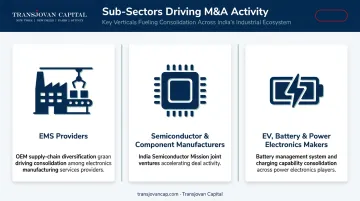
Three sub-sectors are drawing the bulk of activity:
- EMS providers scaling through acquisitions to meet OEM demand for supply chain diversification away from China
- Semiconductor and component manufacturers attracting JV and M&A interest under the India Semiconductor Mission and new component-manufacturing schemes
- EV, battery, and power electronics makers consolidating as demand grows for localised BMS, charging, and storage capabilities
Family-run electronics and electrical component businesses are prime targets here. They often have OEM relationships and factory-floor capability that a strategic can't build fast enough on its own.
Large Indian conglomerates are equally active. Tata Electronics' acquisition of a majority stake in Pegatron's Indian operations is a clear example. An Indian group bought control of a global strategic's local EMS platform to build in-house iPhone-assembly capability, according to a Reuters report.
Why Electronics Manufacturers Need Sector-Specialised M&A Advisory
Generalist advisors are trained to spot financial red flags. Electronics deals demand something else entirely.
Valuation drivers get missed. Proprietary IP, BIS/UL/CE certifications, and active R&D pipelines don't show up cleanly in a standard financial model. An advisor unfamiliar with electronics may underweight a design-linked incentive claim or overlook a certification gap that blocks post-deal shipments.
Buyer fit matters more than price. Global strategics evaluate targets on technology fit and manufacturing footprint, not purely on multiples. A sector advisor understands what a Tier-1 EMS acquirer actually screens for versus what a component-focused PE platform wants.
Cross-border structuring gets complicated fast, and deals in this space typically involve:
- Determining the FDI route (automatic vs. government approval, especially for land-border-country investors)
- Negotiating technology transfer and licensing terms
- Structuring transfer pricing arrangements between the target and its new parent
Vendor concentration is a silent deal-killer, since many EMS and component businesses depend on two or three large OEM contracts. A buyer will dig into that exposure hard, and a generalist advisor rarely stress-tests it before it becomes a negotiation problem.
What to Look for in a Sector-Focused Advisory Partner
When shortlisting an advisor, look for:
- A closed-deal track record specifically in electronics, electricals, or semiconductor manufacturing — not just generic industrials experience
- An active global buyer and PE network relevant to component and electronics acquisitions
- Partner-led engagement, so senior bankers (not junior analysts) handle technically dense negotiations on certifications, IP, and manufacturing terms
Recent M&A Trends & Deals in India's Electronics Sector
The last two years have produced a clear pattern: capability-led consolidation in EMS and components, alongside partner-model expansion in semiconductors.
Notable transactions:
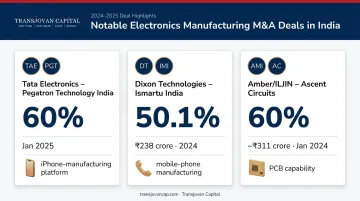
- Tata Electronics – Pegatron Technology India (January 2025): Tata acquired a 60% stake in Pegatron's Indian EMS operation, adding an operating iPhone-manufacturing platform to its electronics business
- Dixon Technologies – Ismartu India (2024): Dixon took an initial 50.1% stake for ₹238 crore, with an agreement to move up to 56% across two tranches, adding mobile-phone manufacturing capability
- Amber/ILJIN – Ascent Circuits (January 2024): Amber's ILJIN unit acquired 60% for roughly ₹311 crore, adding bare PCB capability across single, double, and multilayer boards
Beyond these, semiconductor expansion is moving through technology-partner JVs rather than pure M&A. Tata's fab partnership with Taiwan's PSMC and CG Power's OSAT tie-up with Renesas and Stars Microelectronics are approved projects rather than acquisitions, signaling where component supply chains are heading.
Two buyer patterns stand out: global strategics divesting India operations into local control, as seen with Pegatron's move to Tata, and Indian conglomerates and mid-caps pursuing bolt-on acquisitions to build in-house electronics, PCB, and EV-electronics capability.
How Transjovan Capital Supports Electronics Manufacturers Through M&A
Electronics manufacturers need an advisor who understands both the deal mechanics and the shop floor. That's where a dedicated sector practice makes a measurable difference, visible across six areas of the relationship.
Sector depth, not generalist coverage. Transjovan Capital's Industrials advisory covers Semiconductor & Electronics and Battery Manufacturing as named focus areas. Nupur Mandal, Senior Vice President, has advised on cross-border transactions ranging from USD 100 million to USD 1 billion, with sector experience spanning Industrials, Manufacturing, Semiconductor & Electronics, and Battery Manufacturing.
A client roster that includes electronics majors. The firm's client base includes global electricals and electronics names such as Legrand, Schneider Electric, and Servotech, alongside industrial groups like Cummins, Mahindra, and Hitachi. Managing Partner Gaurav Asthana has personally served as a preferred buy-side advisor to Legrand on acquisitive mandates.
Corporate Development as a Service (CDaaS). Rather than a one-off transaction engagement, CDaaS embeds an advisory team with the client for multiple years, covering acquisition strategy, target sourcing, Day-1 readiness, and post-merger integration.
For a promoter-CXO managing production targets alongside a deal process, this model removes a significant bandwidth burden compared to running an isolated transaction.
Partner-led execution. Ex-Big 4 advisors and former CEOs/CFOs lead every mandate, not junior deal teams, bringing hands-on experience in manufacturing integration and boardroom governance.
Global reach across four offices. With teams in Delhi, New York, Paris, and Sydney, the firm connects Indian electronics manufacturers to strategic acquirers across Europe, the US, and APAC — the exact geographies driving China+1 buyer interest.
Outcomes over deal volume. The firm tracks value through synergy capture and long-term outcomes, not the number of deals closed, keeping advisory incentives aligned with the promoter's actual growth goals.
Key Considerations During an Electronics M&A Deal
Closing the deal is only half the job. A handful of issues determine whether the transaction actually creates value.
Protect proprietary technology and certifications. BIS registration numbers are not transferable between entities, per BIS's own change-of-control documentation. Deal structures need to account for re-registration timelines, patent ownership, and certification continuity before diligence wraps up, since these same details directly affect deal economics.
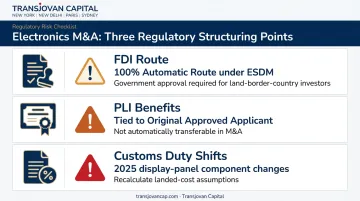
Navigate FDI and incentive rules carefully. Key structuring points include:
- ESDM permits 100% FDI under the automatic route, but land-border-country investors need government approval
- PLI scheme benefits stay tied to the original approved applicant — they don't transfer automatically with a change of control
- Customs duty shifts (like the 2025 changes to display-panel components) can affect landed-cost assumptions in the deal model
Structuring the deal correctly only pays off if integration follows through. Plan post-merger integration early. Manufacturing process alignment, quality system harmonisation, and workforce culture integration between acquirer and target often determine whether projected synergies actually materialise. This work should start during diligence, not after signing.
Transjovan Capital's Track Record in Electronics M&A
Transjovan Capital's perspective on electronics M&A in India comes out of live mandates rather than desk research. Managing Partner Gaurav Asthana has made the case publicly that India's semiconductor market — about $45-50 billion in 2025 and projected to reach roughly $120 billion by 2030 — is being re-rated on capability rather than installed capacity. "In the past, capacity was the main priority in the IT and electronics markets," he told Electronics For You Business. "The situation today, however, is different; everything is focused on capability." He cited NXP's acquisition of Kinara as a deal priced on technology rather than revenue, and put the test for founders plainly: "The keyword is quality, not revenue size."
That thesis runs straight into valuation. Writing in Dataquest, Asthana argued that Indian semiconductor companies building proprietary silicon IP today are building acquisition premium for tomorrow, mapping capital into five priority areas — design and IP, front-end fabs, OSAT and packaging, EMS/PCB, and equipment and materials — and noting sharpening acquirer interest from Japan, Germany, Israel and the United States. The firm has advised on $15 billion+ in cumulative transactions across 250+ clients, and took the Platinum award for Best M&A Advisory Firm at the M&A Conclave & Awards hosted by Transformance Forums in Bengaluru in October 2024 (announcement).
Frequently Asked Questions
What are the recent M&A deals in India's electronics sector?
Notable recent deals include Tata Electronics' 60% acquisition of Pegatron Technology India (EMS), Dixon's phased stake in Ismartu India (mobile manufacturing), and Amber/ILJIN's acquisition of Ascent Circuits (PCBs).
Why is India's electronics manufacturing sector attracting so much M&A interest right now?
PLI incentives, the India Semiconductor Mission, and the China+1 supply chain shift have combined to scale up domestic production and exports rapidly. This has made Indian electronics platforms attractive to both global strategics and domestic conglomerates.
What is Corporate Development as a Service (CDaaS) and how does it help electronics manufacturers?
CDaaS is an embedded, multi-year advisory model covering strategy, target sourcing, and integration support. It reduces the bandwidth burden on promoter-CXOs who would otherwise manage a long transaction process alongside daily operations.
How long does an electronics sector M&A deal typically take to close in India?
There's no fixed timeline. CCI review alone averaged over 50 calendar days in 2024, and additional time is needed for technical diligence, FDI clearances, and certification checks.
What should electronics manufacturers look for when choosing an M&A advisor?
Look for a track record of closed deals specifically in electronics, electricals, or semiconductors, an active global buyer network, and partner-led execution rather than junior-analyst-driven negotiations.
Can a boutique advisory firm effectively handle cross-border electronics M&A deals?
Yes. Boutique firms with global office networks and deep sector focus often outperform large generalist firms, since senior bankers handle the negotiation directly rather than delegating technical work down the chain.