Here's the catch: most Indian building materials companies are family-run, regionally concentrated and structurally unready for institutional M&A. That gap creates real risk for buyers walking into unaudited books, and real opportunity for sellers who prepare properly.
This article breaks down the forces driving consolidation, the deal patterns emerging across sub-categories, the friction points that slow transactions down, and the structured approach Transjovan uses to execute cross-border Building Materials deals.
Key Takeaways
- Public capital spending and fragmented manufacturing are fueling India's Building Materials M&A boom
- Inbound strategics, conglomerates, and PE roll-ups are consolidating tiles, pipes, adhesives, and paints
- Valuation gaps and regulatory layering (FDI, CCI, environmental clearance) drive the biggest deal friction
- Financial and governance readiness before approaching buyers shortens transaction timelines
- Partner-led advisory with cross-border reach bridges promoter expectations and institutional buyer requirements
Why India's Building Materials Sector Is Now an M&A Hotspot
Government-led capital spending is the clearest tailwind. India's union capital outlay has climbed steadily, reaching ₹11.21 lakh crore for FY2025-26, equal to roughly 3.1% of GDP. Roads, housing and smart-city programmes translate directly into demand for cement, tiles, pipes, wiring and insulation.
Fragmentation Is the Structural Reason Consolidation Is Accelerating
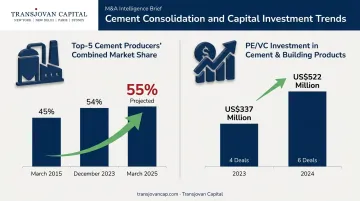
Thousands of regional, family-owned manufacturers still operate below meaningful scale. But consolidation at the top is already underway. Cement illustrates this most clearly: the top five producers' combined market share rose from 45% in March 2015 to 54% by December 2023, according to ICRA, with 55% projected by March 2025.
This consolidation wave is pulling in global strategics too: they increasingly prefer buying an established Indian platform over building greenfield capacity. Saint-Gobain's acquisitions of Rockwool India and Twiga Fiberglass, Wavin's majority stake in Vectus, and Daikin's purchase of Citizen Industries' air-handling-unit business all reflect the same logic: speed-to-market and instant access to distribution beat a multi-year plant build.
Private capital has followed. EY's Private Equity and Venture Capital Trendbook shows PE/VC investment in cement and building products rising from US$337 million across 4 deals in 2023 to US$522 million across 6 deals in 2024. Funds are treating the sector as a proxy play on urbanisation itself.
A parallel dynamic is reinforcing this momentum: the China+1 shift. Western anti-dumping duties on Chinese tiles have pushed global buyers to source from India instead, making export-oriented Indian manufacturers attractive acquisition targets for companies diversifying their supply chains away from China.
Demand-Side vs Supply-Side Drivers
It helps to separate the two forces at play:
- Demand-side drivers: construction activity, housing policy, infrastructure pipelines
- Supply-side drivers: raw material access, manufacturing cost advantage, capacity consolidation opportunities
Spotting a deal often means asking which side of that line the opportunity sits on.
Key M&A Deal Patterns Shaping the Sector
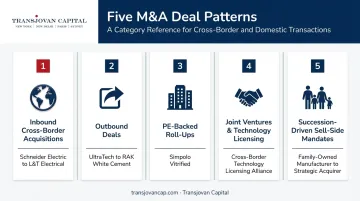
Five distinct patterns are showing up repeatedly across Building Materials transactions.
Inbound cross-border acquisitions. Global majors buy into Indian platforms for manufacturing footprint and distribution reach rather than starting from scratch. Schneider Electric's combination with L&T's Electrical & Automation business and Daikin's HVAC acquisition follow this logic.
Buyers like Legrand and Cummins illustrate the same appetite in adjacent industrial categories. Both count Transjovan's Managing Partner Gaurav Asthana among their preferred buy-side advisors for market-entry and scale-up mandates in India.
Outbound deals. Indian conglomerates are acquiring overseas technology, brands and niche capability to move up the value chain. UltraTech Cement's subsidiary took its stake in UAE-based RAK White Cement to 54.39% in November 2024. Asian Paints agreed to acquire Sri Lanka's Causeway Paints through an all-cash transaction.
PE-backed roll-ups. Fragmented sub-categories are being consolidated into scaled platforms for eventual exit. Motilal Oswal-linked funds invested in Simpolo Vitrified, combining tiles, sanitaryware and bath-fittings businesses into one platform, while Infra.Market sold roughly 10% of its concrete subsidiary RDC Concrete ahead of an IPO.
Joint ventures and technology licensing. Green building materials are moving through collaboration structures rather than outright acquisition. UltraTech's pilot with UCLA targets eliminating up to 98% of CO2 emissions from limestone decomposition; Dalmia Cement's MOU with Carbon Clean explores large-scale carbon capture.
Succession-driven sell-side mandates. Aging promoters across tiles, pipes and paints manufacturing are increasingly treating a strategic or financial sale as their generational transition strategy, rather than passing the business to the next family member by default.
Challenges That Make Building Materials Deals Complex
Three friction points recur across nearly every mandate in this sector.
The valuation gap. Promoters often anchor pricing expectations to legacy goodwill and decades of relationship-built market share. Buyers price off EBITDA multiples and comparable transactions instead. This bid-ask gap is one of the most common reasons Indian building materials deals stall or collapse mid-negotiation.
Regulatory and compliance complexity. Manufacturing-heavy targets face layered approvals:
| Approval area | Key requirement |
|---|---|
| FDI | 100% permitted under the automatic route for manufacturing |
| Land-border investment | Government-route approval required for investors from bordering countries |
| CCI merger control | Notification required above ₹2,000 crore in Indian business operations; statutory review up to 150 days |
| Environmental clearance | Cement plants ≥1.0 million tonnes/year classified Category A; smaller units Category B |
| State pollution board | Consent to Establish required before construction begins |
None of these gates disappear just because a sector permits automatic-route FDI. Each adds its own timeline.
Governance and data-readiness gaps. Family-run businesses frequently lack audited multi-year financials, formalised vendor and customer contracts, or a clean cap table. This slows financial due diligence and often extends deal timelines by months, sometimes killing momentum entirely before terms are agreed.
Transjovan's Playbook: A Structured Approach to Building Materials M&A
Transjovan positions its Corporate Development as a Service (CDaaS) model as an embedded, multi-year engine rather than a one-off transaction advisory. In a fragmented sector where opportunities surface continuously, a standing corporate development function outperforms episodic deal-making.
Partner-Led, Not Delegated
Mandates are led directly by ex-Big 4 professionals and former CXOs, not handed off to junior teams. Managing Partner Gaurav Asthana brings 21+ years of cross-border M&A experience, having advised Fortune 500 corporations including Legrand, Cummins and Altana. These companies operate across electricals, industrial equipment and specialty coatings, categories directly adjacent to Building Materials.
Target Mapping, Valuation and Integration
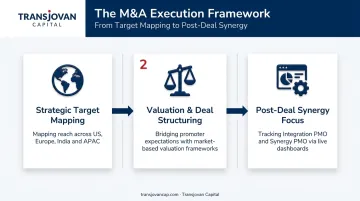
The firm's approach runs through three connected phases:
- Strategic target mapping: using Transjovan's network across the US, Europe, India and APAC to identify cross-border buyers or acquisition targets in Building Materials
- Valuation and deal structuring: bridging promoter expectations with market-based valuation frameworks built for manufacturing-heavy businesses, backed by diligence and synergy case development
- Post-deal synergy focus: running Integration PMO and Synergy PMO workstreams, tracking synergy capture through live dashboards and quarterly board-ready reporting rather than counting deals closed
That last point matters more than it sounds. Transjovan measures success through synergy capture, not transaction volume. That distinction shows up directly in how manufacturing, distribution and supply chain integration get managed after signing.
A Practical Global Footprint
Offices in New Delhi, New York, Paris and Sydney give Indian Building Materials companies a direct route to outbound targets. Global players entering India get a local execution partner rather than a fly-in advisor.
Preparing Your Building Materials Business for a Successful Transaction
Whether you're selling a family-run manufacturer or acquiring one, preparation determines how smoothly the process runs.
Get financial and governance readiness in order first:
- Audited financials covering at least three years
- Formalised contracts with key customers, suppliers and distributors
- A clean, documented cap table with no ambiguity on ownership
With financials and governance settled, shift to defining deal rationale. Define strategic and synergy objectives before you talk numbers. Buyers and sellers who enter discussions with only a valuation target tend to negotiate past each other. Clarify whether the goal is capacity expansion, technology access or distribution reach — it changes how you structure the deal entirely.
Once objectives are clear, bring in outside help. Engage an experienced M&A advisor early. The right advisor manages buy-side or sell-side preparation, benchmarks against sector-specific deal comparables, and navigates cross-border regulatory requirements before they become deal-breakers late in the process.
Transjovan Capital's Track Record in Building Materials M&A
Transjovan Capital's own work on building materials M&A in India shows how these principles play out in practice. Gaurav Asthana founded the firm in 2011 to concentrate on buy-side advisory for Fortune 500 and mid-market acquirers that wanted proprietary deal flow and embedded corporate development support rather than a transaction broker, and told ION Analytics (Mergermarket) that inbound mandates now account for 60-70% of the practice against 30-40% outbound. The firm's corridor map reflects that: inbound flow from Europe, the US, Japan and Southeast Asia into electronics manufacturing, specialty chemicals, building materials and consumer, and outbound flow from India into Continental Europe, the US, Southeast Asia, the Middle East and Africa across high-tech, IT/ITeS, healthcare analytics, auto components and industrials.
Asthana has also quantified why Indian assets clear at the levels they do, telling ION Analytics (Mergermarket) that acquisition multiples in India's high-growth sectors run roughly 50% above Western comparables — a spread he ties to sector growth of 14-15%, close to double India's GDP growth. The firm has advised on $15 billion+ in cumulative transactions across 250+ clients, and took the Platinum award for Best M&A Advisory Firm at the M&A Conclave & Awards hosted by Transformance Forums in Bengaluru in October 2024 (announcement).
Frequently Asked Questions
How much do M&A advisors charge?
Fees typically combine a monthly or fixed retainer with a success fee tied to deal value. The exact structure varies based on deal size, complexity and whether the mandate is buy-side or sell-side.
What are common deal structures used in Indian Building Materials M&A?
Majority buyouts, minority growth investments, joint ventures and asset or slump sales are all common, depending on promoter intent and buyer strategy.
How long does a typical Building Materials M&A transaction take in India?
Timelines generally run 6 to 12 months, driven by due diligence complexity, regulatory approvals such as CCI review, and negotiation dynamics between parties.
What is Corporate Development as a Service (CDaaS)?
CDaaS is Transjovan Capital's embedded, multi-year advisory model that provides continuous M&A and strategic support, rather than a one-off transaction engagement.
Why is India attractive for global Building Materials buyers right now?
The combination of sustained infrastructure spending, manufacturing cost advantages and a fragmented target landscape makes India an appealing base for consolidation and market entry.
What should a building materials company do before approaching potential acquirers?
Get financials audit-ready, clarify your growth strategy, and engage an advisor to benchmark valuation expectations before entering serious discussions.